Tuesday, January 26, 2010

Attack of the 39 Foot Woman!


Attack of the 39 Foot Woman!
The Outs- February 2010
Ellen Jo Roberts


Cue scene…and ACTION! A giant woman invades the Verde Valley! Larger than life, a vision in white! The townspeople revolt violently! Chaos! Confusion!…and Cults? How will this story end? Stay tuned!
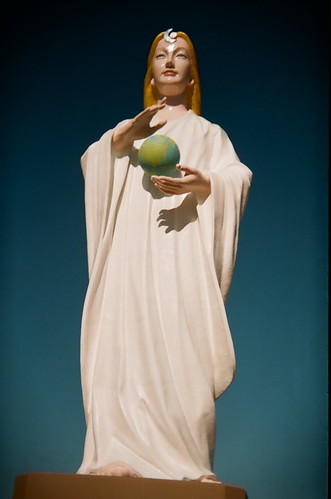


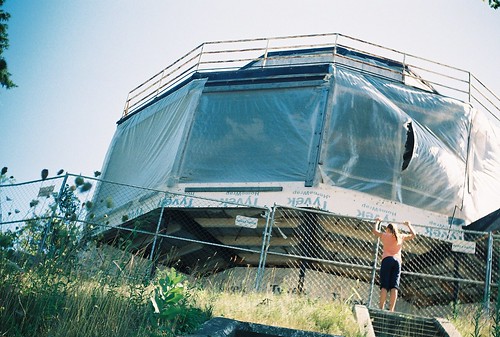
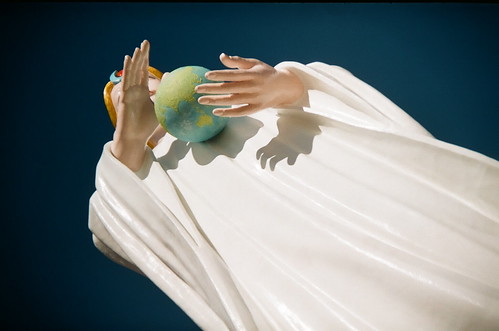
The Mago towers at the edge of Cottonwood, along Bill Gray Road, 39 feet tall, and standing on a 9 ½ foot base. Part of the Sedona Tao Center’s Mago “Earth Park”, she represents a vision of “earth mother”, gingerly holding a floating globe within her colossal hands. Like many atomic giants that terrorize the tiny townsfolk, Mago’s origins are in Asia. “Soul of the Earth” is the Korean mythology of Mago. Her outsized presence has stirred the Verde Valley into an equally jumbo-sized lather. For months, hundreds of letters to the editor rant and rave against her appearance: some protests reasonable, others prejudiced and hateful.
Reasonable complaints argue that this statue simply violates the building code, design regulations, and height ordinance. While others quote the Bible and argue against the basic tenants of the Constitution. Still others say it blocks the view and could potentially cause visual impairment to the vehicular public due to its dominance along State Highway 89A. Perhaps the biggest problem many Verde Valley residents struggle with in this tale is the center’s connection to controversial Dahn Yoga, its cult-like leader, Ilchi Lee, and his organization’s questionable business practices.


By the time you read this article, the giant Mago may be gone.
Sorry if you missed her. At press time, the park’s lawyer, Flagstaff land use attorney, Willam P. Ring, P.C., had offered a compromise to Cottonwood’s Planning and Zoning Commission offering to remove the 39 foot statue in exchange for a smaller 9 foot version.

“We understood, from the criteria, that monuments of spiritual quality were not subject the height ordinance”, Mr. Ring explained, at the public meeting January 25th, citing various Cottonwood building codes, “We are willing to admit this evening that was OUR misunderstanding. We are willing to retire that statue and replace it with a smaller Mago statue”.


I am a huge fan of roadside kitsch. We travel far and wide to catch sight of highway mascots, folk art, and assorted monuments to bad taste. There is something just so full of silliness, so full of joie de vivre, it makes me just plain happy to be alive on planet earth. When somebody believes in something so strongly and feels so compelled to create something so crazy, it renews my faith in the human spirit. The Mago and the other various religious figures depicted at the Sedona Mago Center’s Earth Park definitely qualify as Kitschville to the max. I half expected Mother Mago would be holding a giant donut, or a muffler, like her fiberglass kin folk across the USA. So, yeah, I gotta admit, I went there, and I kinda loved it. It was so totally over the top that it knocked my socks off.
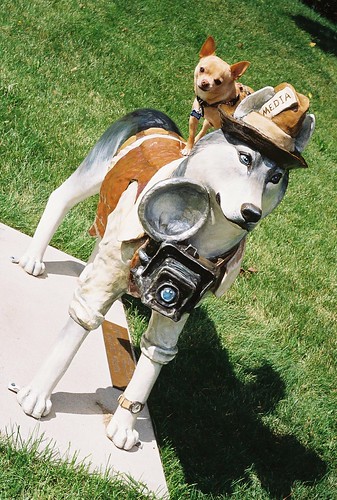
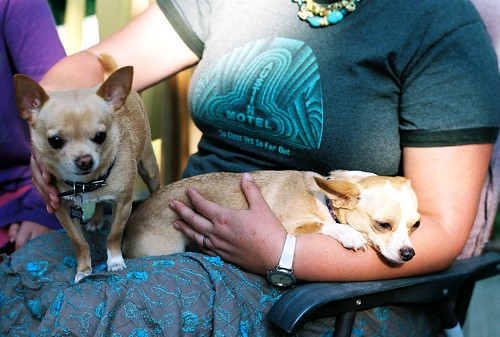
The Mago is gigantic and glossy. She can be seen from as far away as Jerome, and far out along Highway 260. She is a pale-faced blonde, in a bright white robe. Locals squawk at her blonde “Barbie Doll” looks. It doesn’t meet our traditional notion of an “earth mother”, which is generally more in earth tones-- like the native and natural tribes that make up the majority of the globe. Against the Arizona blue sky, with Sedona’s red rocks in the distance behind her, she is a striking scene. Looking up at the 39 foot tall Mago I imagine this must be how I look to my pet Chihuahua, Floyd.
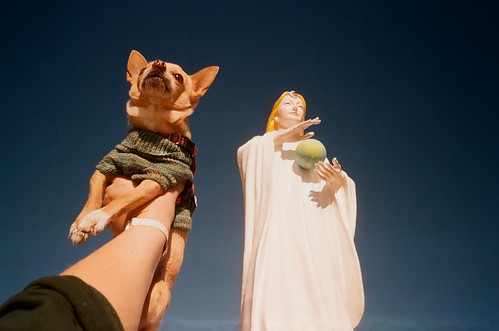


“The flowing robes, the grace. Striking.”
Carl Spackler, “Caddyshack” c. 1980

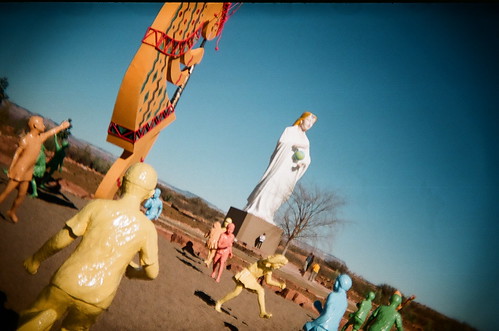
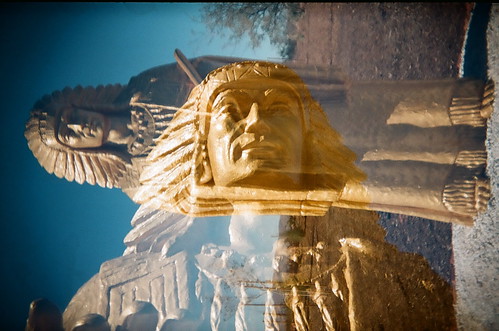
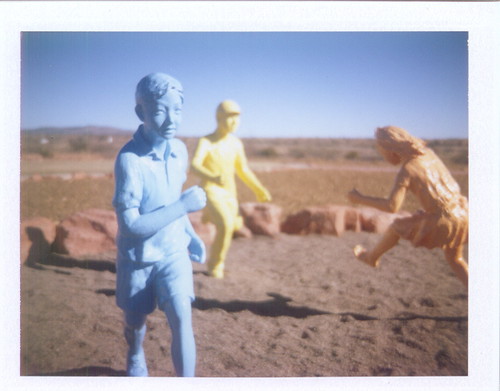
It would only be a matter of time before cartoonist Bill Griffiths (a well-known fan of gigantic roadside weirdness) would arrive in Cottonwood, Arizona to draw a “Zippy the Pinhead” comic featuring the Mago. The park, neatly landscaped with shrubs, trees, and stone pathways, is also home of many other not-quite-as-colossal figures, referred to by the city of Cottonwood as “ornaments’. There is a 15 foot tall Kokopelli statue, surrounded by lil’ multicolored children in action, running, kicking jumping in every direction. Naturally, the native North American legend of Kokopelli is one of fertility—the stranger that comes to town with his big “flute” leaving a throng of pregnant women in his wake. That’s where all these childrens came from! Basically, Kokopelli was just a gigolo! Why are we not protesting him? A small side courtyard features 10 foot tall golden figures of “Enlightened Ones” depicting Jesus Christ, Buddha...maybe Zeus, Confucious, and some Native American figure in full Plains feathered regalia.


While I was at the park avidly snapping photos, a pleasant man cheerfully introduced himself as “Alex, the owner”. We chatted a bit. He explained that the center, their own private property, was something they wanted to open up for everyone to enjoy, for the public’s use. He then invited me to come into a small building for more information and some tea. I saw the pile of shoes outside the door, and lost my nerve. If there were strings attached to this park, I didn’t want to be tangled up in them.


The Earth Park, consisting of 6 acres of land at Bill Gray Road and Highway 89A, was originally issued a permit in 2006 simply as a welcome center, parking lot, and shuttle staging area, to bring visitors from Highway 89A back out to the organization's retreat center many miles along the unpaved and wild Bill Gray Road. The Tao Center of Sedona opened its Mago Retreat in a remote area of the Coconino National Forest between Sedona and Cottonwood back in 1998. The retreat center is renowned for its “green” practices, using solar energy, grey water, and installing thousands of native trees and plants. They have an organic garden, fertilized by compost from their dining hall and manure from their horse stables.

In the past 3 years additional interim permits were approved allowing for such things as small events at the Earth Park, things like farmers markets, weddings, and parties. Landscaping was improved, and small gazebos were constructed. A conditional use permit legally allowed the Mago Center to erect the 50 foot Mago for their opening celebration, December 16th 2009. Once the permit expired, as it now has, the statue would have to be removed. These interim and conditional use permits assumed a final permanent design for the property would be presented within 3 years. It has not been. This makes the Cottonwood Planning and Zoning Commission testy. A stop order has been placed on various additional unapproved projects. .
The public hearing to review the statue’s conditional use permit needed to be postponed a month, when crowds too large to be seated arrived to protest. The meeting location was rescheduled for a much larger venue, Cottonwood’s Mingus Union High School auditorium.

“It’s incredible that you are the only planning and zoning commission in the U.S. to be gullible enough to allow this,” said feisty Cottonwood resident Judy Love, calling the Mago an ”incredibly ugly” statue, “That statue is a free advertising sign to get people into their compound, and relieve them of their money. It’s all about the money. It’s a business, not a faith based church, but it’s along the same lines as Jonestown, the Moonies, David Koresh, and the recent sweat lodge incident in Sedona. We should not allow this to happen in our community.”

“Why not give your neighbors a chance?” asks Dahn Yoga spokesman Joseph Alexander from Mesa AZ, “I have volunteered at the Mago Earth Park. It is designed to share with all people. This is not about religion, or one religion. It’s about recognizing each other as fellow citizens of the earth.”

Johhny LeDoux from Cottonwood declared himself as a member of the Nazarene Church, “To me this is an affront. This is an idol. This is a graven image.”

“I am opposed,” said Cottonwood businessman, Mark Avery, “I did not come here to talk about religious aspects. It should be known that the Tao Center is a for profit business.” Mr. Avery then sited the recent CNN report and investigation of Ilchi Lee. “If you put up a 4 foot statue it is not going to attract anybody. It’s not about religion. It’s about sign code. How can I attract people? It’s my business. I need to attract people. If you don’t enforce this, how can you control it when the hardware store wants to put up a 50 foot hammer?…It’s a business and it’s getting bigger by the minute.”

Ilchi Lee, a legalized American citizen born in South Korea in 1950, is a “brain philosopher”, and founder of a series of brain and body training programs, some criticized for their intensity and danger. Dahn Yoga includes traditional elements of yoga already familiar to us: stretching, meditation, circulation, and “chi” representing human energy flow. The Korean word “Dahn” translates as “primal, vital energy.” But, the program also allegedly features overexertion, sleep deprivation, dehydration, numbing repetition, and other tactics commonly used for breaking the spirit and controlling the mind. Various lawsuits were brought to court and dismissed throughout the ‘00s, including wrongful death, sexual assault, and unfair business practices. A current Arizona lawsuit, filed in May 2009, includes claims against Ilchi Lee from 26 former Dahn members and masters from throughout the United States, and Korea. All plaintiffs claim that after lengthy association with Dahn Yoga (sometimes years worth of various studies and programs, with aggressive encouragement to recruit new members and new money) they were finally “able the break the psychological manipulation and indoctrination sufficiently to leave Dahn.”

“The Dahn organization (“Dahn”), which is controlled by Defendant Ilchi Lee, operates under a complex web of corporate names, and is comprised of myriad for-profit and not-profit business entities and organizations, including but not limited to the Corporate Defendants, Dahn Yoga & Health Centers Inc., Tao Fellowship, BR Consulting, Inc., Mago Earth, Inc., Vortex, Inc., and CGI, Inc., all of which collectively operate and control more than 130 “Dahn Yoga” Centers in the United States, including 6 in Arizona, as well as more than 300 Dahn Yoga Centers in South Korea, 350 in Japan, and approximately 20 in Canada and the United Kingdom.”
-Case number 2:09-cv-01115-SRB in the United States District Court for the District of Arizona

The Sedona retreat hosts about 3000 guests each year, as the primary training facility for Dahn worldwide, and is noted many times throughout the current lawsuit. In the legal documents the essence of the organization comes across as a giant pyramid scheme, an aggressive business plan. Members are encouraged to attend more and more classes, and programs, sometimes going into great debt in order to do so. They’re encouraged to enlist new members into the fold, for more money. Dahn defendants deny all claims made in the lawsuit, referring to the plaintiffs as “disgruntled employees”.

“When Defendants deemed that they had been sufficiently indoctrinated, Plaintiffs were coercively induced to attend an extended Dahn Yoga training retreat in Sedona, Arizona, called ‘Master’s Training’. This retreat was designed by Defendants to further indoctrinate Plaintiffs into Dahn and reinforce a Dahn members 100% devotion to Dahn, and Defendant Ilchi Lee and his ‘Vision’”.
-Case number 2:09-cv-01115-SRB in the United States District Court for the District of Arizona

“When I look at Mago statue I see hope. Hope for unity. Hope for the future I had not seen before I began this practice,” said Johnell Moore a Dahn devotee from Mesa, Arizona. “The United States Constitution gives me the right to practice my spirituality in any way I like, as long as it doesn’t interfere with your rights.”


Danny DeBose, “an American Citizen and Veteran” of Cottonwood said, “One of the things I was fighting for was freedom of religion, for people to worship how they wish. That’s why we came here to this country. I’d like our constitution to be held up. I’m in favor of the Mago Park…Sometimes people don’t like what they see in art. But perhaps this is because they don’t like what they see in themselves.”

Many feel the Mago could become a major tourist draw benefiting the entire Verde Valley. The Mago Center is a for profit organization, with future plans for a motel, restaurant, gift shop and horse back riding at the site of their Earth Park. Hiding behind religion when it suits them, the Tao Center seems to want to play both sides of the coin depending on what side is more advantageous at the moment. In the end, it’s not about religion, business, good art or bad art. It’s about Cottonwood building codes, zoning, and design review. Rules, plain and simple.

5’9’’ Ellen Jo Roberts lives in a historic brick bungalow that meets all Clarkdale building codes.
She shares her home with 6’4’’ Bike daddy Chad, and several rambunctious pets that are all up to date on their vaccinations and fully licensed by local authorities.
Read all about it at ellenjo.com

Tuesday, January 19, 2010

Navigating the New Economy

Navigating the New Economy
The Outs - The Noise
January 2010
Ellen Jo Roberts


On “Black Friday,” the morning after Thanksgiving, we were nestled around a campfire, cuddling with coffee mugs to ward off the chill of the night before. We spent the holiday under the stars camped on a wild beautiful bluff overlooking the Verde River. Friends had organized an outdoor banquet, completely off the grid, but not lacking a thing. There were two turkeys, with all the traditional tubers and root side dishes, stuffing, numerous pies of assorted fruits and nuts, and a broad variety of beverages both hot and cold.
As we woke up to the day, all wild-haired and sleepy-eyed, somebody said,
“Isn’t it funny that at this very moment people are storming Super-Walmart, wrestling each other for the best deals on flat screen TVs?”
We all shook our heads, chuckling in disbelief.
The thought that people had camped out in the very same valley, the very same night, but in an asphalt parking lot waiting for “doorbuster deals,” could not have sounded more foreign to us.
Not just because we didn’t have the bucks to buy each other expensive electronics, and not just because the idea never even occurred to us — but also because frenzied spending seems a thing of the past — from a time when people spent money they didn’t have on things they didn’t need.

The current economy may be the new economy, the new normal — with the spendy memories of the not too distant past gone out like a tide that ain’t never coming back.
For us, our lives luckily have not changed too much — but, we’ve never lived large. Actually, that’s just a nice way of saying we were poor and broke before, and we’re poor and broke now. We here in Northern Arizona are well acquainted with “poverty with a view,” so for us it’s like the rest of the country is finally slowing down to our speed.
We may be on a low budget but this doesn’t mean our life isn’t rich. Our newest vehicle is 23 years old, and we don’t have any car payments. We bought a small house with a manageable mortgage. We shop local whenever possible. Many times we just go without. We seldom dine out, see movies at the show, or buy new clothing. Most everything we own is 2nd or 3rd hand. No cable TV, no satellite radio, no high-speed internet. For us, this way of life hasn’t changed much in 15 years.


This doesn’t mean we are without our extravagances.
I like a new pair of Fluevogs every few years, and ordering Fuji instant film for my old Polaroid cameras. Chad has expensive tastes in shampoo and hair wax. He indulges me the cost for art supplies, and processing 35mm film. We treat ourselves to new Levis every year, and splurge on a seasonal bottle of Bombay Sapphire gin. Perhaps our most ridiculous luxury is jetting our Chihuahua, Floyd, around with us on (rare) airplane trips.
Despite these lil’ splurges, we live cheap, filling our lives with experiences rather than expenses. We are very grateful to both still be employed, keenly aware of the many Americans who’ve spent the last few years scrambling for jobs after being downsized, out-sourced, or having their retirement savings swallowed by economic failure.


How has your life changed? In what ways have you changed your habits to navigate the new economy? How have our local communities been impacted, being heavily reliant on tourism? This is what I wanted to know. This is what I asked people. I talked to many artists and creative types who, by nature of their creativity, adapt to whatever is dished their way.
I have friends who’ve taken pay cuts, lost their jobs, and lost their homes.
But even in these tough clouds, silver linings are evident.


“People don’t think so materialistically. They think of other values in life, and live more simply,” said Verde Valley artist, Birgitta Lapides. “So, I think some good can come from it. People can realize the truly important things in life. It’s more who you are than what you have.”
Ms. Lapides shows her work in Jerome, a town that operates in its own economic micro-climate, a different planet than Every Day, USA, but still not completely immune to the ebb and tide of the outside world. Many artists who sell their work in the town have found the need to offer lower-priced series of works because the grand masterpieces are just not selling like they used to. Anne Bassett, renowned Jerome artist and longtime resident, has survived there for years, in times both lean and rich.
“I have aspired to ‘scrape by’ but not actually attained that status yet,” jokes Ms. Bassett. “I expect the US economy to get much worse as our war debt impacts are felt. Our nation's pitiful education system has lost us the edge on being global innovators in technology, and our foot-dragging on global warming has hampered our nation in green advancement, which I believe to be the only expanding financial venue around. My art income has stayed about the same for a couple decades, fluctuations not withstanding. Gold, art and real estate appreciate.”


Real estate, while generally agreed a good investment, has been troubled during recent years, with the realty boom busting big time. Denise Lerette is a realtor in the Verde Valley. She lives in a historic bungalow in Clarkdale, with her cat, Barrington, and dog, Jaeger.
“I'm not exaggerating when I tell you it has been tough,” says Ms. Lerrette, “When it hit our entire economy, it hurt in several different ways. First, of course, is the ol’ pocketbook. I learned how to live very frugally last year. I cannot stress how frugally I really mean! I had my gas turned off for 6 months. I became very adept at heating a tub, doing laundry, and other seemingly common tasks with a bare minimum of energy expended. I did not have cable or even turn on my TV. This I now like! I discovered the library and long walks with Jaeger. I latched on to a little device called a ‘Kill-A-Watt,’ thanks to a good friend in Flag, and got my APS bill down to $25 a month. It taught me a lot about conservation, tenacity, and kindness, above all.”
Ms. Lerrette sees a bright light at the end of the tunnel.
“The upside to all of this was really learning something about the varieties of human natures that do exist. Fortunately, I have not lost my faith in humanity and have seen that human kindness still outweighs its polar opposite. People working together is the only way we will truly survive and live well.”

Bethany Bezdek is a married mother of 3, living in Clarkdale.
The turbulent economy has made a profound impact on her family.
“We gave up our house because of the economy. Big change,” said Ms. Bezdek.
“I used to go to the health food store once a week. Now I go maybe once a month and buy 4 or 5 items. Our grocery bill for the five of us is always more than I think it should be, even with these changes. I grew up on government cheese and powdered milk, so I am not complaining. I still feel very fortunate to have food and to be able to buy it on my own.”
The Bezdeks no longer purchase books or magazines, and have very few meals out. And rather than going to the movies, the family enjoys free entertainment like libraries, parks and hiking. Their life remains joyful, despite the wild financial ride. “Truthfully, it feels fine,” says Ms. Bezdek, “Although I do miss just going out for Chinese on a whim. As cliché as it sounds, I have really appreciated the importance of our family and how lucky we are to love each other and enjoy each other’s company.”

Many people have changed their lives in big ways, and many make changes in small ways that add up big: killing watts and their televisions, cutting cable and internet, brown-bagging their lunches, quitting cigarettes, planning smaller vacations or “staycations.” Many donate more to charity than ever before.


“We really don't realize how spoiled we are until everything has been taken away. Like a kid getting grounded and having their phone, computer and TV taken away,” said Stacey Champion, of Phoenix.
Ms. Champion is the owner of Champion Indoors, an environmental consulting firm. A single mom raising two young children, she takes coupons seriously, and has downsized the “fluff,” like everyone’s nemesis, “Target ‘impulse’ buying.”
Says Ms. Champion, “I feel very fortunate that I grew up Midwestern and blue-collar, because when everything was really good and the money was flying in, I didn't go out and buy a new car, new house, etc. My debt load probably isn't as bad as many other people's because of this. I also take my kids to do as much volunteering and charity work as possible now, so that they can see, first-hand, that even though we aren't able to necessarily ‘do’ or buy all of the things we used to, there is still an awful lot to be thankful for — like a roof over our heads and food on the table. Small but important stuff.”
Ms. Champion, an idealist, believes good times will return, and we will get through this challenging time, “being more grateful and humble in the long run.”

Kenny Mattheis is a jack-of-all-trades, a bit of a genius, and a self-proclaimed “hobo,” who lives in a tiny but chic house in Humboldt, outside of Prescott.
“The biggest change I've had to make in my life due to cutbacks, is the amount of income I can donate to things I believe in. I'm used to giving 60 to 70% of my income to causes I feel will affect my life directly. I'm still able to give the same percentages, but 60% is a lot less these days than it's been in the past.”
Mr. Mattheis is a big fan of a website called Instructables.com, which offers instructions and ideas for fashioning useful second lives out of assorted objects, and things people discard. “Turning some things I don't use any more into useful things I can use, or other people say that they would like, or need. I've even been able to make a little money on the side helping people with projects or making stuff that they would like to have.”

Another issue aggravated by the financial downturn is health care: the millions of citizens who don’t have it, and are farther away from it than ever. “I find myself donating more and more art for raffles or auctions to assist those without medical insurance cover their costs,” says Clarkdale artist Judy Jaaskelainen, “These are people who we might refer to as the ‘working poor.’ They are not 'poor enough' to qualify for AHCCCS or other government assistance, but they do not have the means to cover the cost of medical care.”
Ms. Jaaskelainen is currently involved in selling raffle tickets to raise money for local artist, Mary [Druen] McKeown, who needs two new hip joints. Artists, jewelry makers, and businesses have donated a great list of items. “There will be other fund-raisers on Mary's behalf in the New Year,” says Ms. Jaaskelainen, “Mary is only one of the hundreds, maybe thousands, of ‘working poor’ in and around the Verde Valley. Artists, craftsmen, and musicians seem most at risk.”

In interviewing people, I discovered restaurant meals are the expense most commonly being trimmed from budgets in this new economy.
Jet Tennant, owner of Jerome’s Mile High Grill, runs the restaurant lean, confronting the downslide head on, basing their plan of action on past seasonal successes. “We also keep a strong bare bones crew who are willing to work harder when it is busy, instead of over-staffing. We put off improvements for a year to see how we would be affected. Living in a tourist town offers us a influx of people that other places don't have,” said Ms. Tennant, “I feel like we are riding a wave. It feels a bit wild, but not out of control. Just a ride, which is why I got into the restaurant business and being self-employed in the first place.”


Sedona is one of Arizona’s top tourist destinations, and feeds dollars to all of the outlying communities. Nena Barlow operates Barlow’s Jeep Rentals in Sedona.
“We were lucky to not drop very much early in the ‘recession.’ We have worked a lot harder to make the same money,” explains Ms. Barlow. “We became more aggressive with specials, reviewed and increased our marketing efforts, and set very tight budgets to keep costs in hand.
“What I observed was that the higher-priced goods and services have been the hardest hit. If you have some product that is on the lower-end of the price spectrum for which your customers are shopping, they will still buy. Everyone is looking for a bargain, and no one is too proud to ask for specials or discounts these days. We aren't looking at this as ‘how do we survive?’ but rather ‘how do we run this leaner and meaner from now on?’ Sort of like adopting a new diet — it's not some fad, it's a necessary adjustment we need to make to stay healthy from now on.”

Bradley Blalock is a gifted singer, musician, and a licensed massage therapist, working at the ASIS Clarkdale campus. The current economy has stimulated his creativity. He spends more time practicing music and creating music at home instead of watching TV or surfing the internet. Mr. Blaylock surrounds himself with positive people, “Staying creative and positive, as best I can to live nobly through this, without self-destructively escaping into negative behaviors, one day at a time.”

Our pal Natasha Shealy, a perennial Noise favorite, offers her tips for conserving money. Ms. Shealy lives in smalltown North Carolina, a rural hardscrabble microclimate not dissimilar to our own. She is surrounded by creative people, artists, writers and musicians.
“I cut expenses, and build skills wherever possible. Perhaps a Protestant hangover, I thrill in cutting my own wood for fuel, growing our own food, and brewing homemade beer and wine. I have harvested fowl, but have yet to hunt deer. I leave that to the mountain man … I am recording my ideas for a book to share with others.”
Ms. Shealy has always been inspired by the 1970s series of Foxfire books, with mountain folk telling tales of making soap, building cabins, pickin’ tunes, and slaughtering swine. Something tells me she’d be living this lifestyle and writing about it even if she were a millionaire.


A Jeroman who wishes to remain anonymous shared her secret of success with us: “Once a week I take an hour to tour the great fortune that can be found in the charity and thrift stores of the valley. Had I known what a fun sport this was, I would have started it years ago. When I think of all the countries and cities I have traveled to and yet missed out on the random filtering of items considered surplus! The trickle-down effect of ‘one mans trash is another’s treasure.’ The sport and randomness of finds is a daily renewal on the thrift front. It’s the closest thing to gambling I have ever done ... Some days I want to run out of the store and toss my fist into the air with triumph, and do the Rumpelstiltskin jig of joy.”
I’ve long been an avid fan of thrift shops, dating way back to the year 1985, when a hip older cousin took me to scout out my neighborhood secondhand store in search of a trench coat for his New Wave ensemble. Thrift shops are chock full of housewares, artwork, office supplies, movies, books, clothing, tools, and vintage appliances manufactured better than anything made today and sold at prices well below their value.
We reevaluate the notion of “stuff.” We reexamine the products we use.

The new economy has affected us in interesting and different ways. Some of us not at all, and some for the worse. Some have actually benefited from it, due to special skills, and situations. Many of us live how our grandparents did in the Great Depression, stitching socks, surviving on soup, and growing our own food. Young people just entering the job market have no great expectations for the fantastic career, knowing their fine education now offers no guarantees. Older folks who’ve worked hard their whole lives, planning ahead like the ants for winter, now find themselves in a pickle like the goofy grasshopper, at no fault of their own. Everything’s been erased, re-written, wiped out, like a brand new ball game.
In the end, might we be better for it?
When the true value of the important things shines brighter than bling ever did?
I think you know the answer.


Ellen Jo Roberts is low on budget but high on life. She lives in a historic bungalow in Clarkdale, Arizona with “Bike Daddy” Chad, “Cool Cat” Clyde, “Five Pounds of Fury” Floyd, Ivan a.k.a. “Goofy McSuper-Spaz” and several ancient automobiles.
Read all about it at ellenjo.com

Thursday, October 22, 2009

The Future of the Verde Valley May Be the Future of the World


The Future of the Verde Valley May Be the Future of the World
Clarkdale’s Plan for Sustainability
The Outs- November 2009
Ellen Jo Roberts


A completely new concept for the way a town can function is being planned in our very own backyard. It’s such an amazing idea that it could change the state, the country, and eventually shift the entire world. Right here in Arizona’s Verde Valley, a “Sustainability Park” has been mapped, drafted, and is on its way to reality. The park is scheduled to include numerous ecologically beneficial projects, and production of sustainable energies, as well as 75 acres of birding, nature and picnic areas, and a performing arts venue. It’s all happening in Clarkdale, Arizona, USA-- the first “master planned community” in the United States, a company town created by Senator William Clark for the United Verde Copper Company in 1912, the same year Arizona became a state.

“The [Sustainability] Park will become the economic and social engine of the Town of Clarkdale. It will provide enough electrical power to supply the entire town and then some.”
-A Plan For The Future of Our Town, c. October 1st 2009


Clarkdale sits in a picturesque location, between the foothills of Jerome, and the Verde River. Chock full of handsome vintage homes and historic boulevards, the town was ahead of the times from its very beginning. Unlike the haphazard arrangement of its neighbor, Jerome, Clarkdale was well-planned with uncommon-for-the-time amenities, like spacious streets, modern sewer system, street lights, ample parking, public parks, and plentiful activities for the residents of the town. All buildings and homes were built and owned by the United Verde Copper Company (later taken over by Phelps Dodge). The town went bust when the mines closed in Jerome in 1953, shutting down the Clarkdale smelter. With no company to run the company town, Clarkdale fell into chaos-- until a band of citizens petitioned for incorporation. Clarkdale was emancipated from Phelps Dodge in 1957, and became incorporated as a free and independent town. Renowned for its varied vintage architecture, 4th of July and Halloween festivities, summer concert series in the park, and “Made in Clarkdale” art show, Clarkdale is home to Yavapai College, Salt River Materials Group, Verde Canyon Railroad, Tuzigoot National Monument, and the Yavapai Apache Tribe.


The Clarkdale Sustainability Park is the brainchild of the town’s current mayor, Doug Von Gausig. First elected in 2004, Arizona born Von Gausig, is an avid enthusiast of environmental conservation, preservation of wildlife, and sustainable energy for future generations.
He graduated from ASU in 1970 with a degree in biology, followed by 6 years in the Air Force, before settling in the Verde Valley. He has lived in Clarkdale since 1981.

“There are several interrelated goals, that's the beauty of this project. The Town of Clarkdale has been looking for a stable, sustainable source of revenue and economic development since it was founded”, says Mayor Doug Von Gausig. The draft plan for the sustainability park includes an Algal Fuel facility, for growing algae to be converted to biofuel, a biodiesel plant (in cooperation with Jerome, Arizona’s Verde Biofuel), a 100 acre field of photovoltaic cells for solar energy, a recycling center, a potable water treatment facility, and the heart of the plan, a Plasma Converter. For those unfamiliar, a Plasma Converter or “Plasma Gasifier” is a very clean and cutting edge method for disposal of waste, and conversion of waste products into heat and energy.

“It utilizes a very high plasma temperature stream, (similar to the plasma torches commonly used to cut metals) to literally vaporize almost any material that is introduced to it” A Plan For The Future of Our Town, c. October 1st 2009

“I'm particularly excited about the plasma converter”, says Mayor Von Gausig, “This process takes trash, hazardous waste, industrial waste, wastewater sludge - you name it - and converts it to safe, environmentally friendly energy. It literally converts environmental liabilities like landfills, hazardous waste, medical waste, etc. to a beneficial product - and at the same time helps solve our energy supply needs with renewable electricity. It can also supply ‘waste heat’ to other facilities in the park. This might be used to help purify our wastewater to safe drinking water standards. That alone could save the region millions of dollars annually by averting the need to acquire expensive new water resources!”

“The emerging field of algal and photobioreactor fuel holds great promise as a way to wean us from fossil fuels by creating biodiesel from algae. Typically the algae are grown in highly efficient, closed systems (systems not open to the environment). Algae grown in the facility will produce oils that can be converted easily to fuel oil. Typical yields are around 5,000-15,000 gallons of fuel per acre….
The park would have ample space for a Biodiesel production facility. Biodiesel is normally made from used cooking oil and other waste vegetable oils. This facility could be a perfect adjunct to the algal/photobioreactor fuel operation, converting not only waste cooking oil, but also the oils produced in those facilities.”
- A Plan For The Future of Our Town, c. October 1st 2009

Verde Biofuel CEO Tim McLellan said his company is “very excited to be part of such a dynamic, cutting edge project like the Clarkdale Sustainability Park.” McLellan’s company, based in Jerome, manufactures biofuel trailers containing all the necessary components for laymen to brew their own biofuel from recycled cooking oils. “Sustainability is not only the most intelligent approach to preserving our future, it is the only viable approach there is”, continues Mr. McLellan. “The Clarkdale Sustainability Park is an ideal model for several reasons. Clarkdale is a very small community with a forward thinking, progressive attitude that will serve as a very good example for other cities - large and small. With enough usable land, a sewer system already in place and great support from an enthusiastic community, there is no doubt the Clarkdale Sustainability Park will be a successful project”.

Jason Rogers, Verde Biofuel sales and marketing, adds, “It's great to witness this eco-social paradigm shift taking place not only globally, but locally as well. It's only a matter of time before all communities will come to their senses and do something."


According to Mayor Von Gausig, Clarkdale’s unique geographical position at the “top of the Verde Valley’ has always made retail growth a struggle. Clarkdale is not at major crossroads or “on the way” to any place else. The only reason folks come to Clarkdale is if they meant to. So, generating economy from retail businesses is difficult. Main Street is the quiet home to historic gas station, and a handful of bars, offices, and restaurants, with “downtown” anchored by the massive carcass of a former grocery store, now used for storage space, and up for sale for most
of the past 2 decades.


“We have never considered growth in housing a sustainable economy, so we are always looking for alternative sources of revenue so that we can give our citizens the services they deserve”, said the mayor, “This park will be a major source of revenues for the town in a number of ways, and will improve our future economic development with a clean, robust and durable industry. It will bring eco-tourists, governmental students, and business seminars here to see how it's done.

“Second, I think we can all agree that climate change is the biggest long-term threat that our country and the world faces. Whether one believes that warming is human-caused or not, we know that cannot afford to add any more carbon to the atmosphere. We are also facing depletion of fossil fuels and we all know that reliance on oil from foreign sources is contrary to our national interests. The Clarkdale Sustainability Park will produce clean, zero-carbon electricity and fuel, but with a difference. This park transfers the responsibility for reducing our carbon footprint from the individual, where it is now, to the community. I like to say that the Clarkdale Sustainability Park will have the same impact on the environment as if every citizen of Clarkdale changed to LED lighting, had solar panels on their roofs, and we all drove hybrid vehicles. While asking everyone to insulate better and turn off lights is great, it's not getting the job done. We need to take this problem on as communities, no longer as individuals.”

“Third, there is a tremendous need for ‘incubator’ facilities, like the Clarkdale Sustainability Park. In these parks, several different alternative energy installations will be integrated and synergistic. The park will be a place where seemingly unconnected energy producers, like algae and solar power, can come together to help each other solve the energy problems we are facing. The solution will necessarily lie in a diverse portfolio of energy generators - no one technology has all the answers. In the Clarkdale Sustainability Park they will all learn and improvise new ways to work together more efficiently. It will be a very organic operation that will solve problems and create new opportunities by working cooperatively and adaptively.
In addition to these goals, there is Peck's Lake.”


The proposed location for the park is land surrounding Peck’s Lake, a river-fed oxbow lake in Clarkdale. The lake, part of one of Arizona’s very first “Important Birding Areas” as designated by the Audubon Society, was a favorite recreation area enjoyed by Clarkdale residents for 90 years. Once home to a dance pavilion, 9 hole golf course, 4th of July fireworks, baseball games and boat races, the property has survived several ill-planned, ill-fated attempts at housing developments. Currently owned by Phelps Dodge successors, Freeport McMoRan Cooper and Gold, Peck’s Lake has been closed to the public since January 2004, when the town’s $1.00 per year lease expired and was not renewed. The area has reverted to wild, and the day use/picnic areas have fallen into a state of neglect-- the ramadas taken over by nature, and waist-high weeds, the lake choking with non-native species of plants. The lake’s clogged condition has contributed to the decline of bird population in the area.


“The lake was originally built as a source of process water for the smelter and as a recreational facility for the people of Clarkdale …Until 2003 the lake and surrounding property were leased to the Town of Clarkdale and continuously used for recreation, nature watching, fishing, etc. In 2003 the Town’s lease expired and was not renewed, and in December of that year, Phelps Dodge closed the property to the public and it has remained closed since then.
The lake has continued to degrade over the years to the point that diversity of waterfowl and other birds is now less than half of what it was only 10 years ago…
Peck’s Lake is in the process of eutrophication, which is a biological and chemical process that inevitably produces a wet meadow instead of a lake. In order to stop and reverse this eutrophication, the lake would need to be dredged and otherwise deepened, and the noxious weeds removed”
- A Plan For The Future of Our Town, c. October 1st 2009


Peck’s Lake, off limits to the public for 6 years now, has never been far from the mind of Mayor Von Gausig. Several plans have been envisioned for Peck’s Lake over the years, including a “Friends of Peck’s Lake” organization to clean up, monitor and maintain the trails and day use areas.

“If we can acquire the land surrounding Peck's Lake for the park,” says Mayor Von Gausig, “we will be able to rehabilitate the lake and the natural areas surrounding it to one of the premier wildlife habitats in the state. The facilities in the park, like the plasma converter, will all work together to clean up the environment in and around the lake, and will be a tangible demonstration that we can have a vital industrial installation immediately adjacent to a nature preserve with benefits to both.”

The ideal location of Peck’s Lake allows easy nearby access and connecting trails to area highlights such as Tuzigoot National Monument, Dead Horse Ranch State Park, and Tavasci Marsh. The plan includes abundant public space for day use, including an interpretive nature center and hiking trails, pavilions for community functions and performing arts. It also allows space for retail commercial development.

Though local support has been overwhelmingly positive (and unanimous in Clarkdale Town Council), the plan is not without its challenges.
“There will be lots of and lots of challenges, but in the model we are considering - the organic model - we'll see each of the challenges as opportunities to create a new paradigm”, says Mayor Von Gausig, “The entire project is like an organism. It will be faced with new situations every day, and will have to evolve, adapt and meet them in creative ways. Financing, land acquisition, regulatory adjustments, legislative and legal hurdles, coordination of disparate park tenants, and creative management will all be challenges. We will need to stay focused on the prize, though, and as a community we will come together to solve each of them as they arise. The idea is to nurture this organism and allow it to flourish in ways we can't even imagine today.”

“If the Clarkdale Sustainability Park becomes a reality, in what way will it change the Verde Valley? The state? The world?” I ask.
Mayor Von Gausig replies, “The Clarkdale Sustainability Park will become a reality. As it evolves and grows and learns, it will teach other municipalities all over the world. It will become a model of how we can live on this planet without harming our children's and grandchildren's ability to live a good life here, too - the very definition of ‘sustainability’. The initial plan calls for an interpretive center and learning facility that will coordinate seminars and disseminate the knowledge and experience we will generate. I envision communities from all over the globe coming here to see how we do it and how their communities might do something similar. The impact on the Verde Valley, the State of Arizona, the nation and the world is incalculable. This project will truly change how we fund our towns, where we get our energy, and how we relate to our environment. It will be ‘evolutionary and revolutionary’."

For more information:
http://www.clarkdale.az.gov/
a copy of the draft for Clarkdale Sustainability Park:
www.clarkdale.az.gov/sustainability_park/clarkdale_sustainability_park_white_paper.pdf
http://www.verdebiotrailers.com/
www.audubon.org/bird/IBA
Algal Fuel information: http://www.oilgae.com/
National Renewable Energy Laboratory: http://www.nrel.gov/

Doug Von Gausig’s Natural Sounds and Photos at:
http://naturesongs.com/
and http://www.criticaleyephoto.com/


Ellen Jo Roberts has lived in Clarkdale since 2001. She voted for Doug Von Gausig. She shares a historic brick bungalow (built in 1914 by the United Verde Copper Company) with Bike Daddy Chad, a cat named Clyde, a Chihuahua named Floyd, and a Boston Terrier named Ivan. Read all about it at www.ellenjo.com
Friday, October 16, 2009

The autumn of my 30s

It’s autumn of 2009, and we’ve been trying to get pregnant, unsuccessfully, for 2 years.
We’re both turned 37 year. My feelings are all mixed up—sometimes dark and confused, but sometimes carefree and relieved. So, as always, as I’ve done for my whole life, I thought maybe if I wrote it down, it would make more sense. Though, sometimes writing it down, shedding light on it, only makes it more confusing. People (usually people with children) usually have lots of well-meaning but annoying words of advice, and it makes me wish my husband had never told anyone we were “trying” for a baby. Now I feel funny, different, flawed, when people know we’ve been trying and not succeeding. Maybe if I write it out I take ownership back and will lose my ugly feelings.

Apparently being a good girl all my life-- losing my virginity at 21 to the man I later married, being of robust good health, with a completely uneventful and calendar-perfect ovulation cycle-- makes me somehow less likely to conceive than:

- Every drunk ass bum that has 5 shoeless kids in a shopping cart at Wal-Mart
- The girl with who didn’t know she was even pregnant until 3 months before her due date.
- A man who used to be a woman, took male hormones for many years, but later successfully was inseminated with a turkey baster. Twice.

It's a mystery how it all works, really! In a book it seems to make sense, how it all works, but the actual practice of it is amazing--The conception of a child is a miracle. People always say that, but I never truly understood it until now. There are so many amazing variables, mixes of different body chemistry, luck of timing-- down to the most microscopic window of perfection. It's amazing to me anyone ever gets born at all. It's truly a miracle.

I wonder what I am doing wrong. Do I eat too much of something I shouldn't? Do I drink too much coffee or beer? Did my magic markers in the 1980s pollute my brain's operating system? Should I not go running as much? Is there something fundamentally amiss that I could never detect on my own, some misstep in my development, something my Mom did/didn't do when I was in the womb? Like those DES Daughters of the 1960s/70s who were born without uteruses? Are my hormones dropping the ball somewhere along the route? So many possibilities. (The main possibility we all know is that I am just too dang old now).
I get angry with my husband because maybe it’s his fault! I see him sitting on the sofa and wonder if every part of him is equally lazy, even the tiniest parts of DNA. Then I get angry with myself for being angry, because that sure ain’t conducive to nothing. Sometimes I think there's nothing wrong with either of us, other than a basic lack of communication--not just in mundane day to day life, chores, bills, what to have for dinner-- but now, evident on the most primordial level. We cannot get our acts together to make a baby.
We don't mix. Our chemistry is wrong.

When I was a kid I was the “pied piper” of youngsters (said my Mom)—all the younger kids flocked to me, and for this I always envisioned I’d be a mom someday—jokingly saying I wanted 9 so I could have “my own baseball team”. I was a camp counselor and there was a time I entertained the idea of going back to school for a teaching degree.
Kids are wonderful, amazing, hard work and full of inspiration. I had a fantastic childhood, so maybe the idea of living through another one with a child of my own, seeing the world again through childlike perspective, is one of the things that drives me towards wanting a baby. Maybe I’m just selfish. I’ve got a lot, and maybe I don’t deserve having more.

I got married young, age 23, to my college sweetheart. It all seemed like a lark because I was too young to know any better. My maternal urge didn’t kick in early, like it does for some. In our 20s we were too busy scrapping for our own survival in the harsh economic climate of our beautiful new state, with barely enough to make ends meet. We lived on love, in small strange places, and did dangerous stunts in the wilderness. No way there was enough time or energy or money for a kid added to the mix.
We also never had any “oops”, which is the way parenthood happens for many. All of my life I’d had a perfectly regular cycle—running so perfectly like clockwork that I quit the pill at age 27, and instead we used natural fertility awareness to avoid getting knocked up. The thought behind it was that when we ready to have a child, it would be a cinch!

I watched family and friends start their families without the tiniest pang of envy. It was great for them, but for me, I was going in the right direction, enjoying what our life was. I remember Chad's brother and his wife struggling with their two young toddlers, as Chad and I got our gear ready to go cross country skiing--I had no interest in trading places with them. We got older, made a little more money, and around age 29, bought a house. "Settling down," but not quite thinking of parenthood yet.

Money concerns still make problems for us, but like a friend told me, “You will always have money worries- don’t wait until your money situation is ‘perfect’- because it never will be.”

Around 35 years old, with both of us on board and in complete agreement with 100% enthusiam about this plan, we started to try for a baby. It would be a lark, a gas, an easy slam dunk! Months passed. Sex, and lots of sex, even when we didn’t wanna, or it was inconvenient. I thought I knew what was what, and when was the ideal timing, but after 6 months of failure, I started writing things down on the calendar, invested in a thermometer, and an ovulation kit. Friends who’d tried for 18 months before having luck told me, “Yeah, been there. Done that. It won’t be until you throw all of that stuff away that you’ll have any progress.” They told us we’d have to “go on vacation” to some strange locale. Strange vacations came and went, and still my monthly visitor arrived right on time, just like she had since age 12. I could not shake her.

Every time my period arrives again, I re-evaluate. I don’t get so upset any more. It’s hard to sustain that level of disappointment and bewilderment for 2 years. People ask me why we don’t get fertility treatments, shots or drugs or medical intervention. There are lots of “procedures”, all very expensive, invasive, and none guaranteed. Every month I think about all of those complicated and slightly creepy tests my doctor mentioned, and every month I forget about them. (Though I do suspect it might alleviate some of my stress to get checked out a little bit more thoroughly).

As far as fertility treatments? I am not for them. Our culture sensationalizes and glorifies that kinda stuff now-- like Jon & Kate Plus 8, and "the OctoMom", and even Brangelina, and the Hollywood people-- churning out all those sets of engineered twins. My Mom apparently had been discussing my “problem” with an aunt, and that was what was she suggested. First off, I hollered at my Mom for talking about this with “people”. It’s not for people to know. It’s for me, and my husband and maybe my immediate family. Or maybe nobody. It’s private. I don’t wanna be the topic of someone’s gossip. Besides that, what if were to go through the whole ordeal, the procedures, the operations, the drugs, the time and money—and create a child who never wanted to exist and wasn’t ever meant to be here?

What if the kid turns out to be an asshole?

I’d rather that kid show up when he or she wants to, naturally—I understand, as we get older, the chance of this decreases.

Why do I want to have a child—is it for the child’s benefit or my own?
Am a selfish dirtbag more concerned with my own feelings than how a child might feel having my husband and me for parents? What if we’d be awful parents and ruin this kids’ life? Or, what if instead of being the best of us, the child is the worst of us? Do I worry no one be around to take care of me in my senior years? Maybe. These things are all possible. Do I feel like I am missing out on “Kids Say the Darndest Things”-style hilarity? Would the world be a better more fun and amazing place if I were sharing it with an offspring? I do not know. Is it my own selfishness to take part in all that life has to offer? Childbirth is a fundamental human experience that I’d like to share in and live through. I think? Maybe I’d be better off seeing the Pyramids and the Great Wall of China, and driving to the tip of South America. These are all fundamental human experiences too, but somehow I’ve been conditioned to think of them as shallow and selfish.

I have friends who are against procreation because they think this world is bad rotten place and they wouldn’t want to bring a child into it. Or they have the type of political beliefs where they don’t eat meat, and they think the world is overpopulated. Me, I am one of those kooky types constantly mesmerized and hypnotized by the beautiful world around me. I have friends and family with young children. I admire them all but do not envy any. I am in admiration of the notion of pregnancy, and admire the women and men who've had the experience.
Each family is not without its own dynamics I’ll never understand, but can completely appreciate. If parenthood is universal it’s not always necessarily in the same language.

My brother and his wife are new parents. Seeing their baby son, at 1 month old, did not inspire more baby lust or maternal urge, as I thought it might. I thought I’d be crazy koo koo bananas for a baby after meeting him. But, in reality, it caused me to backpedal a bit. Thinking, “Wow, this looks like a lot of work. Wow, this kid is taking up all of their time and energy. They’ll have many years of this.”
The baby was a pooping-eating-crying machine. One of my brother’s friends likened his life as a new parent to that of a roadie, cleaning up bodily fluids, and messes, dodging loud noises, moving heavy equipment from place to place.

My brother and his wife both seemed exhausted, but completely happy in a beyond blessed sort of way. Very pleased with this change in their lives, and this new little human sharing their condo. There is now a way their life has forever changed, in a way I cannot share with them, and cannot relate to—only another parent could understand.

We went back home and I thought, “I’m okay with the way life is now, just us, and the dogs and the cat. No crying, no baby gums pinching my breasts, no mustardy colored poop squirting out of diapers, no worries about someone getting chicken pox, or other childhood illnesses. I won’t ever need to help with algebra homework. Sitting on the porch watching the sunset, driving my ancient 2 seater sports coupe, without a worry, without saving for someone’s college fund, just thinking of what might be the next vacation. Oh, it does seem kinda shallow.

But, doesn’t it seem equally shallow to think the world needs to have my genes continuing on into the next 100 years? Maybe the world is done with me, and I should just accept it, and be creative in other ways—in ways I am good at, like making paintings, drawings, photos and stories. Maybe it’s not in the cards for me to have 9 kids like I planned.

I met my nephew when he was a newborn, and far too young focus his eyes more than a couple of feet in front of his face. Before he could smile on purpose. I think if I’d met my nephew when he was a little older, and smiled at me, this would be a completely different story.

Monday, September 21, 2009

Midwestern Melancholy

Midwestern Melancholy
Whirlwind around Lake Michigan
The Outs
The Noise http://www.thenoise.us/
October 2009
Ellen Jo Roberts


10 days, 3 states, 2 time zones. We managed to spend time with all of our immediate relatives (including the newest family member, a very handsome month-old nephew). We traveled by car, plane, train, trolley, limo, city bus, and foot. We shared space with 5 dogs, 12 cats, 3 ferrets, 2 guinea pigs, and a rabbit. Towards the end of this epic Midwestern adventure I found myself anxious to get back to my Arizona. A lost girl in a big metropolis no longer familiar-- my suitcase smelling funky, full of smoothly polished beach stones, sand, and dog-eared postcards, my cameras exhausted of film, and my chihuahua lonely for his pals back home.


There is something fundamentally forever in the marrow of your bones that comes from the place where you were born. I grew up along the shores of the Great Lakes. Back in my young and dreamier days I whiled away many hours along the beaches of Lake Michigan, imagining my escape to the future. The more years away, the less easy it is to slip back into that world, like a coat that no longer fits, or a radio station on the fritz. I feel less and less like myself. All of my family is back there, and every time I visit I get a little twisted up inside. A pang of longing, for the birthdays, baseball games, and barbecues-- all of the small things I miss out on by being so far away. In my mind everything has stayed the exact same as I left it—so it’s always a surprise to find out that life has gone on without me. My brother and his friends aren’t forever 21, as I imagine them. They’re all married up now, dads, with jobs, car payments and mortgages.


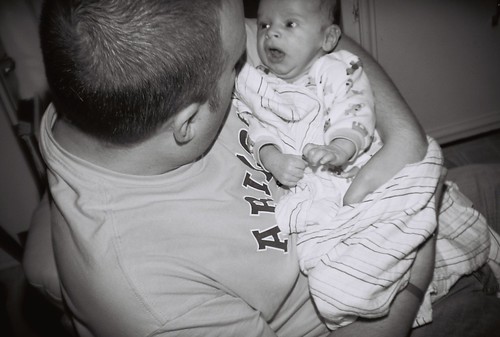
My brother Jim, and his wife, Carla, have a brand new son, freshly born this summer. About 5 weeks old when we met him, he was at the age where he can only focus about 18 inches from his face, and almost starting to learn what they call a “social smile”, smiling on purpose, not just as a symptom of gas. He is awful cute. Jim’s taken to calling “Party Man” and “Shmutzie” for no apparent reason. They’re very good with the baby, and it made me proud to see the family continuing into a new generation with this wee one. My Mom made a big fuss for our visit, making homemade cookies, and other favorite treats. She gathered up some six packs of regional micro-brews for us to enjoy, and took days off of work to go on adventures and spend time with us. Jim and Carla were prepared, with all of their high-tech foldable space age baby gear, to join us for some small day trips around northern Illinois, skirting along corn fields, waiting at stop lights.


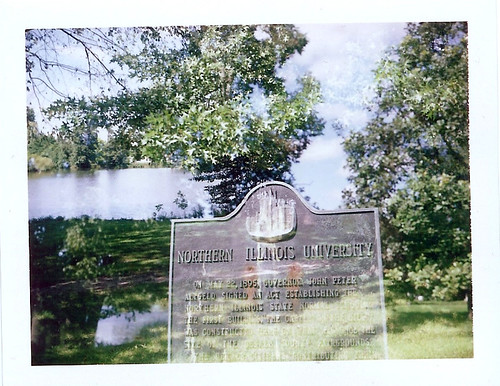
The weather in September is green, sunny and cool. Illinois is a breadbasket state. With rich soil and good rainfall, it’s full of farms growing corn and soybeans, all framing the urban and suburban “Chicagoland” metropolis in giant squares of green. DeKalb is about 65 miles west of Chicago, and home to the famous DeKalb corn, the birthplace of barbed wire, and Northern Illinois University. The art degree that hangs on the wall in my Arizona home is from Northern Illinois University. It’s where I met the man I married, as well as some of my favorite life long pals.


Took a stroll with the family around the campus lagoon, lush with willows, and Canada Geese, after a sundae at Ollie’s, “DeKalb County’s Best Custard Stand” (though any NIU student, current or former, would venture to say that it’s best of the whole state).


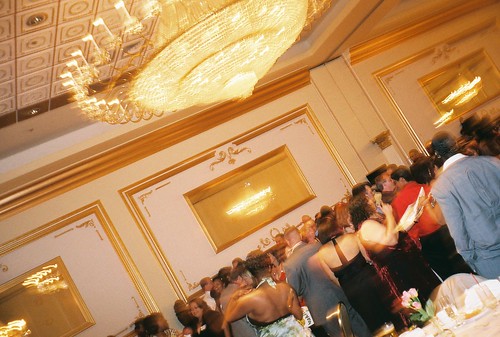
On the topic of alma maters, somehow, my 20th high school reunion happened to fall right during the time of our vacation. Naturally we had no choice but to attend. Lane Technical High School, Chicago, Class of 1989. With a student body averaging about 4,000 kids, there were about 1,000 students in my graduating class 20 years ago. Lane is a giant powerhouse of a public school, anchoring down the entire north side of the city. Back before the Information Age, when everything was still done by hand, the school was renowned for its technical programs: print shop, metal shop, machine shop, electric shop, drafting, commercial art. For many years we were the only high school in the U.S. that printed our own yearbooks. An education at Lane could fast track a graduate right into a trade. Nowadays, the shop programs have all been eliminated, and they no longer print their own yearbooks.


“Despite your bursts of creative thought, you are a wonderful person. Take care of yourself, be kind to small animals, and above all wear your seat belt. Live long and prosper. I’ll see you in 20 years.”- written in my senior yearbook by an art class buddy.

I liked high school. I earned a lot of skills, and friends that are all still valid to my life. One of the things that made Lane Tech such a great school was its huge population—a kind of microcosm of the city around us, with every nationality, attitude, and personality. There wasn’t just one “in-crowd”—everyone had their own in-crowd, and cross-referenced with every other group, like the ultimate mix-‘n-match. So, despite the $95 ticket price (!), I was excited about the reunion all summer. I bought a new party dress, and new party shoes and made a new necklace just for the reunion. As it turns out, I don’t know what I’d been so excited for! Because the reunion wasn’t really any good! I do not regret attending, but it was a disappointment. Only about 10% of my graduating class managed to attend. So, while there were some favorites and surprises, there were many more notably absent. Like my art class buddy who practically promised he’d be there via his yearbook inscription in 1989. Damn him.


Also, the DJ was terrible, playing loud-ass contemporary crunk, forsaking all headbanger, hippie, house, new wave, and old skool hip-hop folk in the crowd. The only thing of “our era” he managed to mix in was an endless stream of Michael Jackson, since the reunion happened to fall on the late Virgo’s 51st birthday. (Especially ironic, since Jehovah Witnesses do not celebrate birthdays).


Some favorite friends and delightfully surreal moments made it worth all the hassle and distance we went through to get there, but overall the interaction with fellow graduates was superficial, shouted over loud music, and not very fulfilling. Everyone looked pretty good—a little taller, a little bigger. The women either got rounder, or more angular.

Some arty pals had the right idea and cleverly crashed the party at 10:00pm, just in time for the group photo, and some free drinks. Why hadn’t we thought of that? We did manage to make a good time of it - knocking back some gin & tonics, and dancing to Michael Jackson. Late, tired, baffled by misty rain and confusing streets, we got lost trying to get out of there, completely flummoxed by the web of cloverleafs, and parking lots, with Chad trying to find our way by the moon, Arizona style, and having no luck.


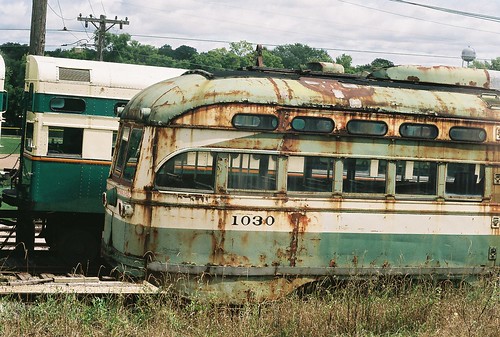
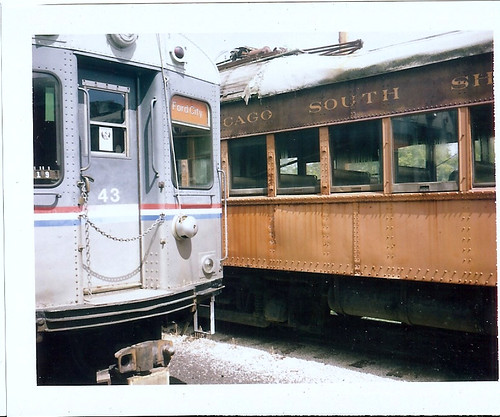
While family, and reunion could be considered recurring themes of this trip, another would be trains. Chicago is well known as a major rail location, with intersecting lines connecting all over the United States, and almost every where you look. The Fox Valley Trolley Museum in South Elgin, Illinois, is home to a collection of vintage rail cars from the Chicago Transit Authority and South Shore Line, and a 1902 trolley that is the oldest “intra-urban” still in use. We’d passed this place, on historic Route 31, along the Fox River, many times, and figured it was a good easy day trip for the Shmutzie gang. Baby’s first train ride! One of the things that fascinates me most in Midwest is rust. It’s almost cute when I see it, since it’s so foreign to Arizona. Rust is everywhere in Illinois- it’s like its own world, language, planet of rust. I could wander that museum yard and take photos of the faded patina and jagged rust decorating the old rail cars for hours.


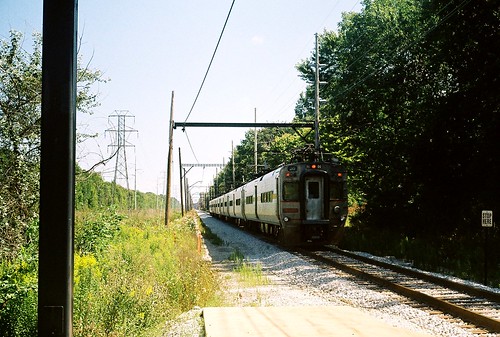
With the infrastructure of the city, public transportation and help of family and friends, we were able to save some bucks and get around without renting a car. A train from Chicago took us towards where Chad’s family lives, in Southwestern Michigan. The South Shore Line was a famous holiday route during the golden age of rail travel, to take vacationers from Chicago to the beaches of Southwestern Michigan. It still runs daily, mainly as a commuter route between downtown Chicago and northwestern Indiana, miraculously allowing pets aboard, provided they are sequestered in a travel carrier.


For $7.00 each, we were on the 10:10am departure from Chicago’s downtown Millennium Station, with Floyd snoozing in his airplane case, headed east to Beverly Shores, Indiana. Chad’s folks drove down from South Haven, Michigan to collect us on the beach at Indiana Dunes National Lakeshore.


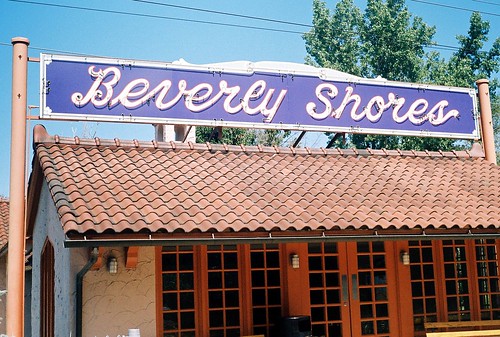
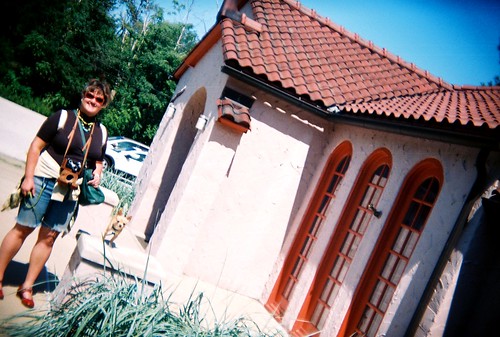
Beverly Shores was a summer vacation destination concocted by a real estate developers, Frederick and Robert Bartlett in the 1920s and ‘30s. The development never panned out much, but the town does have the most adorable 1929-built depot ever. I was in love with the depot and its stylish neon sign long before I ever even saw it in real life. When the train dropped us off there it was like meeting a movie star, since I’d admired it from afar for so long. From the tracks to the beach, it’s a ½ mile walk. We trekked down the road, dragging our tightly packed luggage to the shore like an episode of “The Amazing Race”.


Beverly Shores is famous for one thing other than the delightful Mediterranean Revival train depot. After Chicago’s 1933-34 “Century of Progress” World’s Fair, Robert Bartlett had several buildings from the “Homes of Tomorrow” exhibit barged across Lake Michigan and dumped unceremoniously on the dunes of Beverly Shores. Bartlett thought they’d make a good gimmick to attract vacationers. However, the display homes, which weren’t built to last, soon fell into disrepair and many decades of neglect.


It wasn’t until the National Park Service took over control of the homes, that they were placed on the Register of Historic Places in 1986. In a program implemented in partnership with the State of Indiana, and its Historic Landmarks Foundation, stabilization and restoration of the homes began. Featuring 1930s visions of the future-- cultured stone, enamel paneling that could slide in and out and change the color of your home, a place for an airplane hangar underneath the kitchen (since everyone in the future would be having their own airplane, naturally!)—each home was an idealistic pre-fabricated vision of a tomorrow that never happened. Of the original 16 Century of Progress homes, 5 still survive at Beverly Shores—each in varying stages of restoration. The program is a success due to private individuals who applied and were awarded the opportunity to restore the homes in exchange for 30-year leases. After 30 years, the homes revert occupancy to the National Park Service. Each October there is a tour of all 5 homes: the Florida House, the Armco-Ferro House, the Cypress Cabin, the Wieboldt-Rostone House, and The House of To-Morrow.


The rural dune lands around Lake Michigan are glorious--steep sand dunes anchored by beach grasses, with birch trees flickering in the wind like Arizona cottonwoods and aspens. Chad’s Mom is a rock hound, gathering up smooth stones and lake-flattened rocks until her pockets are full and dragging towards the ground. Southwestern Michigan is peaceful-- one can see why it would be a respite from Chicago’s hustle and bustle. For me, it’s full of memories from summer camp days, perfect sunsets, and times long ago.


Our Roberts nieces and nephews are age 9, 10, and 11, old enough to toss around in the surf, and tell horror stories around the campfire. They live in a big old frame home on a typically leafy South Haven street. Their life is full of bikes, scooters, games, craft projects, a trampoline, a tree fort, and myriad critters—guinea pigs, cats, dogs, ferrets, and a rabbit. If I were a child I’d love to grow up in that house with them. They also have a chihuahua named Snooky, and had planned to marry her off to Floyd when we arrived. (When spooky Snooky didn’t show the least bit of interest in fearless Floyd we figured the wedding was probably a bad idea).


Chad’s parents live a short walk from the beach, and we walked down to the pale sands of the shore to see the sunset every day.


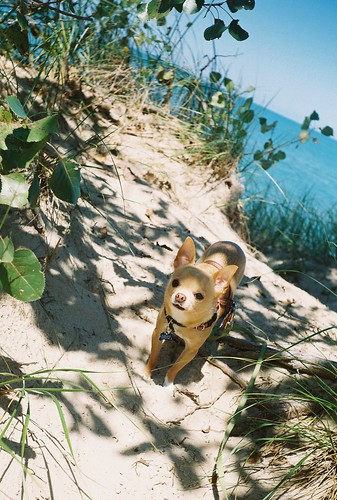
Michigan’s Van Buren Dunes State Park is a nice place to spend an afternoon, enjoying a picnic of peanut butter and jelly sandwiches, and soda (they call it “pop”). We spent a day running up and down dunes, hanging out on sandbars in the cold lake water, collecting rocks, and soaking up the last moments of Michigan summer. Labor Day in the Midwest is something a bit melancholy-- the end of summer and return of colder seasons. For us in Arizona it is precisely the opposite---joyous at the thought of cooler days, and the end of summer’s heat. Throughout this trip I couldn’t help but compare and contrast my Arizona life with this Great Lakes life I’d left behind, wondering how I’d be different had I stayed. Would I talk faster? Walk faster? Be more serious or more silly? Would I look older or younger? Rounder or more angular? What kind of career might I be in? I’d certainly drive a newer car, because that’s what people do there in the Rust Belt.


After several days in Michigan we headed back to Chicago via train, and spent an evening with a high school pal, Heather and her fiance, Mike. They are both tri-athletes, in preparation for an upcoming “half-Ironman”, both very fit and driven. Heather and Mike live in a hip north side neighborhood called “Roscoe Village”. When we were kids we just called it “Grama and Grampa’s neighborhood” because that’s where my grandparents lived. There was no glamour back then, just elderly folk pushing shopping baskets to the local corner stores. Now it’s full of boutique shops, young families, and fancy cafes.

My Chicago friends have so many places to choose for breakfast that they’re sometimes completely incapacitated by the abundant selections. They sit there, thinking of all the too many options. “We don’t have this problem where we live,” I joke, but nobody laughs. They’re so wrapped up in their city lifestyles they have absolutely no interest in what exactly it is we do in Arizona. It is the very end of the trip, and at this moment I feel like such a total foreigner, fresh off the boat in my weird skirt, and cameras slung around my neck. I look at my cluttered suitcase, think of the Karmann Ghia waiting for us at Sky Harbor, and the road home through the desert night.

Why is it that I always look my best in my own bathroom mirror?
Maybe it’s simply proof that “you can never go home again.” Doesn’t stop me from trying, because many of the people I love most in the world are back there. Maybe it is a symptom of Arizona living. This is my home now. I feel most like myself most here, more than anyplace else. The air, the sky, the elements in the dirt. They are in the marrow of my bones now, too.


For more information:

Fox Valley Trolley Museum http://www.foxtrolley.org/
Ollie’s Frozen Custard http://www.olliessycamore.com/
Lane Technical High School http://www.lanetech.org/
South Shore Line http://www.nictd.com/
Century of Progress Homes http://www.nps.gov/indu/historyculture/centuryofprogress.htm

Ellen Jo Roberts was born in Cook County, Illinois in the spring of 1972. She lives in a 95 year old house in Clarkdale Arizona, with a 37 year old husband, a 9 year old cat, a 6 year old chihuahua, 5 year old Boston Terrier and an assortment of vintage Volkswagens that remain well-preserved in the dry desert climes. You can read all about it at ellenjo.com