Showing posts with label vacation. Show all posts

Wednesday, August 18, 2010

California Dreaming along Highway 1

California Dreaming
Coastal Campout Along Highway 1
The Outs- Ellen Jo Roberts
The Noise
September 2010

highway 1

California’s Highway 1 is just a road, just a narrow curving ribbon of macadam perched along the western edge of the USA. It’s also something legendary, lyrical, mythical, magical: from books, magazines, movies and commercials.
A National Scenic Byway, it’s been designated an “All American Road”.
We all dream of Highway 1, as part of our collective consciousness.

My husband and I celebrated our 15th wedding anniversary this summer, a milestone worthy of a special road trip celebration. We wanted to be part of the dream, so we planned a Highway 1 adventure. All year we poured over library books, maps, brochures, Google Earth, and the state park websites, plotting our journey, booking our reservations. For Chad, the planning part is sometimes even more exciting than the trip itself. For months he lay awake in bed at night, satellite imagery dancing in his head.

ellen and chad at mcway falls

We travelled on the cheap, loaded up with camping gear and a picnic basket full of dry goods. Our only “luxury” was renting a Toyota Prius for its excellent fuel economy (averaging 50+ mpg), lower environmental impact, and modern comforts like satellite radio, climate & cruise control. We do all our longer road trips like this. Renting a car conserves both our vintage Volkswagens and our marriage.
The scenic routes Chad chose were both more direct, and more time consuming. After our first 13 hours on the road, we arrived in San Luis Obispo County, in a seaside town called Avila Beach, where we set up our tent after dark, at an area campground. The next morning we were up early, making our first memories of Highway 1, via San Luis Obispo. “SLO” as the locals call it, is hopelessly adorable, chock full of tidy Mediterranean bungalows and well-groomed yards. It’s home to California Polytechnic State University (“Cal Poly”), and the delightfully tacky 1950s “Madonna Inn”, with its outsized pink sign, and crazy gingerbread flourishes.

madonna inn  san luis obispo ca- argus

sea lions on beach near gorda, ca

Highway 1 through the central California coast is one of the rare things that lives up to the hype. You fear a collision from gawking at the scenery. It’s also achingly slow moving, constantly curving, elevating, and bound to cause moments of nausea in even the sturdiest passenger. It is riddled with delightful pull-offs and scenic overlooks. The ocean on a cloudy day is grey, but when the fog lifts the water changes color to an unbelievable turquoise, with tangled forests of kelp floating offshore like vegetable soup.

Big Sur, from “El PaĆ­s Grande Del Sur” (big country to the south), a moniker given by Carmel’s early Spanish settlers, remains fairly remote and sparsely populated. Highway 1 wasn’t completed through the area until 1937, and electricity didn’t arrive until the 1950s. Vast stretches are unpopulated, and the mountainous terrain to the east is Los Padres National Forest. The area is historically wealthy with inspiration for photographers, artists , beatniks, poets, writers, and other free spirits escaping from large cities to the south and north.

McWay Falls from above

"McWay Falls” is an icon of Big Sur, a t-shirt emblem just like the Bixby Bridge further north. Located near Julia Pfeiffer Burns State Park, the waterfall tumbles west of Highway 1 onto a secluded seashore, sheltered in a stone cove. The only creatures on the beach below it were seagulls. It’s off limits to humans, though a boardwalk above allows views of the beautiful scene.


A few hours north on Highway 1, with every mile taking twice as long as we’d planned, we headed east to the quicker 101 to make up some speed to our next destination, San Francisco. It was nearly sunset by the time we arrived in the foggy city by the bay. Even the dreary weather couldn’t dim its loveliness, all vertical and cascading down hills in vintage perfection.

balboa cafe- chocolate polaroid night exposure

Cold in July, with everyone was wearing sweaters, coats and hats, I kept thinking of Mark Twain’s joke :” The coldest winter I ever spent was the summer I spent in San Francisco.” Perhaps it was a culmination of a long day of driving, the maps strewn everywhere in the cramped car, Chad arguing with the GPS lady-- I dunno-- but I burst into tears driving down famously steep Russian Hill. I was so scared!
We’ve driven on some hair-raising mountain roads before, crawling boulders in the wilderness, but nothing has ever frightened me as much as Lombard Street in San Francisco. I’m no “Bullitt”.
There are stoplights at the top of a 45 degree hill. There are points where you cannot see the road above/ below you and you must just have faith there is nothing in your way as the light turns green. And if your car isn’t in great shape- if the engine is weak or the brakes are bad-- you’d better just go home.

lombard street looking down from russian hill

Our San Francisco night was spent at the Motel Capri, an inexpensive mid-century gem located in the Marina District, close walking distance to many interesting street scenes.

Floyd in San Francisco

Time in San Francisco was too short: just a night and part of the next morning-- not nearly enough to soak up this vibrant city. Hiking up the steep streets on a Sunday morning with all of my cameras clattering, I was grooving on the big city life, being just a face in the crowd, one of many. No one batted an eyelash at me (unlike in my own tiny town where I am a featured landmark.) San Francisco is a smart, wealthy city, beloved by many who’ve left their hearts there. The streets are so steep it’s a full-on cardio work out all the time. A friend of mine lived there for 7 years and says, “Try walking up and down those hills every day, yeesh! I ended up in Delaware - flat as a pancake. To paraphrase Tony Bennett ‘I Left My Girlish Figure in San Francisco.’"

lombard street-"the world's crookedest street"

From San Francisco we crossed the Golden Gate Bridge north to Marin County, to have lunch with a dear favorite friend, an Arizona ex-patriot. She and her surfer beau live in a cozy 1910 built "love shack" near the sea in tiny Stinson Beach, and invited us to stay.

Heidi and Michael

We cancelled our camping reservations at Manresa Beach State Park near Santa Cruz in favor of setting up tent in their garden amidst their surfboards, nestled between the fog-shrouded Mt. Tamalpais, “Birthplace of Mountain Biking”, and the cold grey waves of the Pacific.

where we camped- stinson beach

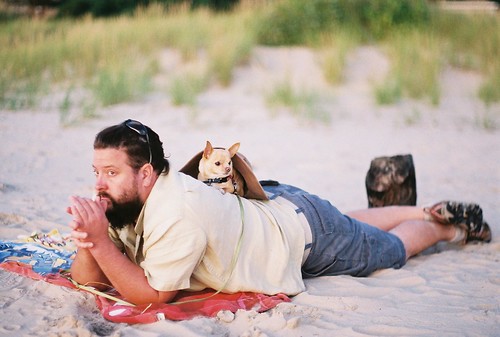
Marin County is notoriously suspicious of outsiders. Nearby Bolinas is famous for removing their city sign, to discourage tourists. Hanging with the locals we were instantly accepted as locals by proxy. Romping and running wild with our dogs on the beach was a thing of pure joy. Our friends cooked us a wonderful dinner, we drank wine, laughed, and told stories well after dark. It was a highlight of our trip and finally felt like the vacation had begun.

beach dogs- stinson beach 2

Highway 1 north of San Francisco is fragrant with eucalyptus. The giant groves of quick growing Australian trees are not native, and have their detractors for this reason. Despite this, the willowy giants have somehow become synonymous with California. The gold rush and railroads brought the species here in the 1850s, when the state government authorized and encouraged their quick growing establishment. The astringent smell of the eucalyptus fills our noses.
Suddenly we are in love with this part of California. My mind wanders back to the beautiful eucalyptus tree we already have, in our own Arizona front yard.

heidi moved from SF to Stinson Beach

Our next campsite was back down the coast at San Simeon State Park, followed by a night at Pfeiffer Big Sur State Park. We’d reserved all of our campsites months earlier, most of them at state parks for about $40 per night.
Pfeiffer Big Sur, a popular park since 1933, is a bit magical, nestled into the redwoods, and delineated by the clear grey green Big Sur River. There were swarms of ladybugs everywhere when we arrived. I wouldn’t have been surprised at all to see a unicorn.

pfeiffer big sur redwoods

Side note: They sell beer (!) at California State Parks. (Hey Arizona State Parks, ya’ listening?) After setting up tent it’s customary to take a dip in the Big Sur River. Hot, sunny, drinking beer in the river—just like home.

chad in big sur river 2

Chad led us on a sunset expedition to nearby Pfeiffer Beach. Amazing, framed by giant sea bound monoliths, and smooth purple sand, Pfeiffer Beach was blustery cold, full of photographers, picnickers sipping red wine, unruly dogs, and loud crashing waves.

pfeiffer beach at sunset- july 14th

Our final night on the Big Sur Coast was spent at Kirk Creek, a federal campground. There are world-class resorts all up and down Big Sur, each charging hundreds of dollars a night. None would compare to this $22.00 campsite. When we arrived, our jaws dropped. Site #11 at Kirk Creek was the best campsite we've ever had in our lives: big, beautiful, carpeted by soft grass, high on a bluff overlooking the sunny Pacific, surrounded by sweet scented wild fennel, sage, and yarrow. A steep trail leads down to the rocky shore below.

kirk creek dinner

fennel growing wild and smelling good

north of sand dollar beach 3

black tan green

Unpacking, setting up, breaking down, and repacking camp every day was hard work. The Prius was so small we basically had to unload the entire car, and reload the entire car every day. Thank God for Chad's engineering-style mind. The camping life is hard work, toting water, lifting gear, washing dishes outdoors, washing our hair in sinks—everything takes more time and energy.
And somehow, the food tastes better. The sleep in the tent is more restful.
The hard work makes everything more valuable somehow.

kirk creek trail begins at campground

kirk creek beach 7- 15 setting sun

highway 1 at night- long exposure

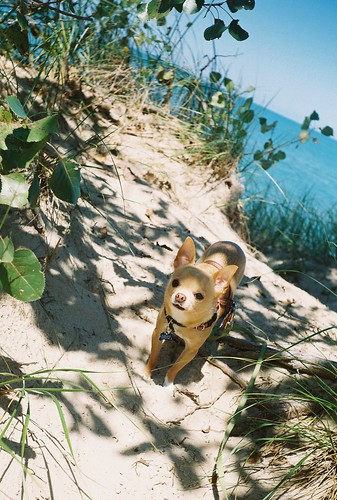
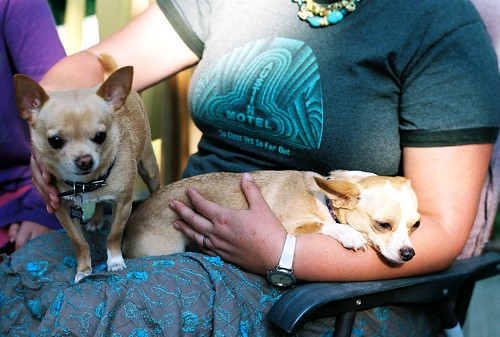
Without showers for days, we were kinda’ grungey, with our rock star hair and dirty feet like a couple of goddamn hippies. It didn’t bother me at all, until we took the dogs for a stroll through a field of tall dried thistle, just north of nearby Sand Dollar Beach. Headed to a special seashore Chad selected, I looked down at the dogs and noticed little dark dots all over them. Yanking my chihuahua up by his harness, my fears were confirmed. Ticks! The dogs are covered with ticks!! Panic sets in and a shriek wells in my throat. I start brushing them off of him frantically, brushing them off my bare legs, and looking for the nearest exit. Sitting on a barren bluff, high above the rocky beach, socked in with raging high tide, I managed to clear all the ticks off of Floyd, because they are easy to spot in his pale fur. Ivan, the Boston Terrier was not as lucky. We manage to find most of them in his dark brindley fur, but miss the final two until the next day.
That night I feel itchy all over, and wish for a shower.

north of sand dollar beach

north of sand dollar beach- scared protecting floyd from ticks

chicken dinners- broken neon

Away from the sea and back to the desert, we spent a night at a 1950s built motel in Palm Springs. San Francisco in July is cold enough for polar fleece. Palm Springs in July is like a blast furnace. It was still over 100 degrees when we rolled into town at 9pm, and already back up to 109 by 9am the next day.
Travel tip: Palm Springs motel rooms are cheap in July.

palm springs travel lodge

"Salvation Mountain", about 75 miles from the Coachella Valley in a remote sun-baked location near Niland, has been on my list of places to see for years. Our last day on the road, we head a lil’ bit out of our way down to see this amazing bit of folk art. The Colorado Desert sits below sea level, and is sparsely occupied during the summer. Bombay Beach along the Salton Sea is a 1960s resort town gone wrong, a post-apocalyptic paradise full of bombed out trailers and land locked boats.

bombay beach grounded boat

Further south is “the last free place”, Slab City, a transient community setting up camp on concrete slabs left behind from a World War 2 military installation.

slab city- the last free place

We arrive at Salvation Mountain, a massive bit of crazily colorful religious folk art created by Leonard Knight. Mr. Knight, 78, has spent decades carving and coating the side of a dirt hill with adobe, straw, thousands of gallons of donated paint, and various versions of “God is Love”, scripture, and testimony to Jesus.

salvation mountain-artist's chair and supplies

sun baked bible truck

Everything is fancifully painted: cars, trucks, bikes, boats. 113 degrees at high noon. I thought my Chuck Taylors might melt. Salvation Mountain was worth the many out-of-the-way miles. It is a true thing of beauty, and as important to American iconography as Highway 1.

for god so loved the world

Driving through the heat of day, we arrive back in our neighborhood by dusk.
The Verde Valley always looks really good after a long road trip, after driving through many random small towns of assorted quality.
“You know something, this place we live in is pretty damn good. It looks pretty great here.” Back at home we feel exhilarated, relaxed, as we pour over Polaroids, tip back cold California beers, and sit close to the eucalyptus tree.


http://www.madonnainn.com/index.php
http://www.sfmotelcapri.com/
http://www.parks.ca.gov/
http://bigsurcalifornia.org/
http://www.salvationmountain.us/

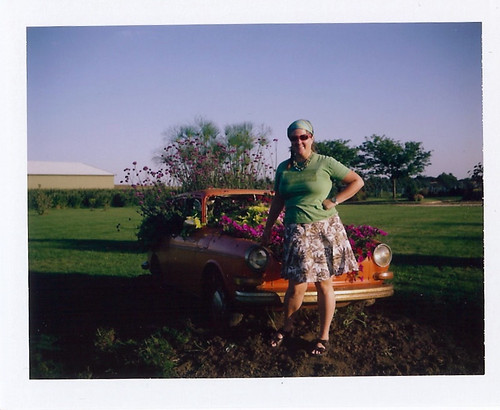
Ellen Jo Roberts lives in a historic brick bungalow in Clarkdale Arizona, with Bike Daddy Chad, 2 small dogs, a cat, and a collection of vintage Volkswagens, none of which have cruise control, air conditioning or satellite radio.
Read all about it at ellenjo.com

Monday, September 21, 2009

Midwestern Melancholy

Midwestern Melancholy
Whirlwind around Lake Michigan
The Outs
The Noise http://www.thenoise.us/
October 2009
Ellen Jo Roberts


10 days, 3 states, 2 time zones. We managed to spend time with all of our immediate relatives (including the newest family member, a very handsome month-old nephew). We traveled by car, plane, train, trolley, limo, city bus, and foot. We shared space with 5 dogs, 12 cats, 3 ferrets, 2 guinea pigs, and a rabbit. Towards the end of this epic Midwestern adventure I found myself anxious to get back to my Arizona. A lost girl in a big metropolis no longer familiar-- my suitcase smelling funky, full of smoothly polished beach stones, sand, and dog-eared postcards, my cameras exhausted of film, and my chihuahua lonely for his pals back home.


There is something fundamentally forever in the marrow of your bones that comes from the place where you were born. I grew up along the shores of the Great Lakes. Back in my young and dreamier days I whiled away many hours along the beaches of Lake Michigan, imagining my escape to the future. The more years away, the less easy it is to slip back into that world, like a coat that no longer fits, or a radio station on the fritz. I feel less and less like myself. All of my family is back there, and every time I visit I get a little twisted up inside. A pang of longing, for the birthdays, baseball games, and barbecues-- all of the small things I miss out on by being so far away. In my mind everything has stayed the exact same as I left it—so it’s always a surprise to find out that life has gone on without me. My brother and his friends aren’t forever 21, as I imagine them. They’re all married up now, dads, with jobs, car payments and mortgages.


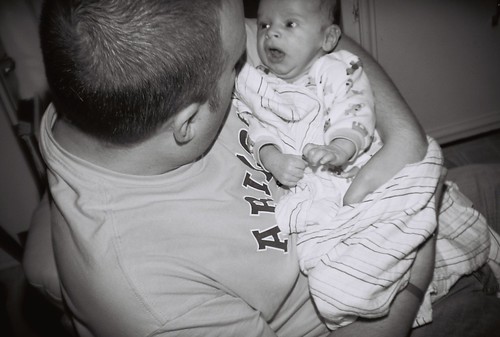
My brother Jim, and his wife, Carla, have a brand new son, freshly born this summer. About 5 weeks old when we met him, he was at the age where he can only focus about 18 inches from his face, and almost starting to learn what they call a “social smile”, smiling on purpose, not just as a symptom of gas. He is awful cute. Jim’s taken to calling “Party Man” and “Shmutzie” for no apparent reason. They’re very good with the baby, and it made me proud to see the family continuing into a new generation with this wee one. My Mom made a big fuss for our visit, making homemade cookies, and other favorite treats. She gathered up some six packs of regional micro-brews for us to enjoy, and took days off of work to go on adventures and spend time with us. Jim and Carla were prepared, with all of their high-tech foldable space age baby gear, to join us for some small day trips around northern Illinois, skirting along corn fields, waiting at stop lights.


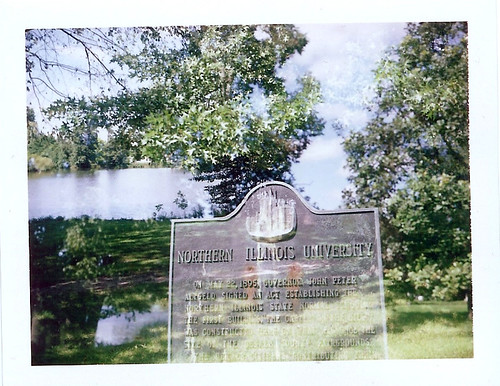
The weather in September is green, sunny and cool. Illinois is a breadbasket state. With rich soil and good rainfall, it’s full of farms growing corn and soybeans, all framing the urban and suburban “Chicagoland” metropolis in giant squares of green. DeKalb is about 65 miles west of Chicago, and home to the famous DeKalb corn, the birthplace of barbed wire, and Northern Illinois University. The art degree that hangs on the wall in my Arizona home is from Northern Illinois University. It’s where I met the man I married, as well as some of my favorite life long pals.


Took a stroll with the family around the campus lagoon, lush with willows, and Canada Geese, after a sundae at Ollie’s, “DeKalb County’s Best Custard Stand” (though any NIU student, current or former, would venture to say that it’s best of the whole state).


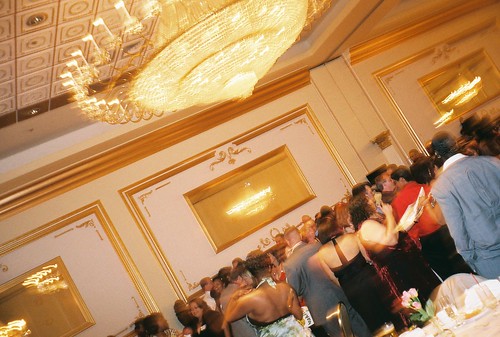
On the topic of alma maters, somehow, my 20th high school reunion happened to fall right during the time of our vacation. Naturally we had no choice but to attend. Lane Technical High School, Chicago, Class of 1989. With a student body averaging about 4,000 kids, there were about 1,000 students in my graduating class 20 years ago. Lane is a giant powerhouse of a public school, anchoring down the entire north side of the city. Back before the Information Age, when everything was still done by hand, the school was renowned for its technical programs: print shop, metal shop, machine shop, electric shop, drafting, commercial art. For many years we were the only high school in the U.S. that printed our own yearbooks. An education at Lane could fast track a graduate right into a trade. Nowadays, the shop programs have all been eliminated, and they no longer print their own yearbooks.


“Despite your bursts of creative thought, you are a wonderful person. Take care of yourself, be kind to small animals, and above all wear your seat belt. Live long and prosper. I’ll see you in 20 years.”- written in my senior yearbook by an art class buddy.

I liked high school. I earned a lot of skills, and friends that are all still valid to my life. One of the things that made Lane Tech such a great school was its huge population—a kind of microcosm of the city around us, with every nationality, attitude, and personality. There wasn’t just one “in-crowd”—everyone had their own in-crowd, and cross-referenced with every other group, like the ultimate mix-‘n-match. So, despite the $95 ticket price (!), I was excited about the reunion all summer. I bought a new party dress, and new party shoes and made a new necklace just for the reunion. As it turns out, I don’t know what I’d been so excited for! Because the reunion wasn’t really any good! I do not regret attending, but it was a disappointment. Only about 10% of my graduating class managed to attend. So, while there were some favorites and surprises, there were many more notably absent. Like my art class buddy who practically promised he’d be there via his yearbook inscription in 1989. Damn him.


Also, the DJ was terrible, playing loud-ass contemporary crunk, forsaking all headbanger, hippie, house, new wave, and old skool hip-hop folk in the crowd. The only thing of “our era” he managed to mix in was an endless stream of Michael Jackson, since the reunion happened to fall on the late Virgo’s 51st birthday. (Especially ironic, since Jehovah Witnesses do not celebrate birthdays).


Some favorite friends and delightfully surreal moments made it worth all the hassle and distance we went through to get there, but overall the interaction with fellow graduates was superficial, shouted over loud music, and not very fulfilling. Everyone looked pretty good—a little taller, a little bigger. The women either got rounder, or more angular.

Some arty pals had the right idea and cleverly crashed the party at 10:00pm, just in time for the group photo, and some free drinks. Why hadn’t we thought of that? We did manage to make a good time of it - knocking back some gin & tonics, and dancing to Michael Jackson. Late, tired, baffled by misty rain and confusing streets, we got lost trying to get out of there, completely flummoxed by the web of cloverleafs, and parking lots, with Chad trying to find our way by the moon, Arizona style, and having no luck.


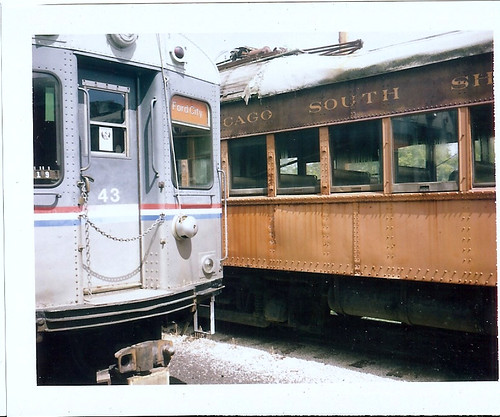
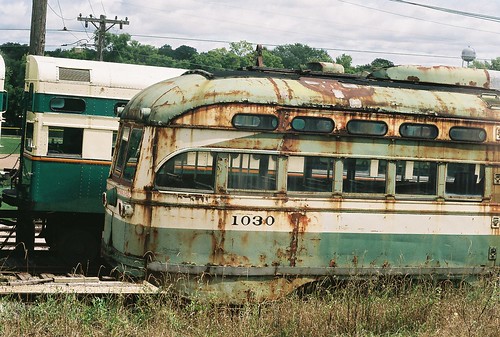
While family, and reunion could be considered recurring themes of this trip, another would be trains. Chicago is well known as a major rail location, with intersecting lines connecting all over the United States, and almost every where you look. The Fox Valley Trolley Museum in South Elgin, Illinois, is home to a collection of vintage rail cars from the Chicago Transit Authority and South Shore Line, and a 1902 trolley that is the oldest “intra-urban” still in use. We’d passed this place, on historic Route 31, along the Fox River, many times, and figured it was a good easy day trip for the Shmutzie gang. Baby’s first train ride! One of the things that fascinates me most in Midwest is rust. It’s almost cute when I see it, since it’s so foreign to Arizona. Rust is everywhere in Illinois- it’s like its own world, language, planet of rust. I could wander that museum yard and take photos of the faded patina and jagged rust decorating the old rail cars for hours.


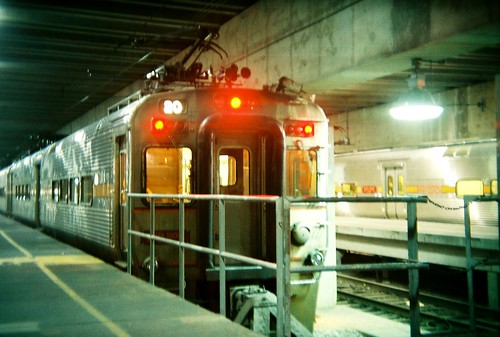
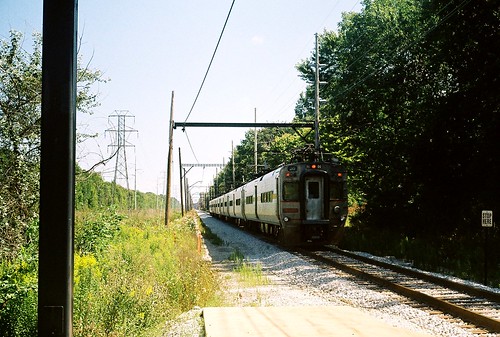
With the infrastructure of the city, public transportation and help of family and friends, we were able to save some bucks and get around without renting a car. A train from Chicago took us towards where Chad’s family lives, in Southwestern Michigan. The South Shore Line was a famous holiday route during the golden age of rail travel, to take vacationers from Chicago to the beaches of Southwestern Michigan. It still runs daily, mainly as a commuter route between downtown Chicago and northwestern Indiana, miraculously allowing pets aboard, provided they are sequestered in a travel carrier.


For $7.00 each, we were on the 10:10am departure from Chicago’s downtown Millennium Station, with Floyd snoozing in his airplane case, headed east to Beverly Shores, Indiana. Chad’s folks drove down from South Haven, Michigan to collect us on the beach at Indiana Dunes National Lakeshore.


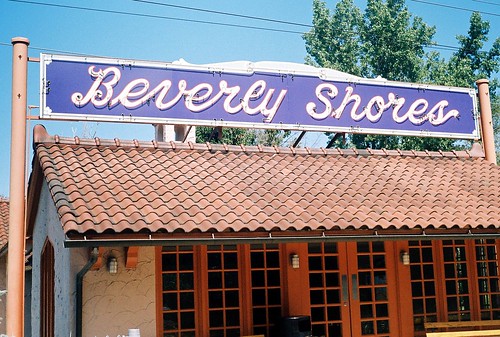
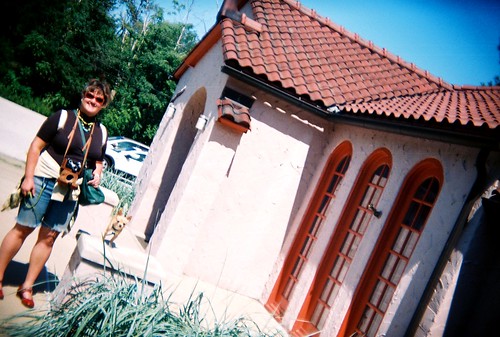
Beverly Shores was a summer vacation destination concocted by a real estate developers, Frederick and Robert Bartlett in the 1920s and ‘30s. The development never panned out much, but the town does have the most adorable 1929-built depot ever. I was in love with the depot and its stylish neon sign long before I ever even saw it in real life. When the train dropped us off there it was like meeting a movie star, since I’d admired it from afar for so long. From the tracks to the beach, it’s a ½ mile walk. We trekked down the road, dragging our tightly packed luggage to the shore like an episode of “The Amazing Race”.


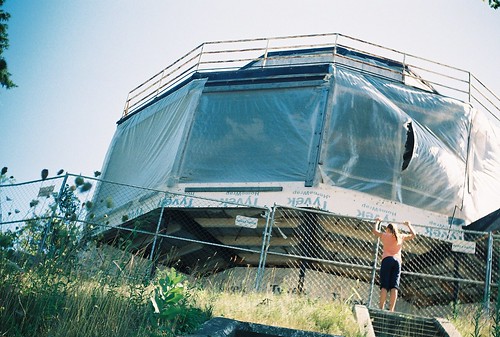
Beverly Shores is famous for one thing other than the delightful Mediterranean Revival train depot. After Chicago’s 1933-34 “Century of Progress” World’s Fair, Robert Bartlett had several buildings from the “Homes of Tomorrow” exhibit barged across Lake Michigan and dumped unceremoniously on the dunes of Beverly Shores. Bartlett thought they’d make a good gimmick to attract vacationers. However, the display homes, which weren’t built to last, soon fell into disrepair and many decades of neglect.


It wasn’t until the National Park Service took over control of the homes, that they were placed on the Register of Historic Places in 1986. In a program implemented in partnership with the State of Indiana, and its Historic Landmarks Foundation, stabilization and restoration of the homes began. Featuring 1930s visions of the future-- cultured stone, enamel paneling that could slide in and out and change the color of your home, a place for an airplane hangar underneath the kitchen (since everyone in the future would be having their own airplane, naturally!)—each home was an idealistic pre-fabricated vision of a tomorrow that never happened. Of the original 16 Century of Progress homes, 5 still survive at Beverly Shores—each in varying stages of restoration. The program is a success due to private individuals who applied and were awarded the opportunity to restore the homes in exchange for 30-year leases. After 30 years, the homes revert occupancy to the National Park Service. Each October there is a tour of all 5 homes: the Florida House, the Armco-Ferro House, the Cypress Cabin, the Wieboldt-Rostone House, and The House of To-Morrow.


The rural dune lands around Lake Michigan are glorious--steep sand dunes anchored by beach grasses, with birch trees flickering in the wind like Arizona cottonwoods and aspens. Chad’s Mom is a rock hound, gathering up smooth stones and lake-flattened rocks until her pockets are full and dragging towards the ground. Southwestern Michigan is peaceful-- one can see why it would be a respite from Chicago’s hustle and bustle. For me, it’s full of memories from summer camp days, perfect sunsets, and times long ago.


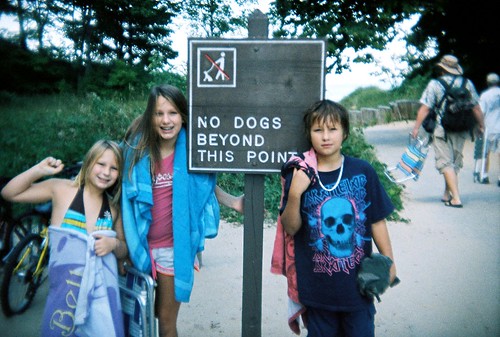
Our Roberts nieces and nephews are age 9, 10, and 11, old enough to toss around in the surf, and tell horror stories around the campfire. They live in a big old frame home on a typically leafy South Haven street. Their life is full of bikes, scooters, games, craft projects, a trampoline, a tree fort, and myriad critters—guinea pigs, cats, dogs, ferrets, and a rabbit. If I were a child I’d love to grow up in that house with them. They also have a chihuahua named Snooky, and had planned to marry her off to Floyd when we arrived. (When spooky Snooky didn’t show the least bit of interest in fearless Floyd we figured the wedding was probably a bad idea).


Chad’s parents live a short walk from the beach, and we walked down to the pale sands of the shore to see the sunset every day.


Michigan’s Van Buren Dunes State Park is a nice place to spend an afternoon, enjoying a picnic of peanut butter and jelly sandwiches, and soda (they call it “pop”). We spent a day running up and down dunes, hanging out on sandbars in the cold lake water, collecting rocks, and soaking up the last moments of Michigan summer. Labor Day in the Midwest is something a bit melancholy-- the end of summer and return of colder seasons. For us in Arizona it is precisely the opposite---joyous at the thought of cooler days, and the end of summer’s heat. Throughout this trip I couldn’t help but compare and contrast my Arizona life with this Great Lakes life I’d left behind, wondering how I’d be different had I stayed. Would I talk faster? Walk faster? Be more serious or more silly? Would I look older or younger? Rounder or more angular? What kind of career might I be in? I’d certainly drive a newer car, because that’s what people do there in the Rust Belt.


After several days in Michigan we headed back to Chicago via train, and spent an evening with a high school pal, Heather and her fiance, Mike. They are both tri-athletes, in preparation for an upcoming “half-Ironman”, both very fit and driven. Heather and Mike live in a hip north side neighborhood called “Roscoe Village”. When we were kids we just called it “Grama and Grampa’s neighborhood” because that’s where my grandparents lived. There was no glamour back then, just elderly folk pushing shopping baskets to the local corner stores. Now it’s full of boutique shops, young families, and fancy cafes.

My Chicago friends have so many places to choose for breakfast that they’re sometimes completely incapacitated by the abundant selections. They sit there, thinking of all the too many options. “We don’t have this problem where we live,” I joke, but nobody laughs. They’re so wrapped up in their city lifestyles they have absolutely no interest in what exactly it is we do in Arizona. It is the very end of the trip, and at this moment I feel like such a total foreigner, fresh off the boat in my weird skirt, and cameras slung around my neck. I look at my cluttered suitcase, think of the Karmann Ghia waiting for us at Sky Harbor, and the road home through the desert night.

Why is it that I always look my best in my own bathroom mirror?
Maybe it’s simply proof that “you can never go home again.” Doesn’t stop me from trying, because many of the people I love most in the world are back there. Maybe it is a symptom of Arizona living. This is my home now. I feel most like myself most here, more than anyplace else. The air, the sky, the elements in the dirt. They are in the marrow of my bones now, too.


For more information:

Fox Valley Trolley Museum http://www.foxtrolley.org/
Ollie’s Frozen Custard http://www.olliessycamore.com/
Lane Technical High School http://www.lanetech.org/
South Shore Line http://www.nictd.com/
Century of Progress Homes http://www.nps.gov/indu/historyculture/centuryofprogress.htm

Ellen Jo Roberts was born in Cook County, Illinois in the spring of 1972. She lives in a 95 year old house in Clarkdale Arizona, with a 37 year old husband, a 9 year old cat, a 6 year old chihuahua, 5 year old Boston Terrier and an assortment of vintage Volkswagens that remain well-preserved in the dry desert climes. You can read all about it at ellenjo.com