Showing posts with label the noise. Show all posts

Monday, January 19, 2015

If Life Is a Bowl of Cherries, What Am I Doing in the Pittsburgh?

Originally published Dec. 2008:

If life is a bowl of cherries, what am I doing in the Pittsburgh?

The Outs
December 2008
Ellen Jo Roberts
 The Noise

“Vivid dreams and restless sleep in Pittsburgh. Covers too heavy, room too hot, toss and turn, calves aching from flat hike in flat Chuck Taylors, snow, rain in face, tired, eyes wild, up too late watching crime dramas and cop stories.” –notebook jottings.


One can be certain your jet is bound for Pittsburgh when you take stock of the passengers around you. You’ll notice the abundance of Steelers team logos, from jerseys, to caps, to tie tacks and cufflinks. Even the tiniest tot is decked in Steelers gear. It’s the one thing that unifies those folk from western Pennsylvania, as varied as their ethnicities may be. I rolled into downtown “Pix-berg”, as the locals call it, just as a Steelers game was about to kick off. The streets were clogged with Steelers fans like cholesterol clogs arteries. Gold and black garb as far as the eye could see, flooding towards Heinz Field.


Pixberg was not for me, my friend! Normally I can wear a city like a new outfit and pretend I live there, but Pixberg never quite fit-- it was a bit stiff in the shoulders, not to mention frickin’ freezing. The daily subfreezing weather and occasional blizzards in my face were, at first, amusing, as it was so different from the sunny Arizona autumn I’d left behind. It was a fresh blast, a jolt to the senses. However, after a few days of my sunglasses languishing untouched in my suitcase I started to feel the lack of Vitamin D. Pixberg chewed me up and spit me out!  Ach-tooey!
Fer reals, this city was quite interesting, in a post-industrial/picturesquely hilly sorta way--- lots of old architecture, handsome neighborhoods, and interesting locals. People there are real salt of the earth types, nothing fancy, not putting on airs-- just real honest-to-God rough-hewn citizens. In Pittsburgh everyone swears quite casually-- they drop the F bomb as often as we might say "and", or "the". They use it as a noun, verb, adjective, and adverb. Also, everyone smokes. 


My friend Lisa used to live in Pittsburgh back in its depressingly dirty 1970s, and has no fond memories of it. She says everyone smoked there because the air was already so bad it didn’t matter.  

 Modern Pittsburgh, 2008, is cleaner, livelier, and down right spiffy in certain areas. Once known as home to numerous smog spewing steel factories, coal mines, Westinghouse Appliances, and many freight rails, most of the heavy manufacturing has left the area, leaving behind cleaner, greener industry like regional office headquarters, universities, and retail businesses. Pittsburgh, once the butt of environmental jokes, is now home to the nation’s first “green” convention center. Big names like Carnegie and Heinz still carry much weight, culturally, with universities, museums, and investments into the city’s aged infrastructure. The Heinz corporate headquarters are still located in Pittsburgh, and the Heinz History Museum is a good primer on Pittsburgh lore. My taxi driver was from Ghana. He came to Pittsburgh because his parents went to school there. He said while most of the bad industry has left Pittsburgh, most of the same old people are still in control. “We need some new people in control”, he declares in his thick West African brogue.

Because of the Monongahela, Allegheny and Ohio Rivers converging on the city Pittsburgh has 1,700 bridges. The number of bridges is second only to Venice, Italy! Said Lisa, "Yeah, and if you find yourself on the wrong side of one, you're screwed!!"

I was in town for a conference, for my “real job”, but was able to wander the “Golden Triangle” of downtown, solo with several cameras, to do some touring on foot during my free time. I’d arrived with a list of travel tips from Meredith Seiverd, our very own Noise Creative Director, and native child of Pennsylvania. Often times during my visit I’d think “I wonder if Meredith was ever on this same sidewalk, looking at this same view. I wonder if this is the exact spot where Meredith picked up her bad habits and tendency to use profanity?”

Another native child of Pittsburgh is Andy Warhol, born Warhola, under the sign of Leo, in August of 1928. While Warhol’s career may have been most notorious during his New York City years, Pittsburgh was where he got his start, and where he attended school, at the Carnegie Institute’s School of Art. 
 The five-story Andy Warhol Museum is a complete fascination, chock full of major artworks of significant importance, kitschy artifacts, a full library of Interview magazines, and even a few of Warhol’s multi-hued wigs and favorite Polaroid cameras. The impact Andy Warhol made on this planet, not just in the world of art but to the entire sensibility of popular culture is evident as you stroll the museum. He changed everything forever. His life was brief, dead at age 58, but his impact still reverberates through us even now. What I admire most about Warhol was his active creativity—he was always drawing, painting, printing, photographing, filming, making audio-recordings, writing letters. His documents of the eras in which he lived are invaluable resources today. 


Walking the hard cold concrete of Pittsburgh, crossing numerous bridges and 2 of the 3 rivers, one can understand how the fertile mind of Warhol sprang forth from this hilly metropolis. A place where they stuff cole-slaw into everything. Folks on the plane told me to have a “prih-manny sammich” (Primanti sandwich), a bit of regional cuisine. Apparently it’s a sandwich roll stuffed with whatever you want plus cole-slaw and fries, all in the bun. It was invented by the Primanti Brothers in the 1930s, for construction workers and truckers, so they could eat their meal one-handed. Those clever Pix-berg folk. When in Pittsburgh I drank the local brew, Iron City Beer. It was especially good after spending an entire day on airplanes, although truth be told, anything might taste good after such an ordeal.


Mister Rogers Neighborhood was actually in Pittsburgh, and Fred Rogers a local boy. Pittsburgh’s downtown is home to both the Steelers and the Pirates, with Heinz Field and PNC Park on opposite rivers. It’s also home to their “cultural district”, and abundant shopping, of the big old-timey department store variety. There are “ghost signs” everywhere, faded painted-on mementos of days long gone. All of the bridges are a sunny yellow, and magnolias bloom year round, in the form of a bit of public art by Chicago artist Tony Tasset. It fooled me, to see these big magnolia trees in bloom—I did a Looney Tunes style double-take, and may have even glanced at my watch. I had to cross the street to get a closer look. Very realistic sculptures of magnolia trees in bloom. A delightful bit of trickery brightened the otherwise gloomy weather—delighted even more to discover the work was by Ohio-native Tasset, who had been a professor of mine in the early 1990s at the University of Illinois at Chicago.


The Monongahela and Duquesne Inclines are notable symbols of the city, carting passengers from the Golden Triangle downtown, up to the neighborhood called “Mt. Washington”, or as the locals say, “Warshington”. Lore has it that this was the spot where young George Warshington first surveyed the land, laying his eyes on what was to be Pittsburgh. The Inclines have been in operation since the late 1800s, and are sort of like a combination of an elevator and a cable car, riding rail tracks up the steep hill to Mt. Washington. Price to ride is $2.00 for adults, $2.50 if you want a transfer for the ride back down. The Mount Washington neighborhood is like a movie set, the homes all vintage and tightly packed, the macadam sometimes rubbed-off to reveal cobblestone. 


Some streets are steeper than what you’d find in Jerome, Arizona—like that old joke about how you could walk off your front porch and into your neighbor’s chimney. With striking views across the Monogahela River back into downtown, the scenic splendor was short-lived once a blizzard swept in, cutting visibility down to just a few yards.  


For those wanting a view from below rather than above, the Gateway Clipper fleet takes tourists on an architectural tour by river. Meredith worked for the Gateway Clipper as a photographer back in her youth, taking photos of passengers as they boarded the riverboats, in order to sell them the shots upon their return. She’s entertained us with many wacky stories of those days, including how people would sometimes try to steal their photos off the display board rather than pay for them. Life in Pittsburgh may be rough, and I imagine it’s a tough place to grow up. Many lessons to learn in a place like this, and not just from Mr. Rogers. There’s a sort of attitude there, a sort of dare I say it, a steeliness. Riding the Monongahela Incline as a dorky tourist cluttered with cameras, the energy given off by fellow passengers, all locals having their regular routine, was distinctly of the “don’t get involved” variety. All eye contact averted, no attempt to engage me in dialogue. It suddenly made me feel very out of place, the faded Arizona sunshine still painting my cheeks now burning hot and lonely. Maybe if I’d had been traveling with a friend I’d have not felt like such an oddball. Or maybe Pittsburgh just didn’t fit. 

For more information:
Ellen Jo Roberts is from Chicago, Illinois, also a dreary climate during the winter. She lives and works in Clarkdale, AZ., sharing a vintage bungalow with her husband and assorted critters. All the cool people live in Clarkdale. Be there or be square. Learn more at www.ellenjo.com


Friday, December 20, 2013

Hot Springs and The Thing!


Random Western Wanderings.

In This Episode: Hot Springs and The Thing!

The Noise- January 2014

The Outs

Ellen Jo Roberts


Greetings from Truth or Consequences, New Mexico, a dusty old town on the banks of the mighty Rio Grande.

Western New Mexico seems far away, no matter where you’re coming from. As one friend put it, it is the ideal place for felons to disappear forever because, like, who’s gonna look for them here? This road trip took us along hundreds of miles of two-lane blacktop, past never-ending forests of roadside yucca, through ghost towns and over corkscrewing mountain passes. Along the way we stayed at historic motels, wandered art districts, met interesting folks and made careful observation of the ways Arizona and New Mexico are similar and yet so very different.


After exiting I-40 at Holbrook we were the only car on the road most of the way to Glenwood. With Gila National Forest all around, the interesting ghost town of Mogollon to the northeast (home of the Winter Sun family’s Super Salve Company) and the San Francisco Hot Springs just south, Glenwood is a historic community with a small stretch of business butted up to a slow curve of Highway 180. The monsoon season hit the southwest big last summer. Arizona rains were relentless and in New Mexico it was no different. Glenwood’s main tourist attraction, The Catwalk National Recreation Trail, sustained heavy damages from flooding and remains closed until further notice. Named for an elevated pipeline frame, a relic of the mining era hugging the canyon walls above the Whitewater River canyon, the Catwalk was a popular trail, and its closure has impacted tourism in the immediate vicinity. 

We were the only guests checked into a strange old roadside motel. The furnace made sounds like a cat purring. The room was a wild cacophony of textures: wood paneling, rock walls, shag carpeting. Lots of different out-buildings and random artifacts littered the property, including assorted ice cream freezers and a vintage Schwinn Stingray. Stairs to the motel’s second floor had fallen away or been removed. The people in Glenwood were pleasant but I’d not say they were overly friendly. They regarded us as though we were French people on holiday rather than their neighbors from the state next door.


Heading south from Glenwood you soon pass the San Francisco River and the trailhead to its hot springs pools, also scoured by the summer floods but being rebuilt according to locals.


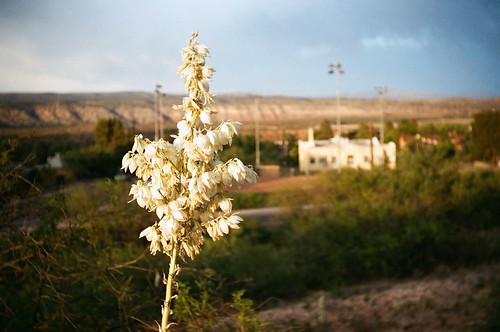
Further down 180, you meet up with the Gila River and a ridiculous number of towering yucca, saluting you from the hillsides like their California cousin, the Joshua Tree. Silver City arrives somewhat suddenly, a surprisingly big city in the otherwise lonely wilds of southwestern New Mexico. Born from a 19th century mining boom, Silver City is a perfect size town—large enough to offer some engaging culture and diversity but small enough to still be considered “charming”. It’s got the perfect blend of appealing features: bountiful art galleries, crazy mannequins and cool 20th century downtown architecture, all of it fringed with beautiful wilderness and just enough seediness to make it a “real” place.


Silver City’s Main Street is actually 65 feet below grade, sunken into a rocky wash now referred to as The Big Ditch. The town’s original dwellers foolishly chose this frequently flooded thoroughfare as their Main Street. The business owners kept rebuilding after each flood until the “big one” struck, in the summer of 1895. Now Main Street is better known as Big Ditch Park, where the lazy trickle of San Vincente Creek contentedly rolls over the rocks below.


From Silver City it’s a wild, winding drive on Highway 152 over the Mimbres Mountains, the Black Range and Emory Pass to arrive at our turnaround point on this random roadtrip, Truth or Consequences. The constant switchbacks and hairpin curves totaled less than 35 miles, but added 90 minutes to our drive time.


Dropping down into the valley below the pass, Kingston and Hillsboro are two historic mining communities, both part ghost town and part alive with Hillsboro being the more vigorous of the two.

By the time we pulled into Truth or Consequences, it was after dark and I was road weary from driving those relentless curves. We had reservations at a nifty lil’ restored motorcourt a few blocks from downtown. The owner of the motel was also a cranial-sacral specialist and she had an intense, hypnotic gaze I later found to be symptomatic of the city and similar to the New Age open-faced spiritualism conjured in Sedona. The people of Truth or Consequences are frequently involved in some sort of healing arts, no matter their day job, and their penetrating expressions seemed to be trying to bore right into my soul. Or, maybe they were alien visitors from another planet. Either way, fine with me. I’ve got nothing to hide.


Truth or Consequences (or “T or C” as called by the locals because the full name is such a mouthful), is a small city in Sierra County, built atop a deep reservoir of mineral hot springs that generate a flow of 2.5 million gallons per day. The Chiricahua Apaches deemed these hot springs sacred, calling them by the name “Place to Pray”. In the 1930s and 40s it was known as a health spa town, full of bathhouses and masseuses. The Rio Grande frames the edges of the town, gathering stream and steam from the hot springs as they join it upon exit from the assorted bathhouses.


The Hot Springs Historic District congregates close to the river. During its pre-World War II heyday there were more than 40 bathhouses in town, and a “21 Day Soak” regimen was touted to cure anything that ailed you.


Today a collection of ten active and open-for-business bathhouses dot the neighborhood. They range from expensive upscale to vintage downtrodden but all are piped with the same mineral-rich water ranging from 98-115º degrees Fahrenheit. The springs are not sulfury, so the volcanic smell familiar with hot springs in other regions is absent in these baths. Instead, 37 different minerals bubble up from the earth, including Lithium, a “natural mood balancer.” After a soak in these magical, slightly salty waters, we did feel younger, calmer, more limber. The public baths we visited were perched right at the edge of the Rio Grande. From our 104º soak, we watched the sun set over Turtleback Mountain in the distance and imagined the olden days, with early visitors camped in tents and slathered in mud to cure their rheumatism.


Advertised as the “City of Health” and “Health Capital of the Southwest” the name of this place was actually Hot Springs, New Mexico until 1950.  In 1949, Ralph Edwards of the radio (and later television) show “Truth or Consequences” announced a stunt to celebrate the show’s 10th anniversary. They wanted a town to volunteer to change its name, in exchange for publicity and exposure in connection with the very popular show. Many towns entered the contest, but Hot Springs was deemed the champ. The premise of the long-running (1940-1978) game show involved challenging contestants with impossible trivia questions. Failure to answer correctly before the buzzer rang meant the contestants must instead complete some wacky, humorous stunt. In addition to having a town in New Mexico take its name, Truth or Consequences was also notable for being the very first game show ever shown on television, in an early broadcast in 1941 when the medium was in its infancy. 


Another surprising way Truth or Consequences is first on the cutting edge: Commercial space travel. Spaceport America is a “gateway to space” and "the world's first purpose-built commercial spaceport". Located 20 miles east of T or C in the Jornada Del Muerto desert basin, the Spaceport is now open and operational. Construction began in 2006 though the concept dates back to the early 1990s.  Several tenants call it home, but its keystone is certainly Sir Richard Branson’s Virgin Galactic, the first commercial spaceline. Virgin Galactic has already succeeded at launching 20 space missions from this location, suborbital test expeditions to the outer reaches of the earth’s atmosphere, 60 miles sky high from sea level.

T or C is a weird town, but in a fun way. The people, with their warm sincerity and crazy soul-searching stares certainly make an impression. Just like Arizona, there is a great blend of cultures: Native American, Mexican, crusty old cowpokes, musicians, artists, hippies and transplants new and old.


The downtown shopping district is a cool scene of classic kitsch and dusty old western style. T or C’s main grocery store, Bullocks, probably hasn’t changed much since the 1980s and reminded me of the neighborhood grocery store of my childhood with its rubber entry mats prompting the entry and exit doors to open separately, its low ceilings and cluttered aisles. I knocked over an entire display of Pepto Bismal and no one batted an eye.

 New Mexico: Not Really New. Not Really Mexico”- t-shirt spotted in downtown T or C.


New Mexican towns never have as many trees as Arizona towns. I always feel a bit windswept and sun-parched in New Mexico. Though New Mexico is very much like Arizona, geologically and historically, I was vexed to discover there are people in The Land of Enchantment who do not consider themselves fans of their neighbor to the west. We have traveled to New Mexico often in the past year and a general, jovial camaraderie from fellow western folk is something we have savored. On this most recent visit I was stunned by a conversation with a particularly strident employee of a bathhouse.

“I am enjoying Truth or Consequences,” I said with a smile, all positivity and light, trying my hand at hypnotic expressions, “I’m a fan of towns of the west and this one is surprisingly artsy and very interesting.” Despite my warm fuzzies, she was instantly dismissive, frowning, saying T or C “lacks culture”, and then hit me with this sucker punch from behind her work desk:

“I’d NEVER go to Arizona.”
Because of our horrible governor and her politics. And how our horrible governor was influencing the behavior of their slightly less horrible governor. I felt all the air escape from my lungs. I don’t think she realized how insulting she was being. I’m no fan of Jan Brewer so to paint the entire state and all of its residents with the same brush you’d use on the governor seemed absurd to me. How could she not see the irony of her prejudice? Besides that, she really harshed my mellow after a nice mineral soak. I kept going on and on about it as we headed back to the motel, to the point Chad finally said, “I wish you’d NEVER even TALKED to that woman.”


On the ride back we continued in a loop, following a southern route, interstate quick, along I-10 back to Arizona. Hatch, New Mexico is well known as the Chile Capital of America, but did you know it’s also the Capital of Colossal Fiberglass Figures?


Along the interstate,  famous billboards tout the rapid approach of something called “The Thing”. “The THING! WHAT IS IT?”  Building to a crescendo with every passing mile, these roadside teases did their trick on me, “Oh, we’re stopping. At THE! THING! We must find out, WHAT! IS! IT?!”


The Thing is located near Willcox, right off the interstate. It’s a gas station, a fast food pit stop, a gift store. And it’s also a crazy, amazing, creepy collection of the American bizarre! For only $1.00 entry fee (75 cents for kids) you can stroll through three big steel sheds stocked full of insane artwork, machines and autos, questionable artifacts, dusty mannequins, rain damaged furniture and unintentionally humorous displays.  My favorite? A 19th century telephone in a glass case, sitting next to a 1950s rotary phone. The words above the two phones, “Ma Bell, My How Far You’ve Come!” (Ma Bell, you have no idea!)  As for “The Thing”? What was it? Well, I can’t say. Maybe a mummy, maybe a dummy. Chad thought it was an alien. I took no photos while strolling the collections at The Thing, because I believe every American should pay a visit and see for yourself. It’s only $1.00.

 
Traveling the west is always fun. There’s always such a crazy mix of wild and tame, modern and ancient, futuristic and historic, weird and wonderful. As great fans of sun-baked patinas, vintage neon, silly roadside attractions, dramatic landscapes and wide open roads, we will certainly celebrate more western wanderings on the horizon.

Ellen Jo Roberts lives in Clarkdale AZ with Chad, Floyd, Ivan, Ned and Hazel. Read all about it at ellenjo.com


.

Thursday, October 22, 2009

The Future of the Verde Valley May Be the Future of the World


The Future of the Verde Valley May Be the Future of the World
Clarkdale’s Plan for Sustainability
The Outs- November 2009
Ellen Jo Roberts


A completely new concept for the way a town can function is being planned in our very own backyard. It’s such an amazing idea that it could change the state, the country, and eventually shift the entire world. Right here in Arizona’s Verde Valley, a “Sustainability Park” has been mapped, drafted, and is on its way to reality. The park is scheduled to include numerous ecologically beneficial projects, and production of sustainable energies, as well as 75 acres of birding, nature and picnic areas, and a performing arts venue. It’s all happening in Clarkdale, Arizona, USA-- the first “master planned community” in the United States, a company town created by Senator William Clark for the United Verde Copper Company in 1912, the same year Arizona became a state.

“The [Sustainability] Park will become the economic and social engine of the Town of Clarkdale. It will provide enough electrical power to supply the entire town and then some.”
-A Plan For The Future of Our Town, c. October 1st 2009


Clarkdale sits in a picturesque location, between the foothills of Jerome, and the Verde River. Chock full of handsome vintage homes and historic boulevards, the town was ahead of the times from its very beginning. Unlike the haphazard arrangement of its neighbor, Jerome, Clarkdale was well-planned with uncommon-for-the-time amenities, like spacious streets, modern sewer system, street lights, ample parking, public parks, and plentiful activities for the residents of the town. All buildings and homes were built and owned by the United Verde Copper Company (later taken over by Phelps Dodge). The town went bust when the mines closed in Jerome in 1953, shutting down the Clarkdale smelter. With no company to run the company town, Clarkdale fell into chaos-- until a band of citizens petitioned for incorporation. Clarkdale was emancipated from Phelps Dodge in 1957, and became incorporated as a free and independent town. Renowned for its varied vintage architecture, 4th of July and Halloween festivities, summer concert series in the park, and “Made in Clarkdale” art show, Clarkdale is home to Yavapai College, Salt River Materials Group, Verde Canyon Railroad, Tuzigoot National Monument, and the Yavapai Apache Tribe.


The Clarkdale Sustainability Park is the brainchild of the town’s current mayor, Doug Von Gausig. First elected in 2004, Arizona born Von Gausig, is an avid enthusiast of environmental conservation, preservation of wildlife, and sustainable energy for future generations.
He graduated from ASU in 1970 with a degree in biology, followed by 6 years in the Air Force, before settling in the Verde Valley. He has lived in Clarkdale since 1981.

“There are several interrelated goals, that's the beauty of this project. The Town of Clarkdale has been looking for a stable, sustainable source of revenue and economic development since it was founded”, says Mayor Doug Von Gausig. The draft plan for the sustainability park includes an Algal Fuel facility, for growing algae to be converted to biofuel, a biodiesel plant (in cooperation with Jerome, Arizona’s Verde Biofuel), a 100 acre field of photovoltaic cells for solar energy, a recycling center, a potable water treatment facility, and the heart of the plan, a Plasma Converter. For those unfamiliar, a Plasma Converter or “Plasma Gasifier” is a very clean and cutting edge method for disposal of waste, and conversion of waste products into heat and energy.

“It utilizes a very high plasma temperature stream, (similar to the plasma torches commonly used to cut metals) to literally vaporize almost any material that is introduced to it” A Plan For The Future of Our Town, c. October 1st 2009

“I'm particularly excited about the plasma converter”, says Mayor Von Gausig, “This process takes trash, hazardous waste, industrial waste, wastewater sludge - you name it - and converts it to safe, environmentally friendly energy. It literally converts environmental liabilities like landfills, hazardous waste, medical waste, etc. to a beneficial product - and at the same time helps solve our energy supply needs with renewable electricity. It can also supply ‘waste heat’ to other facilities in the park. This might be used to help purify our wastewater to safe drinking water standards. That alone could save the region millions of dollars annually by averting the need to acquire expensive new water resources!”

“The emerging field of algal and photobioreactor fuel holds great promise as a way to wean us from fossil fuels by creating biodiesel from algae. Typically the algae are grown in highly efficient, closed systems (systems not open to the environment). Algae grown in the facility will produce oils that can be converted easily to fuel oil. Typical yields are around 5,000-15,000 gallons of fuel per acre….
The park would have ample space for a Biodiesel production facility. Biodiesel is normally made from used cooking oil and other waste vegetable oils. This facility could be a perfect adjunct to the algal/photobioreactor fuel operation, converting not only waste cooking oil, but also the oils produced in those facilities.”
- A Plan For The Future of Our Town, c. October 1st 2009

Verde Biofuel CEO Tim McLellan said his company is “very excited to be part of such a dynamic, cutting edge project like the Clarkdale Sustainability Park.” McLellan’s company, based in Jerome, manufactures biofuel trailers containing all the necessary components for laymen to brew their own biofuel from recycled cooking oils. “Sustainability is not only the most intelligent approach to preserving our future, it is the only viable approach there is”, continues Mr. McLellan. “The Clarkdale Sustainability Park is an ideal model for several reasons. Clarkdale is a very small community with a forward thinking, progressive attitude that will serve as a very good example for other cities - large and small. With enough usable land, a sewer system already in place and great support from an enthusiastic community, there is no doubt the Clarkdale Sustainability Park will be a successful project”.

Jason Rogers, Verde Biofuel sales and marketing, adds, “It's great to witness this eco-social paradigm shift taking place not only globally, but locally as well. It's only a matter of time before all communities will come to their senses and do something."


According to Mayor Von Gausig, Clarkdale’s unique geographical position at the “top of the Verde Valley’ has always made retail growth a struggle. Clarkdale is not at major crossroads or “on the way” to any place else. The only reason folks come to Clarkdale is if they meant to. So, generating economy from retail businesses is difficult. Main Street is the quiet home to historic gas station, and a handful of bars, offices, and restaurants, with “downtown” anchored by the massive carcass of a former grocery store, now used for storage space, and up for sale for most
of the past 2 decades.


“We have never considered growth in housing a sustainable economy, so we are always looking for alternative sources of revenue so that we can give our citizens the services they deserve”, said the mayor, “This park will be a major source of revenues for the town in a number of ways, and will improve our future economic development with a clean, robust and durable industry. It will bring eco-tourists, governmental students, and business seminars here to see how it's done.

“Second, I think we can all agree that climate change is the biggest long-term threat that our country and the world faces. Whether one believes that warming is human-caused or not, we know that cannot afford to add any more carbon to the atmosphere. We are also facing depletion of fossil fuels and we all know that reliance on oil from foreign sources is contrary to our national interests. The Clarkdale Sustainability Park will produce clean, zero-carbon electricity and fuel, but with a difference. This park transfers the responsibility for reducing our carbon footprint from the individual, where it is now, to the community. I like to say that the Clarkdale Sustainability Park will have the same impact on the environment as if every citizen of Clarkdale changed to LED lighting, had solar panels on their roofs, and we all drove hybrid vehicles. While asking everyone to insulate better and turn off lights is great, it's not getting the job done. We need to take this problem on as communities, no longer as individuals.”

“Third, there is a tremendous need for ‘incubator’ facilities, like the Clarkdale Sustainability Park. In these parks, several different alternative energy installations will be integrated and synergistic. The park will be a place where seemingly unconnected energy producers, like algae and solar power, can come together to help each other solve the energy problems we are facing. The solution will necessarily lie in a diverse portfolio of energy generators - no one technology has all the answers. In the Clarkdale Sustainability Park they will all learn and improvise new ways to work together more efficiently. It will be a very organic operation that will solve problems and create new opportunities by working cooperatively and adaptively.
In addition to these goals, there is Peck's Lake.”


The proposed location for the park is land surrounding Peck’s Lake, a river-fed oxbow lake in Clarkdale. The lake, part of one of Arizona’s very first “Important Birding Areas” as designated by the Audubon Society, was a favorite recreation area enjoyed by Clarkdale residents for 90 years. Once home to a dance pavilion, 9 hole golf course, 4th of July fireworks, baseball games and boat races, the property has survived several ill-planned, ill-fated attempts at housing developments. Currently owned by Phelps Dodge successors, Freeport McMoRan Cooper and Gold, Peck’s Lake has been closed to the public since January 2004, when the town’s $1.00 per year lease expired and was not renewed. The area has reverted to wild, and the day use/picnic areas have fallen into a state of neglect-- the ramadas taken over by nature, and waist-high weeds, the lake choking with non-native species of plants. The lake’s clogged condition has contributed to the decline of bird population in the area.


“The lake was originally built as a source of process water for the smelter and as a recreational facility for the people of Clarkdale …Until 2003 the lake and surrounding property were leased to the Town of Clarkdale and continuously used for recreation, nature watching, fishing, etc. In 2003 the Town’s lease expired and was not renewed, and in December of that year, Phelps Dodge closed the property to the public and it has remained closed since then.
The lake has continued to degrade over the years to the point that diversity of waterfowl and other birds is now less than half of what it was only 10 years ago…
Peck’s Lake is in the process of eutrophication, which is a biological and chemical process that inevitably produces a wet meadow instead of a lake. In order to stop and reverse this eutrophication, the lake would need to be dredged and otherwise deepened, and the noxious weeds removed”
- A Plan For The Future of Our Town, c. October 1st 2009


Peck’s Lake, off limits to the public for 6 years now, has never been far from the mind of Mayor Von Gausig. Several plans have been envisioned for Peck’s Lake over the years, including a “Friends of Peck’s Lake” organization to clean up, monitor and maintain the trails and day use areas.

“If we can acquire the land surrounding Peck's Lake for the park,” says Mayor Von Gausig, “we will be able to rehabilitate the lake and the natural areas surrounding it to one of the premier wildlife habitats in the state. The facilities in the park, like the plasma converter, will all work together to clean up the environment in and around the lake, and will be a tangible demonstration that we can have a vital industrial installation immediately adjacent to a nature preserve with benefits to both.”

The ideal location of Peck’s Lake allows easy nearby access and connecting trails to area highlights such as Tuzigoot National Monument, Dead Horse Ranch State Park, and Tavasci Marsh. The plan includes abundant public space for day use, including an interpretive nature center and hiking trails, pavilions for community functions and performing arts. It also allows space for retail commercial development.

Though local support has been overwhelmingly positive (and unanimous in Clarkdale Town Council), the plan is not without its challenges.
“There will be lots of and lots of challenges, but in the model we are considering - the organic model - we'll see each of the challenges as opportunities to create a new paradigm”, says Mayor Von Gausig, “The entire project is like an organism. It will be faced with new situations every day, and will have to evolve, adapt and meet them in creative ways. Financing, land acquisition, regulatory adjustments, legislative and legal hurdles, coordination of disparate park tenants, and creative management will all be challenges. We will need to stay focused on the prize, though, and as a community we will come together to solve each of them as they arise. The idea is to nurture this organism and allow it to flourish in ways we can't even imagine today.”

“If the Clarkdale Sustainability Park becomes a reality, in what way will it change the Verde Valley? The state? The world?” I ask.
Mayor Von Gausig replies, “The Clarkdale Sustainability Park will become a reality. As it evolves and grows and learns, it will teach other municipalities all over the world. It will become a model of how we can live on this planet without harming our children's and grandchildren's ability to live a good life here, too - the very definition of ‘sustainability’. The initial plan calls for an interpretive center and learning facility that will coordinate seminars and disseminate the knowledge and experience we will generate. I envision communities from all over the globe coming here to see how we do it and how their communities might do something similar. The impact on the Verde Valley, the State of Arizona, the nation and the world is incalculable. This project will truly change how we fund our towns, where we get our energy, and how we relate to our environment. It will be ‘evolutionary and revolutionary’."

For more information:
http://www.clarkdale.az.gov/
a copy of the draft for Clarkdale Sustainability Park:
www.clarkdale.az.gov/sustainability_park/clarkdale_sustainability_park_white_paper.pdf
http://www.verdebiotrailers.com/
www.audubon.org/bird/IBA
Algal Fuel information: http://www.oilgae.com/
National Renewable Energy Laboratory: http://www.nrel.gov/

Doug Von Gausig’s Natural Sounds and Photos at:
http://naturesongs.com/
and http://www.criticaleyephoto.com/


Ellen Jo Roberts has lived in Clarkdale since 2001. She voted for Doug Von Gausig. She shares a historic brick bungalow (built in 1914 by the United Verde Copper Company) with Bike Daddy Chad, a cat named Clyde, a Chihuahua named Floyd, and a Boston Terrier named Ivan. Read all about it at www.ellenjo.com

Friday, August 21, 2009

Small Life- The Outs, May 2009- The Outs, The Noise

Small Life

May 2009 Outs
The Noise
Ellen Jo Roberts


I live a small life in a small town. This is not to say I don’t have big ideas, larger than life friends, and huge adventures. It also doesn’t mean I’m small-minded, uptight, or xenophobic. I just live in a small place. Very small. So small that it is sometimes absent from abbreviated maps. And my life is just as small, because I both live and work here, in Clarkdale, a historic “company town” that never outgrew its waistband much. Surrounded by wilderness, and framed by vintage boulevards, I seldom have reason to leave.I savor the tiniest aspects of this small life. The random new wildflowers that appear in my yard. Lizards sunning themselves on the hot bricks of our house. A posse of javelina on my favorite running trail. Familiar faces and autos, folks waving and smiling as I walk my dogs up Main Street. The way the night air is scented with soap and static cling as I stroll past the laundromat, reminding me of a Mexican motel I stayed at once. The postmaster knows me by name, and remarks on the packages and letters I receive.


It’s remarkable to me how small and specific my life has become, because I grew up in the biggest of places, a sprawling megopolis full of every technology, nationality, religion, commerce, and possibility. Any band you wanted to see, any fashion you wanted to buy, any type of food or beverage imaginable. World class art and science museums, prestigious schools, and an amazing network of public transportation and city services. It’s funny that I have almost none of that at my fingertips now, in my very small life. I grew up in the city of Chicago, a major urban area along the southwestern coast of Lake Michigan, named after the wild garlic that used to thrive along its marshy shores. I was a city kid, taking buses and trains, and hanging around downtown. My public high school had 4,000 kids (more than the population of the town where I now live). I lived there until my early 20s, prior to getting the itch for sunshine, big skies and wide open west.


Remember that ol’ Tex Avery cartoon, about the country wolf and the city wolf? They were cousins, those wolves, and they went to visit each other in each respective location. The country wolf was a total freak in the city, just completely overwhelmed by all the urban activity, while his city cousin was as cool as a cucumber. That is, until the city cousin got out to the country to visit and went completely bonkers himself, overwhelmed by the natural rural beauty (and a sexy rural she-wolf). I asked big city folk what they liked about the country, and asked small town folk what they missed about the big city. And vice versa. I got some very thoughtful and thought-provoking responses.Natasha Shealy, a much-beloved voice here at the Noise, moved from a rural western town--Cornville, Arizona -- to a rural eastern town, Marshall, North Carolina. She’s also lived an urban lifestyle in cities like Tucson, Los Angeles and San Francisco. Shealy takes her sultry big city swagger with her wherever she goes, captivating small communities with her energy. “I miss the exotic foods of the big city, the frenetic energy, the intellectual current”, she says, “In the city you can buy stainless steel trash-cans after 5pm. In the city men wear really tight pants.” (Shealy has this theory she is continually hashing out, about men in loose pants vs. men in tight pants, and what it means from a sociological standpoint. I’m not sure if we’ll ever fully find the answer.) “To quote a friend, I am a ‘small town-junkie’ and have lived in my share of charming one street towns ‘til I returned home to Marshall, North Carolina, which is hands-down tops for small towns across America. Old Town Cottonwood gets my vote for second coolest small town, for its proximity to the river, the naughty charm of Kactus Kate's, and the irreverent peacocks who have inspired many a late night poem”.


My brother Jim, a true city slicker who prides himself on never having lived more than 10 or 11 miles from Wrigley Field, thinks that I know everybody in the Verde Valley, and that folks here are, in general remarkably friendly to strangers. “The stars in the sky stand out a lot more in a remote small town, but I’ll gladly forego a few stars for access to an occasional 3:00am taco.” Accessibility to goods and services is definitely a common concern with city folk. They're accustomed to being able to get whatever they want whenever they want it, and are unsure how they'd deal with someplace where the sidewalks roll up at sunset.


Jeremy McReady was in my 3rd grade class. I'll always remember him as a freckle-faced trouble-maker with a twinkle in his eye. He now lives only about 6 miles from his childhood home. “I was born and raised in Chicago, but we used to take weekend trips to a small Michigan town," he said. "Some of my fondest memories are the ones of isolation and nature. The walks in the woods, the fishing, catching frogs, bonfires with family and friends. I always remember a feeling of dread when we would pack up, look for the cat, Winifred, and start the 3 hour trek back. When you drive back the radio stations change and the music seems more aggressive."


Clarkdale resident, Doreen Gribauskas has an urban tale to share. "When I moved to New York City, I had culture shock for 3 months. The city life is so extremely wonderful and terrible all at once. You can see Monet's water lilies one moment and a Vietnam vet with no legs asking for pennies on the subway the next. I used to work down on 14th street making costume jewelry. It was right next to a meat packing plant. There'd be sides of beef hanging on hooks right on the sidewalk, butchers covered in blood, dumpsters full of bones. After work sometimes we'd get a 40oz and sit in the park nearby and watch the transvestites get ready for the night. Full-on meat market, human and bovine. Nice place to visit but I wouldn't want to live there!"


Elaine Bell-Quinn is a Chicago girl, though, when it comes to big cities she prefers NYC for being just a tad more cosmopolitan. "Living in Chicago, I miss New York City. New York City was great for having my laundry picked up, laundered and delivered, undies folded and back to me in the same day,” she laughs, “Amazing sushi delivery, and hearing many different languages on the block. The awesome, fully-stocked corner deli. The neighborhood feel of the city is so different. When I've lived in smaller communities, well, let's say I stuck out like a sore thumb."


Erik Kuska, a Los Angeles animator, artist and puppet master, grew up in Moscow, Idaho, a small town with gravel roads, county fairs, and a 4-H Club. “It was the slowest place on earth to me, but now that I’m racing away in my late 30's, I miss it,” says Kuska. “Small towns to me were people waving as they walked by. A nod on the sidewalk, or a greeting on the trail. Pleasantries. People stopping when you were in the ditch or helping when your horses got out of the pasture. Front door is unlocked, windows left open… But an early trip to California had me yearning for bigger things.” Kuska moved to the Chicago suburbs, then later Los Angeles, and later, overseas to London, England for a time. “Your speedometer picks up as suddenly you’re driving faster, and hoofing it on busy sidewalks to catch trains and make meetings. It’s almost like people become obstacles rather than conversations. You’re dodging rather than greeting, and that’s that. I think all your senses get assaulted with the constant white noise of the city and cars and construction… Emotionally you have a lot more to compare yourself with. The fancy car on the right, the guy’s ipod in the elevator, the houses, the restaurants, the wines… Cities also get you to buy into some ridiculous concepts like $12 beers at Laker games, and $20 valet parking. As a farm kid, paying to have some guy park your car is the silliest thing, right next to bottled water for $3 or a cup of coffee for $4. But soon that’s what you’re doing. Your life becomes linked to your car, and drive-thrus, and traffic.


“Cities were fantastic as they always provided some event, or museum or destination to get excited about...Growing up in a small town taught me to enjoy being with myself, and being around the cities and masses exposes me to multitudes of ideas and concepts. And I find strength in both of those.” Kuska makes another fine point on small town life. Everyone knows your private business in a small town. “My mother, who grew up in McHenry Illlinois, well, she disliked the small town for the main reason that everyone knew everything. The gossip between house-moms, and just being under the microscope of a place where everyone knows each other. Yes, that help is there when you need it. But that pressure is there if you have unique thoughts and the community does not share them. Go to a big city and your neighbors don’t really know you so you can disappear from all that. And even I can admit I’ve had some nights out, where I wanted to disappear and had the pleasure of knowing none of these people knew me or my parents, and I was gonna cut loose!”

In a place like Jerome Arizona, I imagine most people in town have seen each other naked, helped each other through the best of and worst of times, and shared gossip about their neighbors as regularly as breathing oxygen.


Laura Jones of Clarkdale, commonly spotted in the vicinity of Miller’s Market on Main Street, is a native of Long Island, NY, "In my small town, I love picking up my mail at the post office and running into neighbors and chatting. I love attending town meetings where you can actually voice your opinion and think that someone might actually be listening. I love sitting on my front porch and having neighbors just stop by for a chat or beer. In the city, I love reading a great book while riding the subway. I love not driving a car every day."


One small town concern I’ve heard expressed from many of my singleton chums, is echoed by city girl Dianne Tennison of Chicago, “After having stayed in Arkansas for a few weeks during my divorce, and after having seen what my dad got stuck married to where he lived... the dating pool sucks for us singles in small towns."


Mark Dolce is a photographer in Cody, Wyoming. “We, as humans, not necessarily man or woman, cannot live without altering our environment. To what extent is shown in the result of towns, villages, cities, campsites, roads, urban sprawls, golf courses ... a Circle K stuck out in the middle of nowhere or a farm or a field of corn or cotton,” says Dolce,“I prefer small towns - especially since 9-11 when every large environment with tall buildings and highly concentrated areas of people became potential targets. They always were but since 9-11 it became a reality. I do not like to see the air I breathe, I prefer wide open spaces, the landscape is pregnant with meaning ... even the cement jungle and asphalt playground we create in cities each has their own energy to offer.” Katrina Djberof is native to the Pacific Northwest, but she’s lived all over the Americas, both North and South, in cities big and small. “Life in the city that I love,” Djerbof begins, “…the diversity of city culture, food, music, independent media and film, community-owned radio. Individual fashion, dumpster-diving, community activism, reclaiming public space. Riding bikes all over, public transportation, avid recycling, community gardens. Lots of people, the small districts in contrast to the downtown bustle. The geography of Seattle, the walkability of San Francisco, the greenness of Portland, the absolute hectic-ness of Lima & Quito, and the architecture in Buenos Aires - lots of socializing,” flipping the coin, she continues, “Small town living that I love: conservation/preservation activism. A broad spectrum of ages in almost every enclave of activity. Knowing your neighbors, people pulling together to help one another out. The lack of traffic, beautiful sunrises & sunsets, little to no light pollution, spending more time at home and in the garden nesting."


Tina Raymond, grew up urban on the east coast, and now lives in Clarkdale. She rhapsodized over Jerome’s “Mountain Stranded Time” mentality, where time just moves more slowly, where people get sweetly stranded unawares. Raymond waxed poetic about its “2 lane highways, ‘get there when we get there’, walking main street at 2:00am of a misty morning, alone, window shopping.” Mountain Stranded Time hypnotizes us. The pace pacifies us. People just end up here, en route to somewhere else, they just end up staying. Driving to Sedona for a mundane errand I always think, “This is someone’s dream vacation.” The thrill never gets old for me. Maybe because I’m from another place, and I will never lose the romantic notions that drew us here. Sedona realtor extraordinaire, Jolynn Greenfield, offered some interesting opinions on this topic, as she deals with city folk all the time, seeking their own bit of wilderness and big sky. “Recently I sold a home in a [Sedona] neighborhood to a client who also has a penthouse in Minneapolis. She shared that they love the quiet, for a little while -- thus the Sedona purchase-- but they really love the shows, the food, the proximity to the action that they enjoy from their penthouse in ‘the city’.”


My cousin Johnny is a Chicago policeman, though he recently lived in Wyoming for a year or so and it put a spell on him. He's always debating heading back, despite the lower wages, "I gotta say that I liked small town living. It has its drawbacks, like no real place to eat, the shops are limited, the restaurants close early, etc. But life is slower. There is less tension. Maybe it’s where I lived as opposed to small towns in general. The mountains for me, and Jackson specifically, is the place to be. It offers the things that Chicago cannot. I missed my family, friends, home, all of that. But I liked the pace, the feel, the people, the fact that you can leave every door open to everything you own and no one will come in."

Michelle Hayman of Clarkdale sums it up with, “I have lived in the city, and it has its pluses, but I like where I am.” My small life is fully portable to every location. I have a different way of seeing since I’ve lived in the boonies so long. Spotting details I probably used to miss in the hustle and bustle of big city life. On a recent summer visit to Chicago I pointed out a large electric-green katydid in the shrubs near my brother’s condo. I plucked it up into my hand. He was duly impressed saying he’d not seen a katydid “in years”. As I set it back down on a leaf I thought, “I’m sure it’s always out here. He just didn’t see it.”

Artist and photographer Mark Foltz lives in Rimrock, a quiet community on the fringes of Camp Verde, AZ. “If you think of the total of your sense perceptions as a bubble that surrounds you, small towns allow that to expand. Your awareness increases,” says Foltz, “In the city, we have our defenses up to some extent, 24/7. That bubble of perception that surrounds us becomes smaller and harder; natural self defense, and less overall awareness. I like it here way better. I'm less stressed and more aware than I ever was in Akron or L.A.”


Big cities, despite their often times overwhelming metropolitan areas, are generally a collection of neighborhoods, knitted together, each with their own version of small life, with each neighborhood full of folks who seldom need to exit its bordering intersections. Each neighborhood has its own cast of characters, and favorite haunts. In certain regards, I am forever a city girl, since I need that structure of a community. I don’t know if I’d thrive living in a remote cabin in the forest, no neighbors, no library, no parades, nor pals. When I was finishing college and told an art professor my plan to move to Arizona he scoffed at me a bit. "You’ll be a big fish in a small pond there,” he said. I think he was sometimes right and sometimes wrong. I do miss some aspects of big city life, and have wondered where I’d be now had I remained there. But I also know this fact: fish will grow as big as the space allows them to. Maybe we’re all big fish with lots of room to brew up our big, huge, brilliant ideas.


Ellen Jo Roberts has lived in Chicago, and DeKalb, Illinois, and Flagstaff, Jerome and Clarkdale, Arizona. If you see her walking her famous dogs be sure to holler and wave as you drive past. Visit http://www.ellenjo.com/ for abundant silliness and good-natured amusements.

Tuesday, July 21, 2009

Hobos and Weirdos I Have Known and Loved

Eventually I'd like to stockpile all of my old favorite articles from the Noise, in one easy-to-read location-- maybe here.
This one, a favorite of mine, was published in May 2008. My recent visit to Flagstaff inspired me to revisit it....


Hobos and Weirdos I Have Known and Loved
May 2008 "The Noise"- The Outs
By Ellen Jo Roberts

Flagstaff is a railroad town with a long history of hobos arriving via boxcar. Despite downtown's current boutiquey chic, it wouldn't take much to scrape away the glossy veneer, revealing a seedy underbelly populated by vagabonds. Summer breezes bring an abundance of weirdos, rolling in with their knapsacks, all enjoying the mild climate of outdoor living and the plentiful public land. I have known my share of hobos and I have adored them all. Their certain je ne sais quois adds invaluably to the flavor of any town.


First of all, I'd like to clarify what I mean by hobos. I do not include trust fund hippies ("trustafarians"), all traveling in artfully disheveled colonies, resting under downtown shrubs with at least 1 vaguely feral looking dingo mutt. They are hobo-wannabees, easily outted by their good teeth, expensive faux bohemian sandals, and a fanciful romantic notion of what it means to be a tramp. My ol' pal Brian called them "hippycrites". Hippycrites were a pet gripe of ol' Bri. Hypocritical hippies that complained about the government yet "used federal highways and got food stamps".

When I speak of hobos I mean the true busted, broken down, woolly weirdos who are living on the fringes of reality and the thinnest margins of society. They may have at one point had normal lives, jobs, families, in some land far away-- but in their current incarnation they have become "that weirdo". Often times with a geographic designation---"that weirdo who hangs out on Leroux" or some other modifier-- "that weirdo in the white jumpsuit on the bike", "that midget weirdo who pushed the baby stroller", etc. Even people who do not know their names have created a name for them and recognize them from the details.


I grew up in a big city and took public transportation so I am well conditioned to the presence of vagrants and vagabonds. My father, a Chicago policeman, called them "bust -outs". Just a catch-all term for folks living outside of regular society. Maybe homeless, maybe not. Maybe crazy, maybe not. Maybe broke, maybe sitting on a big bank account that nobody ever seemed to discover until long after their death. There were many weirdos in every neighborhood, weirdo mascots specific to a certain street or park, and while not all of them were harmless, the majority were as more frightened of us than we were of them. Each had their own eccentricity, a funny walk, a bad hairstyle, pants pulled up too high or hanging too low. Most shared the common characteristic of muttering to themselves.


Flagstaff attracts a wealth of weirdos. The rails and major interstates all converge on the picturesque mountain town. It is easy to blend in with the eccentric mix of natives, foreign tourists, and college students. It's a place where everyone is passing through, for a day, a week, or a few years. There were many favorite weirdos and freaks in Flagstaff. Remember that mystical fellow with the cape and the staff, fancying himself a wizard of some kind? What was his deal? How about that guy who rolled his VW Bus, then had it towed to a parking lot where he continued to use it as habitation for himself and several cats. There was that old fellow from Virginia who smoked a pipe and occasionally donned his army dress suit, complete with a chest full of medallions. I still think of that lil' guy called Herman, the small slumped wanderer of downtown, in his sweaty trench coat and slicked back hair. I never heard him say a word, but I once saw him smile. When Herman died many folks truly lamented his passing.

A visit to the Flagstaff library always was a certain opportunity to catch a bustout snoozing in a comfy overstuffed chair. Many of these random characters had been 86'ed from most of the bars in town, and several of them had a tendency to piss their pants. At one time, in the not too distant past, rivers of piss polluted downtown Flagstaff. "Dolores the Dwarf" was one of the famously incontinent. She was, as her moniker implies, a dwarf. She was elderly, with a mop top of shaggy white hair, and could often times be seen awakening from her favorite sleeping spot, in a doorway on Aspen Street. She would push a baby-stroller full of all of her meager belongings, swearing at cars and pedestrians, calling everyone foul names, muttering "hippies, punks, communists, polacks!" under her breath as she struggled with her stroller.
"I wonder of she has a family somewhere?" I mused, one day.
"They probably dumped her off here, like a stray dog." I was sworn at by Dolores, and it brightened my day every time. Every encounter with a weirdo enriches my life and adds another tale for the archives. Their outlooks are so vastly different they may as well be from a different planet, or a time traveler from a different millennium.


Grubbs was a favorite character in my Flagstaff story. Sometimes called "Chuck", or "Shiloh", but mostly just called Grubbs. A religion could be built on his teachings, and in fact, my friend Alice created one—she called it The Church of Grubbs. He lived in a motel on Route 66 and went to the Monte Vista Lounge every day to play the ponies at the off-track-betting. Legend has it he once got arrested for peeing off a roof. He was tall, robust and rumpled, with one pant leg tucked into his boot and one left untucked, a sure sign of craziness. There was something Bill Murray-esque about him, something endearing, crooked and oafish like Carl Spackler in Caddyshack. He talked in a blurred, deep, rolling mumble. Most of the time he talked about Eva Braun, Idi Amin, and the Playboy Bunny, a stream on non-sequiturs, though this was occasionally punctuated by sudden bout of clarity. Sometimes he bordered on the brilliant and profound.

He told me he had been a cop. I said, "Wow, that had to be a tough job!" He responded, suddenly articulate, "Nope, easiest job in the world. You put on that uniform and (*snapped fingers*) you get anything you want." Another time, out of the blue he said, "How many people do you think went to Harvard and don't remember it?"
One time he said, "You're my girl, right?" as he walked by and I went weak in the knees. I am Grubbs' girl! He thinks I am his girl!

Perhaps his most enduring comment was his common salutation: "How's yer politics?" I myself have used this to greet people for years. It is perfect.

Grubbs stole a waitress' tip from off the counter and left 3 cigarettes in its place. Some kind of fair trade in his mind. One time I saw him eating flowers out of a planter on Route 66. He was enchanting. Alice asked to take his photo. "For 'The Winner's Circle'? Sure," he said. I'm not sure what the Winner's Circle was, but he for sure was in it, in his mind anyway, wrapped in flowers standing next to his favorite horse. We were also winners, because his image was forever captured for posterity. In the shadowy photo he is sleepy-faced, slightly crooked, with tilted posture, his eyes half closed, and his mouth half open because he of course he hadn't stopped talking the whole time. I wonder what ever happened to Grubbs. Maybe he is still around, playing the ponies now at the Museum Club, eating flowers along the roadside and trading for cigarettes. Maybe he drifted on to greener pastures, or was finally collected back up by his family far away. Maybe he had escaped and they'd been looking for him for years. I wonder if he had any children or was ever married. Maybe he finally made it to the Winner's Circle.

Despite my mom's best teachings I have a habit of talking to strangers, the stranger the better. It is because I know they will always share some nugget of wisdom, even though it may be cloaked in crazy talk and gibberish. I also know that most of us are only a few degrees removed from being hobos ourselves. You never know what is down that next road, and where those rails might take you.

Ellen Jo Roberts lives in the old railroad town of Clarkdale Arizona. She shares a 94 year old house with a 35 year old husband, and several pets of random ages. They are surrounded by assorted 1970s vintage Volkswagens. Read all about it at www.ellenjo.com