Wednesday, July 16, 2014

Sweet Summer Dreams in the Verde Valley

This story was written for Arizona Office of Tourism's Arizona Insider "Guest Blogger" program. The post, which ran July 14th, 2014, was edited and chopped up a bit strangely, making my story a lil' clunky/klutzy in their version. I thought I'd share my original here:

Sweet Summer Dreams in the Verde Valley

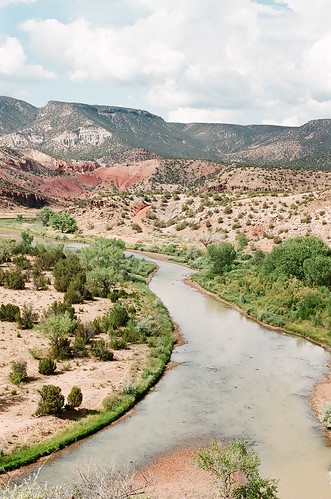
Verde River, Cottonwood, AZ
Brassy big band tunes waft over us from the landmark gazebo, packed full of percussion, strings and horns. Sinking deep into the dark edges of the park's soft summer lawn, we look up at the endless stars that echo the crowd of lawn chairs and blankets below. Cool breezes rolling down from Mingus Mountain add a faint hint of chill to the night air. Though, for a moment it feels we are part of a movie or some bucolic small town dream, in reality, it's the Town of Clarkdale's free Summer Concert Series and just one aspect of this season's magic in the Verde Valley. With live music scheduled on select Saturday evenings through September, it's not at all unusual to witness spontaneous acts of waltzing, two-stepping and foxtrotting in the historic town park.


Summer Concert Series, Clarkdale Park, Clarkdale AZ
The Verde Valley, named one of Lonely Planet's Top 10 US Travel destinations for 2013, is comprised of several historic, high desert communities, each springing forth from the 19th and 20th centuries to utilize some abundant natural resource or fill some urgent local need: mining, ranching, agriculture, military presence and bootlegging. Jerome, Clarkdale, Cottonwood, Sedona, Camp Verde and Cornville each have its own distinct personalities yet remain cohesive. The rivers connect us and flow through us, tangling us together as Oak Creek and Beaver Creek make its way toward the Verde. The region’s ideal climate has long made it an idyllic human habitat as evidenced by ancient dwellings throughout the area, including Montezuma Castle and Tuzigoot.


Verde River as seen from Verde Canyon Railroad, running red during summer monsoon season, 


A variety of attractions, adventures, art, wining and dining provides a wealth of intrigue for visitors. 


Cathedral Rock, Sedona, AZ

Scenic Sedona is the best known Verde Valley town, straddling the border of Yavapai and Coconino counties. Highlights include its expanse of national forest girdling the town, its many hiking and mountain biking trails, resorts, world class spas and cafes. This red sandstone wonderland is renowned for its spiritual energy, vortexes and new age sensibility. But Sedona is not just a postcard or a movie set. It's also a real place behind the scenes, where people live and work. It's where we go to the dentist and where we see movies!

Buddha Beach, Oak Creek, Sedona, AZ

Summer is our warmest season, and for this reason the most popular for riparian fun. We locals spend a good percentage of June, July and August along the shady river and creek banks, picnicking, paddling, splashing, floating or just totally submerged neck-deep in the cool water. The Verde Valley is enjoying some fresh renown as a river fun zone, with day-use access areas being improved from north of Clarkdale through Cottonwood, continuing past Camp Verde. Cottonwood’s Dead Horse Ranch State Park provides great trails, camping, fishing and river access. Verde River Adventure Center in Clarkdale rents kayaks, tubes and other inflatables, providing guide and shuttle service for easy day trips.

Verde River, Beasley Flats, Camp Verde, AZ

Another great way to enjoy the river canyon scenery and wildlife, without getting splashed, is to take a train ride aboard Clarkdale’s Verde Canyon Railroad. Running year-round on a varied schedule, this heritage railroad dates from 1912 and provides a comfortable climate-controlled way to catch a glimpse of the very rare ribbon where riparian and desert ecosystems meet. Starlight rides are a sensational seasonal specialty, heading out in late afternoon and returning through sunset and moonlight.


A flight at Caduceus Cellars, Jerome AZ

While in Clarkdale be sure to visit the newest additions to historic Main Street: The Copper Art Museum and Four-Eight Wineworks, book-ending the area’s mining past and wine future. The Verde Valley’s booming viticulture scene began in the 1990s in Cornville, a sleepy rural town near Oak Creek. Along the winding Page Springs Road, you’ll find the starting point for the region’s growing wine notoriety. Vineyards cascade down the sandy hillsides and wine-tasting rooms cluster like grapes. From here, the wine flows throughout the valley like the creeks that connect us.


Camp Verde, a river town with an adorable historic Main Street, is home to cowboys, horse ranches, pecan farms and Fort Verde State Park. If games of chance and glow-in-the-dark bowling suit your style, Cliff Castle Casino is an entertaining diversion run by the area’s Yavapai-Apache tribe. More daring yet: zip-lining over lions and tigers at Out of Africa Wildlife Park!


Old Town Cottonwood has enjoyed a renaissance over the past decade. Once best known as the bootlegging epicenter of the Southwest, by the 1990s this part of historic Main Street was a sleepy, going-to-seed, slow-down spot. Today, this vintage stretch of 89A is not just a place to tap your brakes. It's worth pulling over for serious exploration. Packed with pedestrians, wine-tasting rooms, antique shops and galleries, great restaurants and fun lodging, Old Town makes a great starting point for an area visit.


And there, mile high, twinkling and winking in the cool nighttime, Jerome watches over all from its lofty perch on Cleopatra Hill. This former ghost town is an exceptional place to enjoy a sunset glowing Sedona red in the distance. Ideal to explore by day or night, Jerome is home to great architecture, shops, museums, wonderful places to eat and historic, haunted hotels where you can rest your head. 


 The town’s popular ARTwalk takes place the first Saturday of every month; from 5:30pm-8:30pm galleries and studios stay open later than usual into the tranquil mountain evening, serving refreshments and conversation with real live local artists. We lived in Jerome for a number of years and enjoyed the tightly-knit community, a crazy mash-up of native long-time locals, hippies, artists and big city escapees. In the 1960s and '70s counterculture types arrived in Jerome and essentially saved the town's history and buildings with their gumption and elbow grease.

Jerome, AZ

With its milder, high desert temperatures, glorious landscapes and vibrant communities there are endless amusements in the Verde Valley, a variety to keep visitors delighted all summer long. As residents, we see a lifetime’s worth of beauty, adventure and cinematic moments everywhere we look.


Clarkdale Classic Station


Ellen Jo Roberts is an artist and shutterbug who lives in Clarkdale, Arizona, where she spends the workday as the group coordinator for Verde Canyon Railroad. Read more of her writing on: http://www.Ellenjo.com. Ellen Jo is a part of the Arizona Office of Tourism’s Guest Blogger Program.

It Just Doesn't Matter

"It just doesn't matter! It just doesn't matter!"
- Bill Murray, Meatballs c.1979

Mother's Day is sometimes hard to swallow. While I love all of the moms in my life, especially my own, and want to celebrate them, I also can't wait for the day to be done and the hoopla to fade away for another year.

There's something awkward about it for me, about people telling me I am a great mom to my pets and other such silliness. It's not my day, and I'd rather not be included in it. You don't need to try to include me in it! Please! I know my dogs are not the same as children (though they do fill a niche in my soul to nurture and care for something).

Though we've been married since age 23, Chad and I never had kids.
I never managed to get knocked-up, even by accident. It wasn't for lack of interest or effort.
It just wasn't in the cards for us.

In our younger years it was about money- Not enough of it.
Then we realized there would never be enough of it.
So we did go for it pretty seriously for a few years in our mid-to-late 30s, but perhaps waited too late.
Fertility is a tricky thing. A scant 48 hours every 28 days, losing potency as the years pass.

After a few years I got checked out, scrutinized by bloodwork and other horrifying, invasive tests only to discover there was not a thing wrong with me on the child-bearing front. Of course my uterus was awesome and my ovaries wealthy! Knowing this didn't make the situation any easier to swallow. Ultimately the idea of medical assistance or scientific intervention was where we drew the line. I felt like if we used artificial means to conjure up a child who did not want to be here we were just asking for trouble. The universe was in control, not us.  Like most heart-breaks I'm sure it will all make sense in the end when we're a bit further away and can see things more clearly, with more perspective.

In being a non-parent I sometimes feel like I missed out on some universal experience and some adventures I will never know. I'm not in the club!  But that's more about my own selfish needs-- not what some kid might be missing. There is no kid that needed to have me as his or her parent.  The world is plenty populous and the universe will be just fine without my DNA extending into a new generation. 

Often I think I've been gifted with a lot of talents, and am being greedy to imagine I could have more given to me. 

I've always had a natural ease around children, an open-faced honesty they respond to, and they gravitate to me. In my younger years always had a trail of kids following me around like the Pied Piper. For many summers I was a camp counselor and an art instructor and thought about becoming a teacher because I find so much fun and inspiration being with children. If you asked me as at age 12 how many kids I might have someday I was sure I'd have a whole baseball team of my own. However, I'm 42 now and each year that passes the idea of bearing a child grows more dim. Mother's Day sometimes makes me feel a little bit like a failure, but that failure feeling is growing dimmer as well. I've let go of the notion.

Here are some other things I don't like about being a Non-Mom...
  • People with kids stop inviting you to their events. They start to hang out with just other people who have kids. I am an outsider looking in. I don't know the secret handshake.
  • Not knowing how to hold a newborn properly. I always feel like a klutz.
  • Most holidays are no big deal. Because most of them are geared towards family and children.
  • People pitying me for not having children. Sometimes I see a sad look hidden behind their eyes, like how one might glance forlornly at a hobo. 
  • I didn't use every part of my body to its fullest capacity! I have organs I never used, and for this I feel bad.  I shouldn't feel this way though, because nobody does, not ever--Not unless they're an Olympic athlete who sings opera, a deep sea diver who writes novels, a mountain climber dabbling in sky diving, or something!) My boobs were never used for their primary intention! What a waste! 360 menstrual cycles, wasted. What was the point of all muss and fuss if none of it was even gonna be utilized?
  • I get angry with my husband somehow, just a random faraway anger, for his half in this failure.
  • If you have friends who are parents, everything else takes a back seat to the demands of raising their children- events they've been invited to but can't attend, friends, other family, their own creative dreams and ambitions.I know for a fact lots of folks use their kids as an excuse when they just don't want to do something. 
  • I have such happy memories of my own childhood, and to this day remain the biggest, happiest silliest kid who never grew up. For this (plus my remarkable patience), I know I'd have been a great parent.
    I see so much beauty in the world and ache to share it with everyone.
  • As much as we're told about all of the parentless children in the world needing a home, adoption seems complicated and expensive.
  • I get the feeling that people think childless couples are selfish yuppies. The term DINKS refers to "double-income-no-kids". But really, aren't I more selfish if I feel I must foist my genes onto an already crowded planet?
  • It must be difficult to raise children in the 21st century. I've seen family struggle with their tweens and young teens, facing issues we never had to deal with growing up in the 1970s and '80s. The internet, smart phones, cyber-bullying, sexting. With the information age, children are growing up online, with all of their exploits filling my newsfeed. Is this healthy for the child's future attitude to have spent its formative years so broadcast so constantly? We shall see how this affects them in adulthood. I like social media and the internet, but I also lived more than half my life without it, and I feel like for this reason I have more of a grasp of its reach than some kid who grew up on it. All of my teen angst is mercifully locked into notebooks stashed in a box in my closet.
  • When I am very old there may be no one to take care of me or check in on me. I might end up "that crazy old lady down the street".All of my precious artifacts will end up in a landfill and all of my photo albums will end up in some thrift store, maybe to be saved by some merciful hipster. Maybe I will be my generation's Vivian Maier...if I'm lucky.
  • The sense of superiority many parents sometimes get. It can be downright cruel to someone who never knew the joys of raising a child.
    Worst of all: When people say "Having children was the most important thing I ever did. Nothing else matters. My life is complete now", what I hear is "Nothing you're doing matters." and "Your life is incomplete."  
     
Here are some things I like about being a Non-Mom.
  • Kids are a colossal, in-fathomable amount of work, expense and time. You can't even get enough peace to sit on the toilet without someone shouting for you. Children are always distracting you and commanding your attention! This is why many of my friends who are parents have forgotten their own identities as human beings, as well as their own interests.
  • You can never leave kids solo, especially young ones, but I can leave my dogs at home alone anytime.
  • According to a Vanity Fair poll, most parents feel their children were at their "most perfect" as newborns, followed by runner-up "when they leave the house and go off on their own as adults." Therefore, the whole middle part must be a big hassle?
  • Pregnancy and birth are used as exciting plot devices on TV shows, to generate interest, just like weddings. However, most of the time after the birth the kids barely register on the radar. Think Jim and Pam on The Office. Nobody cares about the kids anymore after the big exciting birth scene! We barely ever see them again!
  • Toddlers and Tiaras. People sometimes treat their kids like possessions, dolls, marionettes, something other than real-live human beings with their own goals and their own souls. It's gross.
  • I can be the totally cool Auntie without any of the hum-drum, day-to-day stuff. (Though I wish I lived closer to my nieces and nephews and could spend more time with them, hum drum or not).
  • Though they're in the minority, there are lots of important people I admire who've never raised children: Many artists, writers, actors, musicians, special teachers who influenced my life. No one would say these people haven't contributed to the world.
  • My bod is only being wrecked by gravity and the passage of time, not by the passage of a baby through my birth canal.
  • What I leave behind when I'm gone is not in the form of a human being. As an artist I make my creative mark in other ways,  leaving behind a trail of paintings, writing, photos, documentation. Probably every thing we ever put on the internet will linger forever and travel to distant planets. I often wonder if being an artist, constantly creating things both big and small, silly and serious, has already quenched some deep-seated innate craving to create that for some folks is only truly sated by creating babies. (If I had to make a choice between having artistic talent and being able to make babies, I'd definitely stick with art.) 
  • My dogs will never learn to read or write, or have a conversation, but they'll also never ask to borrow the car or for help with their Algebra homework. They will never need college tuition. And they don't talk back. They will never slam a door on my face.
  • Teenagers. Ugh.
  • A child could be your most amazing, enriching relationship but there's no guarantee, despite all of your best efforts, that your child won't one day completely devastate you worse than any other relationship could. Parents who have lost their children to fatal injuries, accidents, drugs, crime or disease, never seem to fully recover. 
In the end, they're perhaps pretty well-balanced the pros and cons of it all.
I imagine if Chad and I had had children early in our marriage they'd be heading off to college about now anyway. 

Oh! 
That leads to one more "pro" :
  • Empty Nest Syndrome. We won't ever need to go through that melancholy feeling parents get when their kids grow up and move away. 
and one more "con": 
  • (Instead I guess it's been supplanted by a low-grade melancholy we've felt for years because no kid ever even bothered to show up in the first place.)
I struggled to compose this post in a way that would not offend my many friends and family members with children. Eventually I realized this post was not for them, rather it was for my legion of fellow childless folk who may share some of these sentiments. People with kids get a lion's share of attention already and don't really need any more. People like me, wondering if it's okay or not that they never managed to have kids? They need some support and encouragement too.

    Friday, December 20, 2013

    Hot Springs and The Thing!


    Random Western Wanderings.

    In This Episode: Hot Springs and The Thing!

    The Noise- January 2014

    The Outs

    Ellen Jo Roberts


    Greetings from Truth or Consequences, New Mexico, a dusty old town on the banks of the mighty Rio Grande.

    Western New Mexico seems far away, no matter where you’re coming from. As one friend put it, it is the ideal place for felons to disappear forever because, like, who’s gonna look for them here? This road trip took us along hundreds of miles of two-lane blacktop, past never-ending forests of roadside yucca, through ghost towns and over corkscrewing mountain passes. Along the way we stayed at historic motels, wandered art districts, met interesting folks and made careful observation of the ways Arizona and New Mexico are similar and yet so very different.


    After exiting I-40 at Holbrook we were the only car on the road most of the way to Glenwood. With Gila National Forest all around, the interesting ghost town of Mogollon to the northeast (home of the Winter Sun family’s Super Salve Company) and the San Francisco Hot Springs just south, Glenwood is a historic community with a small stretch of business butted up to a slow curve of Highway 180. The monsoon season hit the southwest big last summer. Arizona rains were relentless and in New Mexico it was no different. Glenwood’s main tourist attraction, The Catwalk National Recreation Trail, sustained heavy damages from flooding and remains closed until further notice. Named for an elevated pipeline frame, a relic of the mining era hugging the canyon walls above the Whitewater River canyon, the Catwalk was a popular trail, and its closure has impacted tourism in the immediate vicinity. 

    We were the only guests checked into a strange old roadside motel. The furnace made sounds like a cat purring. The room was a wild cacophony of textures: wood paneling, rock walls, shag carpeting. Lots of different out-buildings and random artifacts littered the property, including assorted ice cream freezers and a vintage Schwinn Stingray. Stairs to the motel’s second floor had fallen away or been removed. The people in Glenwood were pleasant but I’d not say they were overly friendly. They regarded us as though we were French people on holiday rather than their neighbors from the state next door.


    Heading south from Glenwood you soon pass the San Francisco River and the trailhead to its hot springs pools, also scoured by the summer floods but being rebuilt according to locals.


    Further down 180, you meet up with the Gila River and a ridiculous number of towering yucca, saluting you from the hillsides like their California cousin, the Joshua Tree. Silver City arrives somewhat suddenly, a surprisingly big city in the otherwise lonely wilds of southwestern New Mexico. Born from a 19th century mining boom, Silver City is a perfect size town—large enough to offer some engaging culture and diversity but small enough to still be considered “charming”. It’s got the perfect blend of appealing features: bountiful art galleries, crazy mannequins and cool 20th century downtown architecture, all of it fringed with beautiful wilderness and just enough seediness to make it a “real” place.


    Silver City’s Main Street is actually 65 feet below grade, sunken into a rocky wash now referred to as The Big Ditch. The town’s original dwellers foolishly chose this frequently flooded thoroughfare as their Main Street. The business owners kept rebuilding after each flood until the “big one” struck, in the summer of 1895. Now Main Street is better known as Big Ditch Park, where the lazy trickle of San Vincente Creek contentedly rolls over the rocks below.


    From Silver City it’s a wild, winding drive on Highway 152 over the Mimbres Mountains, the Black Range and Emory Pass to arrive at our turnaround point on this random roadtrip, Truth or Consequences. The constant switchbacks and hairpin curves totaled less than 35 miles, but added 90 minutes to our drive time.


    Dropping down into the valley below the pass, Kingston and Hillsboro are two historic mining communities, both part ghost town and part alive with Hillsboro being the more vigorous of the two.

    By the time we pulled into Truth or Consequences, it was after dark and I was road weary from driving those relentless curves. We had reservations at a nifty lil’ restored motorcourt a few blocks from downtown. The owner of the motel was also a cranial-sacral specialist and she had an intense, hypnotic gaze I later found to be symptomatic of the city and similar to the New Age open-faced spiritualism conjured in Sedona. The people of Truth or Consequences are frequently involved in some sort of healing arts, no matter their day job, and their penetrating expressions seemed to be trying to bore right into my soul. Or, maybe they were alien visitors from another planet. Either way, fine with me. I’ve got nothing to hide.


    Truth or Consequences (or “T or C” as called by the locals because the full name is such a mouthful), is a small city in Sierra County, built atop a deep reservoir of mineral hot springs that generate a flow of 2.5 million gallons per day. The Chiricahua Apaches deemed these hot springs sacred, calling them by the name “Place to Pray”. In the 1930s and 40s it was known as a health spa town, full of bathhouses and masseuses. The Rio Grande frames the edges of the town, gathering stream and steam from the hot springs as they join it upon exit from the assorted bathhouses.


    The Hot Springs Historic District congregates close to the river. During its pre-World War II heyday there were more than 40 bathhouses in town, and a “21 Day Soak” regimen was touted to cure anything that ailed you.


    Today a collection of ten active and open-for-business bathhouses dot the neighborhood. They range from expensive upscale to vintage downtrodden but all are piped with the same mineral-rich water ranging from 98-115º degrees Fahrenheit. The springs are not sulfury, so the volcanic smell familiar with hot springs in other regions is absent in these baths. Instead, 37 different minerals bubble up from the earth, including Lithium, a “natural mood balancer.” After a soak in these magical, slightly salty waters, we did feel younger, calmer, more limber. The public baths we visited were perched right at the edge of the Rio Grande. From our 104º soak, we watched the sun set over Turtleback Mountain in the distance and imagined the olden days, with early visitors camped in tents and slathered in mud to cure their rheumatism.


    Advertised as the “City of Health” and “Health Capital of the Southwest” the name of this place was actually Hot Springs, New Mexico until 1950.  In 1949, Ralph Edwards of the radio (and later television) show “Truth or Consequences” announced a stunt to celebrate the show’s 10th anniversary. They wanted a town to volunteer to change its name, in exchange for publicity and exposure in connection with the very popular show. Many towns entered the contest, but Hot Springs was deemed the champ. The premise of the long-running (1940-1978) game show involved challenging contestants with impossible trivia questions. Failure to answer correctly before the buzzer rang meant the contestants must instead complete some wacky, humorous stunt. In addition to having a town in New Mexico take its name, Truth or Consequences was also notable for being the very first game show ever shown on television, in an early broadcast in 1941 when the medium was in its infancy. 


    Another surprising way Truth or Consequences is first on the cutting edge: Commercial space travel. Spaceport America is a “gateway to space” and "the world's first purpose-built commercial spaceport". Located 20 miles east of T or C in the Jornada Del Muerto desert basin, the Spaceport is now open and operational. Construction began in 2006 though the concept dates back to the early 1990s.  Several tenants call it home, but its keystone is certainly Sir Richard Branson’s Virgin Galactic, the first commercial spaceline. Virgin Galactic has already succeeded at launching 20 space missions from this location, suborbital test expeditions to the outer reaches of the earth’s atmosphere, 60 miles sky high from sea level.

    T or C is a weird town, but in a fun way. The people, with their warm sincerity and crazy soul-searching stares certainly make an impression. Just like Arizona, there is a great blend of cultures: Native American, Mexican, crusty old cowpokes, musicians, artists, hippies and transplants new and old.


    The downtown shopping district is a cool scene of classic kitsch and dusty old western style. T or C’s main grocery store, Bullocks, probably hasn’t changed much since the 1980s and reminded me of the neighborhood grocery store of my childhood with its rubber entry mats prompting the entry and exit doors to open separately, its low ceilings and cluttered aisles. I knocked over an entire display of Pepto Bismal and no one batted an eye.

     New Mexico: Not Really New. Not Really Mexico”- t-shirt spotted in downtown T or C.


    New Mexican towns never have as many trees as Arizona towns. I always feel a bit windswept and sun-parched in New Mexico. Though New Mexico is very much like Arizona, geologically and historically, I was vexed to discover there are people in The Land of Enchantment who do not consider themselves fans of their neighbor to the west. We have traveled to New Mexico often in the past year and a general, jovial camaraderie from fellow western folk is something we have savored. On this most recent visit I was stunned by a conversation with a particularly strident employee of a bathhouse.

    “I am enjoying Truth or Consequences,” I said with a smile, all positivity and light, trying my hand at hypnotic expressions, “I’m a fan of towns of the west and this one is surprisingly artsy and very interesting.” Despite my warm fuzzies, she was instantly dismissive, frowning, saying T or C “lacks culture”, and then hit me with this sucker punch from behind her work desk:

    “I’d NEVER go to Arizona.”
    Because of our horrible governor and her politics. And how our horrible governor was influencing the behavior of their slightly less horrible governor. I felt all the air escape from my lungs. I don’t think she realized how insulting she was being. I’m no fan of Jan Brewer so to paint the entire state and all of its residents with the same brush you’d use on the governor seemed absurd to me. How could she not see the irony of her prejudice? Besides that, she really harshed my mellow after a nice mineral soak. I kept going on and on about it as we headed back to the motel, to the point Chad finally said, “I wish you’d NEVER even TALKED to that woman.”


    On the ride back we continued in a loop, following a southern route, interstate quick, along I-10 back to Arizona. Hatch, New Mexico is well known as the Chile Capital of America, but did you know it’s also the Capital of Colossal Fiberglass Figures?


    Along the interstate,  famous billboards tout the rapid approach of something called “The Thing”. “The THING! WHAT IS IT?”  Building to a crescendo with every passing mile, these roadside teases did their trick on me, “Oh, we’re stopping. At THE! THING! We must find out, WHAT! IS! IT?!”


    The Thing is located near Willcox, right off the interstate. It’s a gas station, a fast food pit stop, a gift store. And it’s also a crazy, amazing, creepy collection of the American bizarre! For only $1.00 entry fee (75 cents for kids) you can stroll through three big steel sheds stocked full of insane artwork, machines and autos, questionable artifacts, dusty mannequins, rain damaged furniture and unintentionally humorous displays.  My favorite? A 19th century telephone in a glass case, sitting next to a 1950s rotary phone. The words above the two phones, “Ma Bell, My How Far You’ve Come!” (Ma Bell, you have no idea!)  As for “The Thing”? What was it? Well, I can’t say. Maybe a mummy, maybe a dummy. Chad thought it was an alien. I took no photos while strolling the collections at The Thing, because I believe every American should pay a visit and see for yourself. It’s only $1.00.

     
    Traveling the west is always fun. There’s always such a crazy mix of wild and tame, modern and ancient, futuristic and historic, weird and wonderful. As great fans of sun-baked patinas, vintage neon, silly roadside attractions, dramatic landscapes and wide open roads, we will certainly celebrate more western wanderings on the horizon.

    Ellen Jo Roberts lives in Clarkdale AZ with Chad, Floyd, Ivan, Ned and Hazel. Read all about it at ellenjo.com


    .

    Monday, October 21, 2013

    Internet Killed the Video Store

    Internet Killed the Video Store
    Ellen Jo Roberts
    The Outs
    The Noise
    November 2013


    Internet Killed the Video Store

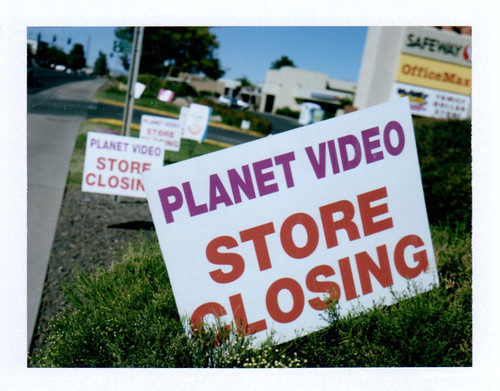
    The last video rental store in the Verde Valley is closing after 18 years.

    As frequent customers of Cottonwood’s Planet Video, we were bummed. Sure, the “box” rentals outside the gas stations and drug stores will provide a steady stream of the new release hits, but what about less mainstream films? What about that vast middle of the store? The library of indies, television series, documentaries, and the 20th century comedies and thrillers? Now we’d never be able to catch up with the current season of Mad Men, and never even get our chance to begin Breaking Bad. Our TV set is sparsely equipped with bunny ears and network channels because we like our movies served supplementally and need no constant diet of them.
    Being witness to both the dawn and demise of the video store age, I understand why its 30-year heyday is now going the way of the dodo bird and the dinosaur. Growing up in the 1980s, going to the video store was a big deal. My brother and I would spend an hour pouring over the titles trying to outdo each other’s choices of schlocko horror films and bad B-movies. With video stores gone we’ve got one less reason to leave the house. We see our friends in virtual neighborhoods and work from home offices. Folks go to school online now. Movies are streamed to devices, watched on laps or in the palms of hands. TV is watched on the internet and no one is ever limited by any network schedule ever. Times change, and as they do, an event like the closure of your community’s very last video store, will punctuate that change.

    barry school 2001, chicago

    In 1979 I was in first grade. My school underwent a renovation that year. All of the vintage wooden desks, bolted to the floor in rows of cast iron, were yanked out and left in a heap in the schoolyard. These well-worn desks, complete with ink-wells (which we’d never quite understood the use of), had been used by several generations of students since the school was built in the 1920s. The ceiling’s pendant lights were removed in favor of dropped foam-core and florescence. We were given independent, ergonomic desks with plastic seats in a variety of colors. Everyone was very excited about this change, as excited as we would be a few short years later when computers made their first appearance in the classroom. In 1979 I stood in the schoolyard looking at the mountain of old desks before they were carted off. Even at age 7, I knew this meant something huge. My Scorpio-rising sign gives me a deeply sentimental bent and I recognized we were standing at the beginning of a new age. We had one foot in the past and one foot in the future! And I was a part of both! Casting off the ink wells and the incandescent lights of our parents and grandparents. What would the future hold? Oh, sweet silly 7 year-old, you had no idea.
    As the technological revolution speeds up ever more rapidly, devouring itself like a hungry black hole, I wonder what current cutting-edge things will someday end up in the schoolyard scrap heap. Most of them probably. There was a time, not long ago, when we didn’t have wristwatch smartphones and our cars didn’t park themselves. Here are some 20th century scraps, gone but fondly remembered…Let’s rewind shall we?

    Complete Lack of Rules


    When I was a kid, there were far fewer safety rules and regulations. We all joke about it now, the rudimentary and ridiculous contraptions we risked life and limb on, sans helmets or air-bags. Safety regulations were almost nil, or in their infancy. It was like the Third World. Seatbelts? They were considered an “optional” feature on most autos until the 1970s. Like FM radio, or cordovan leather seat covers.Not only were tots not trussed into car-seats, my peers remember not even sitting in seats at all, instead driving around in lawn chairs in the back of their folks’ van, standing on the front seats or sitting in the back-back of station-wagons, no seats, no seat belts, inexplicably making peace signs at the drivers behind them. 
    There was a time when most farms were not owned by corporations, when GMOs were a distant fantasy in some evil scientist’s lair, but this doesn’t mean our food was always safer. When my grandma asked me what I thought the initials of the "A & P" grocery chain stood for my completely serious response was "Additives and preservatives?" We were pumped full of chemicals. We blew "Super Elastic Bubble Plastic" toy bubbles made of toluene and other brain-melting ingredients. My friend Lisa grew up in the 1960s, “Our dentist gave us mercury in a bottle cap instead of a lollipop. We'd play with it until it disappeared.” So I’m not saying it’s better to have less rules. Teachers can’t spank their students anymore. Drunk driving, once a common behavior, has become an extremely serious violation with zero tolerance.
       Perhaps the biggest change to the rules involves cigarettes. Up until not very long ago, cigarettes were smoked everywhere, on airplanes, in restaurants, at the grocery store, by pregnant women. You could buy them from vending machines. My cousin remembers being able to buy cigarettes for my aunt at the corner store, “as long as I had a note signed by her.”

    Communications


    Leafing through a Rolling Stone magazine from 1990 I laugh at the wealth of “chat-line” ads in the back. This is how people met interesting strangers before the internet!  They called 1-900 numbers hoping for a chance to lucky! Or meet the loveboat of your dreams! For just 99¢ a minute.
    Nowadays we know who is calling us the moment the phone rings. But there was a time the only way you could tell who was calling was to 1. Answer the phone, or 2. Let the answering machine pick it up to screen the call. "Caller ID", originally a special feature that cost extra bucks, changed that and now every call is identified as soon as it rings. Kids will never again know the clever joys of “crank calls”. The “Jerky Boys” could never happen today. We’ll also soon forget all about payphones. I relied on these until fairly recently when I realized there were none left .On the topic of cell phones, my friend Ellyn, born in 1969, is reminded of watching the 1993 film “Dazed and Confused” (set in 1976) with her 20 year old son, “He was very confused about the scene where the kids plan to meet up at the Moontower that night. He asked me, ‘How did you all know where to go and what time? How did you arrange for rides?’ Ha ha.”
    Technology

    I grew up in a bedroom that had yellow wallpaper. This was because there was a time people decorated their baby’s rooms in green, yellow or other gender-unspecific colors because no one knew in advance if the little tyke would be a boy or a girl. It was all a big surprise until it arrived, squealing and thrashing about in its birthday suit.

    Home computers were once as big as washing machine, and as slow as molasses.

    My friend and fellow Clarkdalian, Sarah, born in 1978, says, “I remember when Macs could only do, like, on one process at a time! I mean, if you had the computer trying to run something, and you switched to a different window, it sorta put the first action on hold. I swear. Macs were famous for being buggy, delicate machines, back in those days.”
    School chum Sabrina recalls, “Computers loaded from a cassette tape in a cassette player, and made horrible screeching noises.”
    In college in the early 1990s we still used reference books and microfiche for research. We pounded typewriters for term papers because only rich kids had “word-processors”. And before the internet, if you'd asked me if there was ever a chance of reconnecting with every single one of my school and summer camp friends, from kindergarten through college, I'd have laughed in your face. No way! Those people are long gone!


    Entertainment


    Besides the late great video store, other objects littering the scrap yard include the black & white television set, the drive-in movie and cassette tapes. Though they're still around and often times still work. Capturing special events for posterity began with a bright eye of light blinding everyone and burning us to film as the Super-8 camera made the rounds. It evolved to a big, clunky video machine on the shoulder which got progressively smaller and smaller until now someone just holds their phone up and next thing you know you’re on Youtube.

    Movies and music have followed basically the same trajectory, recorded on analog materials like celluloid and plastic cassette tape before going digital on CD and DVD. Now the code is mainlined directly to devices, skipping the packaged good entirely. Sitting in a movie theater I am always amazed the tradition of sitting in the dark and eating popcorn with strangers still survives into the 21st century. 


    There is still a smattering of drive-ins throughout the U.S., most of them labors of love with limited seasonal schedules. The only drive-in movie I ever went to I attended in my pajamas, ' cause I was only 3 years-old and my parents were expecting my brother and me to fall asleep. But I didn't. The film was a scary mess called "Bug" about atomic cockroaches that set a California town on a fiery path to disaster. Seeing this at age 3, in my jammies in the back of a big orange Chevy Suburban explains my lifelong penchant for silly movies.

    Music recycles itself so concerts remain nearly the same, but the tickets and the t-shirts were once much cheaper. Up until about 10 years ago concert security used to confiscate your camera if you tried to bring one in. Today many spend the whole show watching the stage through their phone.

    Atari's "Pong" was the first video game, circa 1972. Games have since become so sophisticated that their early forms seem like a different thing entirely, but in their 1980s dawn we played "Frogger", "Centipede", "Galaga", "Pole Position" and "Space Invaders" feeding quarters into machines at places called "arcades", often times adjacent to "roller rinks". P.S. There was a time every town had a roller rink. 


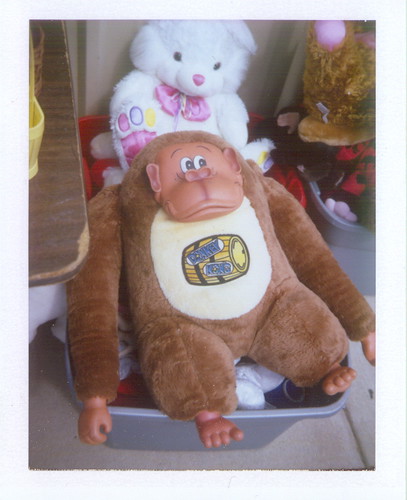
    Donkey Kong!

    Many of the classics, like albums on vinyl, Chuck Taylor sneakers, watching movies with strangers, seem to hang on. Other analog fashion like film photography and hot rod cars thrive on in small subcultures. Savor the era in which you live. Enjoy the sweet filth of newsprint on your fingers as you read this. You will always have one foot in the past and one foot in the future, and that is a magical thing indeed. 
    Ellen Jo Roberts was born with her sun in Aries, moon in Libra, and rising sign in Scorpio. She remembers Han Solo telling Chewbacca to “Laugh it up, fuzzball” as one of the great cinematic joys of her childhood.

    Read more at ellenjo.com


    Monday, August 19, 2013

    Enchanted with the Four Corners

    Enchanted with the Four Corners
    The Outs
    The Noise
    September 2013
    by Ellen Jo Roberts

    The Four Corners comes together neatly in a geometric fashion. You can put one hand in Utah, one hand in Colorado, one foot in Arizona and one foot in New Mexico and be in all four states at once like a crazy game of topographic Twister. Or, you can do like we did and cruise a big lazy loop around all of them one at a time.

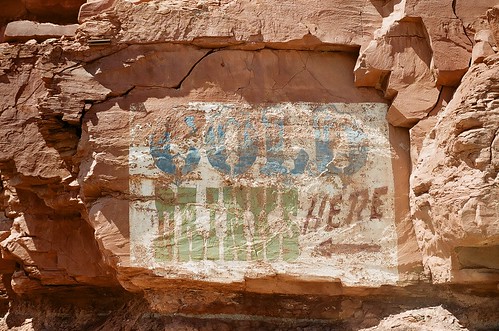
    Mexican Hat, Utah "Cold Drinks Here"

    The first stop on our tour was Santa Fe. It bills itself as The City Different and being a bit of an oddball myself I felt right at home there.
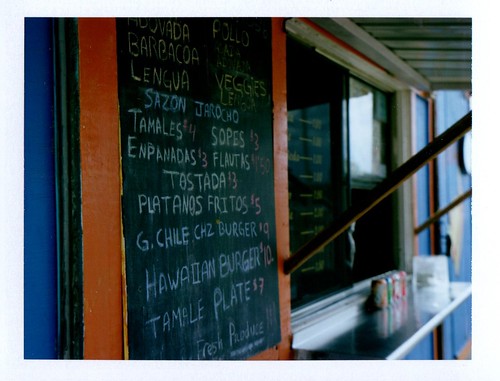
    "Riding the No. 2 Bus to the Plaza and making new friends, eating tamales from food trucks and rolling like locals here in Santa Fe"- written on post cards to pals.
    santa fe taco truck

    My first trip through Santa Fe was 18 summers ago, a quick one-night stopover on our move out west from Illinois, caravanning in our two vehicles packed with all of our worldly possessions. We camped just outside of the ski area, around 8,000 feet. I was a cranky brat, my head splitting with altitude sickness. My late, great Volkswagen Superbeetle was also crippled by the high elevation until a friendly local helped me adjust the carburetor. That was my last visit to Santa Fe. 1995! It seemed crazy that we've lived within a day's drive all of these years and had never journeyed back. The town gave me an expensive and slightly sinister vibe during that single brief visit, bathed in the sunset glow of strange graffiti, "no vacancy" signs, dirty looks, tension between the Native Americans, Chicanos and Anglos.
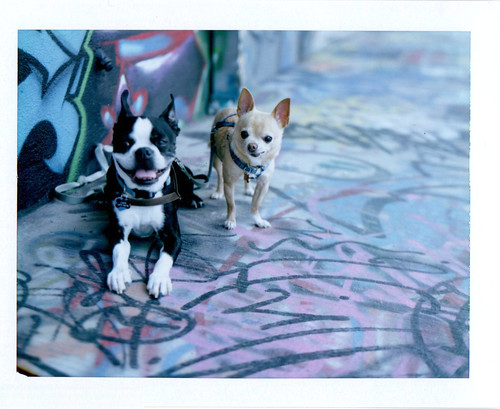
    santa fe ivan and floyd    
     Returning again for a clearer look, I see I was all wrong about Santa Fe.
    The City Different is bursting with diverse culture, tolerance and a general jubilance. There is a strong emphasis on the value of art in this town. It's everywhere you look, and it's definitely its own currency. History is also a commodity to be protected and savored. Local food and beverage are world class. Health is also an important focus, though the city is not without its share of drunks and toothless vagabonds. Nestled in the heaving bosoms of the Jemez and Sangre de Christo mountains Santa Fe's high desert climate makes for a pleasant spirit in its dwellers. Walking the Plaza, always just one step ahead of being lost, finding my way through the historic side streets, buzzing on the energy percolating up through this blessed ground, a rare thought came to me.
    "I could live here."
     
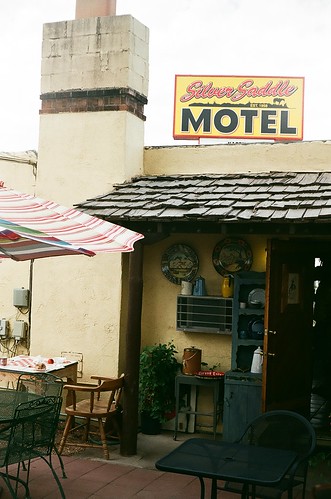
    santa fe silver saddle motel courtyard

    The Silver Saddle Motel sits along the busy Cerrillos Road, a main thoroughfare through town.  A vintage roadside adobe-style beauty built in 1953, the Silver Saddle was my first real introduction to the quirky Santa Fe style so emulated nationwide. The staff at the family-owned motel is delightfully eccentric and full of vivacity. The breakfast in the lobby each morning includes pastries, cereal, fruit, hard-boiled eggs and a good portion of socializing with other travelers. Beverages are served from a mismatched set of kitschy mid-century mugs. The gregarious front desk manager, charmingly draped in turquoise and decked in cool/nerdy eyeglasses, happened to mention her time in high school down to the south in Roswell. Famous actor/Wes Anderson pal Owen Wilson attended military school in Roswell, so I asked, "Did you know Owen Wilson?" "Yes," she laughed, "We actually were in the same graduating class together and in drama class together," and apparently they still maintain correspondence. Val Kilmer's autographed photo hangs nearby. Since he sold his long time Santa Fe home he likes to stay at the Silver Saddle, as it's "the real old skool Santa Fe."

    new mexico between alburquerque and santa fe- turquoise trail, highway 14

    Also called Highway 14 or The Turquoise Trail, Cerrillos Road is a scenic two laner connecting Santa Fe to Albuquerque, and an alternative to Interstate 25. Picturesque relics dot the road its entire length: the ruins of an old mining town called Golden, a crowded biker burg called Madrid, and small, historic Cerrillos, an occasional film set. Up until the 1938, Route 66 traveled through Santa Fe and the historic portion of it shares a similar sensibility to the Mother Road elsewhere with its classic neon, railroad-town feel.

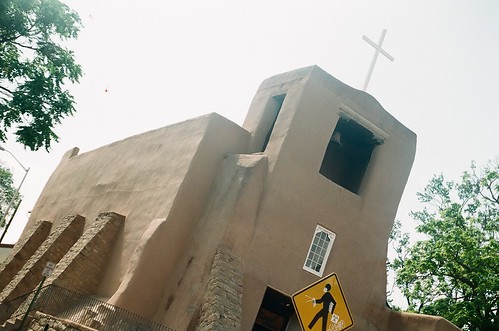
    santa fe san miguel mission 2

    Santa Fe is the oldest capitol in the United States, and its ancient streets pre-date auto traffic by about 300 years, so the popular Plaza is generally crowded with cars and parking is tight. Another automobile note: Spendy Santa Fe is also the Porsche Capitol of the U.S.A. You can't cross the street without stepping in front of some German sports car. The Cerrillos Road No. 2 city bus stops just outside of the Silver Saddle. For $1.00 you can avoid driving and instead have some fun bilingual chats with the locals on public transportation. People in Santa Fe speak Spanish with great fluency; even the Anglo folk have nearly perfect accents. Our morning photo expeditions led us through all of the key historic sites like the San Miguel Mission, Loretto Chapel and its Miraculous Stairway, the Oldest House in the United States, the La Fonda Hotel, the Railyard and Canyon Road's famous row of art galleries. While buying postcards at the old 5 & 10 downtown one morning I managed to run into some random Arizona artist friend who had an on again/off again relationship with Northern New Mexico. "I knew I would catch up to you eventually," he said, exchanging his bike helmet for a giant velvet sombrero from high on a shelf. Santa Fe is chock full of such kismet.

    santa fe lorreto chapel jesus

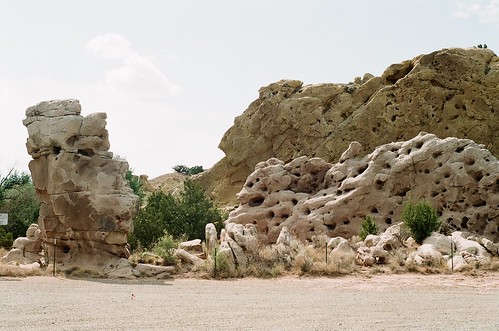
    The area is notably drier than our home base in Arizona’s Verde Valley. The Santa Fe “River” was a shockingly puny trickle and serious fire dangers had closed the National Forest during our summer visit. The lack of agua is a possible deal-breaker in the "I could live here" game. Being river town folks, we were craving some riparian life by the time we packed up and headed on for our next destination: Dolores, Colorado and a camping cabin along its eponymous cool grey-green river. On the road north, we stopped to see Abiquiu, about an hour from Santa Fe. Abiquiu is the place that inspired artist Georgia O'Keefe the very most. She lived there from 1949 ‘til 1984 and  her home studio, "The Ghost Ranch", can be visited and an overnight stay can be arranged. The nearby Chama River snakes through red rock high desert and fragrant fields of sage. The geology of the area is at once familiar and completely foreign: rocks veined with strange geometry, alien formations and intense, saturated colors. I'd never seen anything like them before...except for, perhaps, in a painting by O'Keefe.
    abiquiu, new mexico- chama river

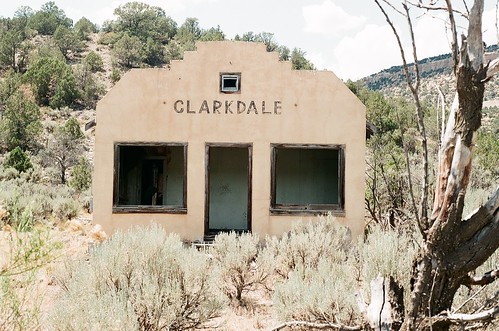
    Further north, in Aztec, NM, along the Animas River, the Aztec National Monument is a display of ancient dwellings and similar to Tuzigoot, much of it rebuilt by WPA crews in the 1930s.  Closer to the Colorado border, we are surprised by sight of a 20th century ruin, a lonely, abandoned structure along Highway 550 emblazoned with the name “Clarkdale”. It’s worth pulling a u-turn for a photo op, though later Google gives us no information about the building or why it wears the name of our Arizona home town.


    clarkdale!.... new mexico?

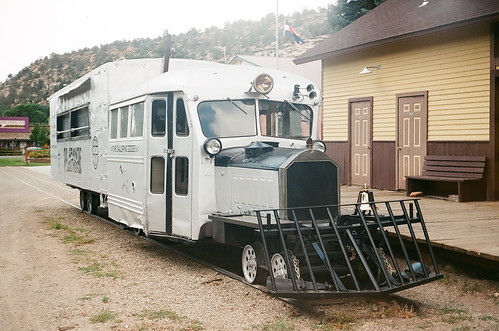
    Dolores sits just below 7,000 feet in a mountain valley. It's an old railroad stop on the Rio Grande Southern Route, and home of the famous Galloping Goose No. 5, a crazy cool train contraption made from an old school bus mixed with a locomotive and painted silver. There are seven Geese total, all built in Ridgway in the 1930s and all still operational. The Galloping Goose was originally used to deliver mail between towns in the Southwestern Rockies. Goose No. 5 is parked outside its own museum in downtown Dolores, though on special occasions it goes journeying on the nearby Durango-Silverton and Cumbres and Toltec Railroads.

    dolores galloping goose 2

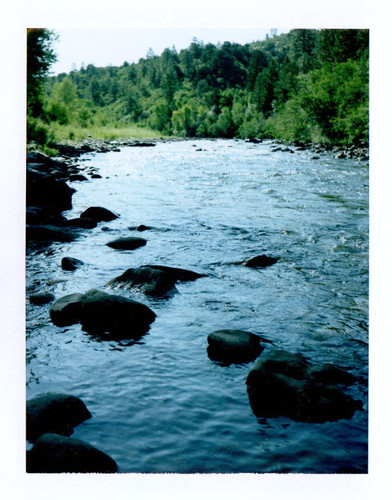
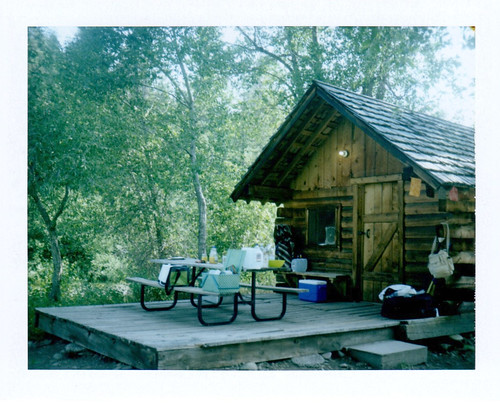
      For a few nights we camped in a rustic cabin along the banks of the Dolores River. We spent every day hiking up on foot and floating down in rafts the rocky Dolores, and every night in a creaky old bed lulled to sleep by the river sounds as it hugged the edges of our rough hewn cabin home.
    dolores river sunset

     The town is small, tidy and historic and claims a pretty decent brewery. Assorted Dolores River Brewery ales can be purchased in canned 4-paks at the local liquor store. Also worth a try: Escalante Ruins at the Canyon of the Ancients visitor center. A mile hike up a sloping paved trail leads to a hilltop ruin and remnants of an ancient kiva. From this vantage point you can also see that the Dolores is dammed. The adjoining reservoir covers an old lumber town long gone called McPhee that gave its name to the lake that drowned it.

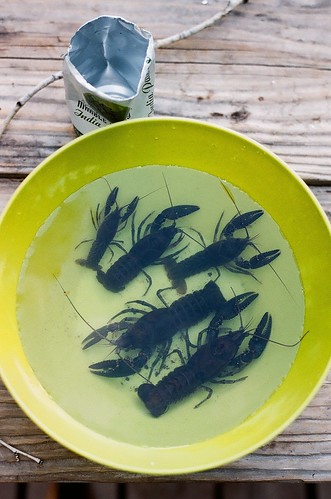
    dolores river camground river cabin #4 dolores river crawdads and the tools i used to capture them
      The most recent of stamps in our National Parks passport book was inked
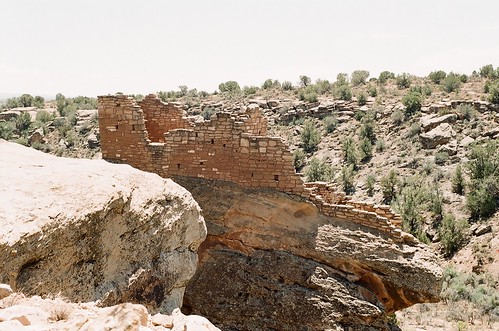
    at Hovenweep National Monument, a stop on our drive back home as we tallied time in each of the Four Corner states. Hovenweep is very remote, right on the Colorado/Utah border and about an hour from the closest town, Cortez, via the sparsely traveled Canyon of the Ancients route. What makes these ruins so impressive, in addition to their lovely canyonside perch, is that they were never rebuilt, or reinterpreted by WPA crews. Hovenweep is "stabilized" but original. Discovered in 1854 and protected by National Park status in 1923, these ancient towers and structures straddling two states are original to the 13th century.

    utah colorado border hovenweep 3

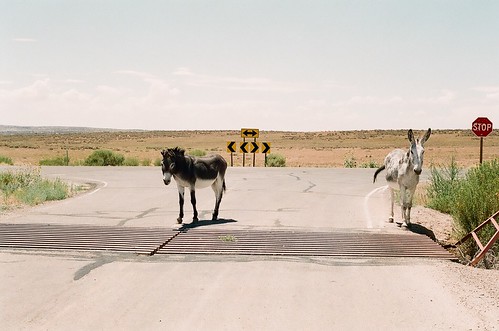
    Through Utah we continued, a dot on the map slowly meandering back to Arizona. We took a wrong turn out of Hovenweep and suddenly have no idea where we are. Lost in the scenic west, we drive along curving, rolling and very nameless roads. No shoulder, no pavement markings, no speed limit signs. No worry, either. Not yet. The day was far too magical. We knew everything would work out. A promising intersection appears, inspiring hopes of being back on a main road, back on route. The new highway is not marked either, except for two burros standing nearby, eagerly awaiting our arrival.
    “Wow, that’s how you know you’re REALLY lost. When the only ones you can ask directions from are a couple of donkeys.”

    We burst into laughter. This is somehow everything wonderful and lovely about the western roads we've just spent the week wandering. The sense of being lost but not being scared. The open skies, beautiful rocks and the sun-baked surprises every mile. The feeling we're just small pieces of something much grander and anything is possible. The sense of enchantment. Our eyes are wide open for the next bit of magic down the road.

    lost in utah with only donkeys to ask directions from

    For more information:
    silversaddlesantafe.com 
    doloresriverbrewery.com
    www.nps.gov/hove/index.htm

    Ellen Jo Roberts lives in Clarkdale Arizona with Chad, Floyd, Ivan, Ned and Hazel.
    Read all about it at ellenjo.com