Wednesday, March 2, 2011

Big Texas! :There's No Basement in the Alamo!

An old favorite, from August 2008...

Big Texas!:There’s No Basement in the Alamo!
By Ellen Jo Roberts
The Outs
August 2008

kodak film- flash bulbs

Texas is a mythical place, larger than life and bigger than all of the original 13 colonies combined. Texas almost seems ridiculous to be so big—like it should’ve been subdivided into North, South, and West subsets like the Virginias, Dakotas, and Carolinas. One side of Texas is western, dry and familiar. Another part is green and fermented, with spanish moss in the trees, plentiful rivers, and hills.
What we did on our summer vacation--What we did was pack up ourselves and the dogs and drive 2,400 miles, round trip, to the gulf coast of Texas, practically Mexico, for a family reunion. On the map it didn’t seem quite so far—a mere 2 states over. But as we finally saw the very first road signs mentioning our specific destination we both were dumbfounded that we’d been so brave and foolish to drive so far. By the end, by the time we’d made it back home, we’d driven for 6 solid days, 8 or 9 hours a day. It was a lot of highway, an amazing range of landscape and ecosystems, and new places never before seen. It also was about $500 in gasoline.

First of all, the Packheiser Reunion. My husband’s mom has many siblings, more than two hands can count. Do the math and that makes for many spouses, cousins, extended family, and a big reunion every year in a different locale. There are Packheisers from sea to shining sea. Each year they meet up in a different region during the Independence Day holiday week. Three years ago the Packheisers reunited in Arizona’s Verde Valley. You may remember us from our matching Packheiser Reunion t-shirts and our “boom-shaka-laka” routine” in Clarkdale’s 2005 4th of July Parade. Or how they landed on Jerome like a swarm on locusts. Locusts in matching t-shirts. Those wacky Packheisers. This year the destination was South Padre Island, a Spring-Break mecca along Texas’ southernmost stretches, minutes from Mexico.

We started our trip chipper and enthusiastic, in a rental car with air-conditioning and cruise control. Driving local highways through Arizona’s White Mountains on Highway 260, we soon crossed into New Mexico, continuing on small highways through small towns.

pietown relic

Along Highway 60, outside of Magdalena, NM, one may catch a glimpse of the “Very Large Array”–gigantic satellite dishes, tuned to communicate with outer space. Rural New Mexico has a glorious landscape, but most of the towns along the way were ghostly relics. Empty storefronts, vintage signs advertising long-closed businesses, no glimpse of pedestrians or residents. Every time the speed limit dropped indicating we were coming up on the next town I sat up a bit straighter in anticipation, and every time was surprised to find more of the same. Has the American roadside of yore gone extinct?
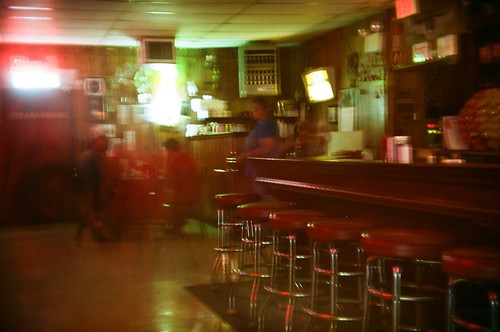
owl cafe interior-1

Our first goal on the map was a lunch-time cheeseburger at the famous Owl Bar & Café in San Antonio, New Mexico. It had been recommended by a friend as a mandatory stop. “The green chile cheeseburger will change your life,” she said.
The Owl Café is a historic roadside dive, dimly lit interior, like a cool dark cave, out of the relentless southwestern sun, and while the cheeseburger didn’t change my life, it was damn good, and the price cheap. By 5:30pm we had arrived in Roswell, our first overnight stop, and the eve of our 13th wedding anniversary. We had been quite excited about Roswell, due to all that alien stuff. In 1947 a UFO crash-landed in the desert about 40 miles west of Roswell. The enigma and the ensuing cover-up has given the city license to a mystique ever since, similar to Nevada’s Area 51, and the Bermuda Triangle. There are dozens of alien–themed gift shops downtown. I cannot say Roswell lived up to our expectations. First off, the city was far bigger than I’d realized, population 50,000 or so, and real seedy. The “vintage motorcourt” I’d found online was nothing more than a standard issue junky motel, nothing special at all, with an IHOP and Home Depot across the street, and construction workers standing outside of their open rooms, drinking cheap beers and wearing no shirts.
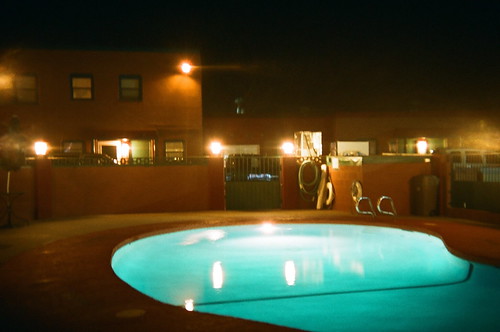
western inn pool-night exposure

The motel, despite being advertised as “completely renovated”, featured shoddy electrical work, loosely installed plumbing, threadbare 1980s office furniture, filthy carpets. We dig funky and old, and can tolerate lots of imperfections if there is something “authentic” about a place, but this was just a dump, dirty and rough. We skedaddled out of Roswell early the next morning, not even waiting for the highly regarded “UFO Research Center and Museum” to open for the day.
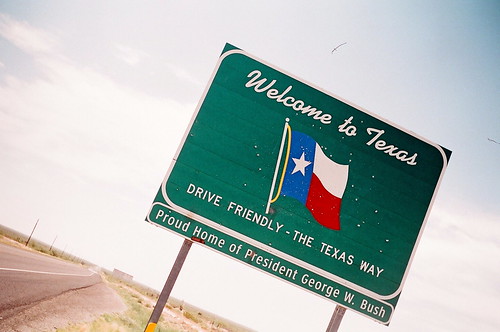
welcome to texas!

Heading south into Texas, a large bullet-spreckled sign welcomed us to the “Proud Home State of President George W. Bush”. Soon we connected with our first patch of interstate road, several hours on the I-10. We stopped to gas up and grab some lunch in a historic and functional town called Ozona. They had a lively old downtown, and a large shady grassy park with gazebo where we stopped to have a picnic. “I thought every town we passed through would be like this one,” I said, as we slurped some cold soda, “Funny though, it’s like only 1 out of every 30 actually is.”

ozona tx- small town goodness

As West Texas turned into the rest of Texas, the familiar high desert scenery had faded into rolling green hills, abundant rivers, live oaks, and limestone cliffs. Our destination for the night was Austin, home of the state capitol and the University of Texas. The Austin Motel, with its famously phallic neon sign, is a much beloved 1930s vintage motel located in the hipster-full “SoCo” (South Congress Street) neighborhood.
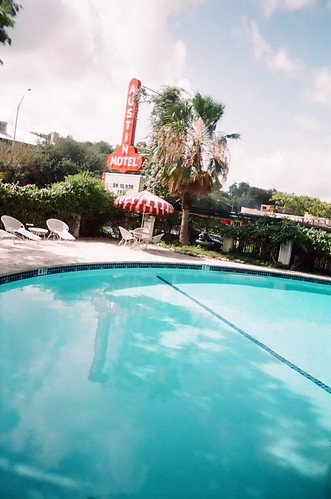
austin motel pool

The pet-friendly Austin Motel did not disappoint. Our room was appointed with kitschy furnishings and a blue-green color scheme that reminded us of home. The motel is within walking distance to everything cool- lots of clubs, cafes, shops, and interesting neighborhoods, not to mention the “Largest Urban Bat Colony in North America”, 1.5 million bats that roost beneath the Congress Street bridge. Around sunset time, people gather in a designated “bat observation area” below, and line up along the bridge above to witness the bats disembarking into the night. A few moments after the sun settled beneath the horizon the bats began to disburse—from one section of the bridge at a time—in great whirling, squeaking waves, around and up, high into the sky. Folks cheered, hollered, jumped in glee, babies screamed, dogs barked. It was one of the most amazing things I’ve ever seen. In the distant sky to the east you could see the bats like a long ribbon of black, like cursive handwriting in some unknown language.

waiting for bats

Dinner at Sol Y Luna, a Mexican restaurant adjacent to the motel-- we guzzled down a pitcher of mango margaritas, delirious and dehydrated from the long highway hours. By the time we hit South Congress the tequila had hit me, and we joined in with the strolling parade of hipsters, weirdos, tourists, panhandlers, and musicians crowding the sidewalks on a summertime Wednesday night.
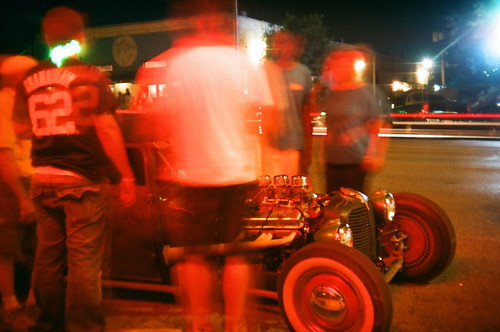
SoCo hot rod, Austin Texas

A late night swim in the motel’s luxe pool cleared the fuzz ‘n’ buzz from my head. The pool sits along the busy street, so you feel not far from the action, though it is hidden like a secret oasis behind lush landscaping and old shade trees. A good night sleep in Austin helped us push on the final 6 hour sprint south to the reunion.
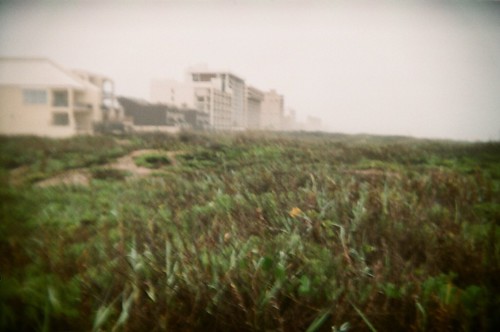
foggy beach looking North

South Padre Island is a popular destination for Midwestern college students and folks east of the Mississippi. It’s a slim slip of a barrier island along the southeastern-most gulf coast of Texas, and full of souvenir shops, multi-story hotels, and tourist traps. It’s also home to “Sea Turtle Inc.”, a rescue center started in 1977 by “The Turtle Lady”, Ila Loetscher. The center’s primary goal is nurturing injured sea turtles and assisting a variety of young hatchlings towards success in the wild. Guests may visit the center and see the resident animals, as well as witness daily releases of hatchlings heading out to sea. The Gulf of Mexico’s western coast is natural breeding area to many varieties of protected sea turtle species.
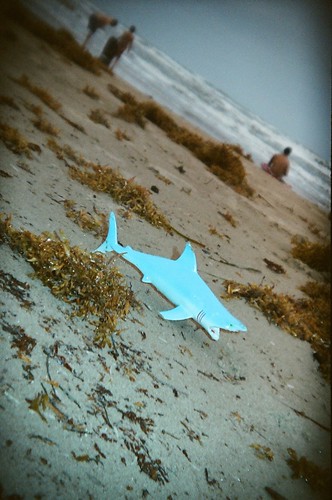
land shark!

South Padre is also renowned and respected for its excellent waves and kite-boarding opportunities, and for its tremendous riptide which repeatedly dragged us far and away from where we started out. Its beach sand is also highly regarded, ranked best for sand-castle building by “professional sand sculpture artists”, due to the fineness of its grain, moisture retention and other qualities essential to really top-grade sand sculpture.
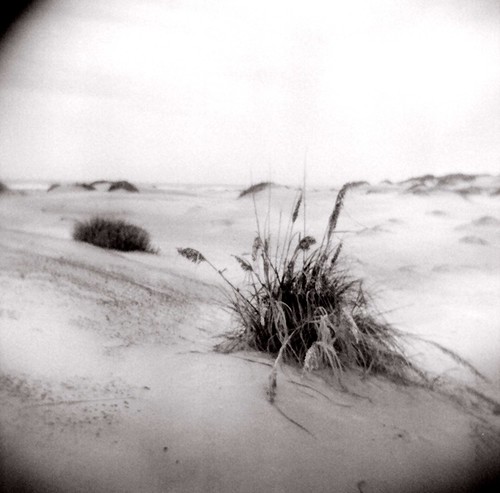
south padre island -beach/ holga

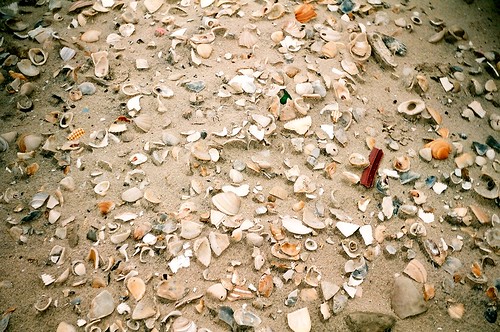
The northern portion of the island is uninhabited and visitors are allowed to drive vehicles onto the sand for miles, finding remote camping, and access to fantastic shell-covered beaches. The tropical humidity and salt air made us feel young again, rehydrating our squinty Arizona wrinkles and giving our hair a glossy curl.
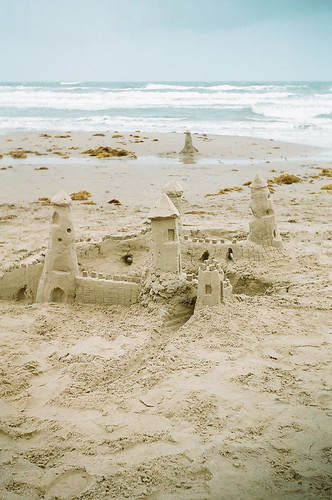
South Padre Island sand castle

shell beach

“Cyclone season” officially began on June 1st, and the family reunion was (only slightly) marred by relentless tropical rains which fell day and night, letting up just long enough for some beach time with the kiddos, and a grand fireworks display.
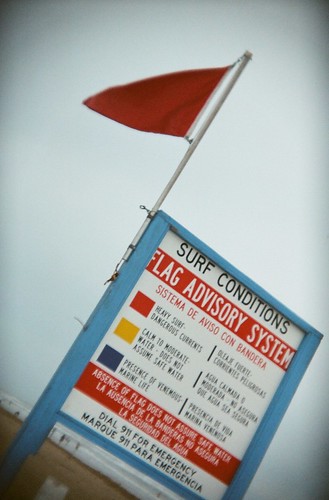
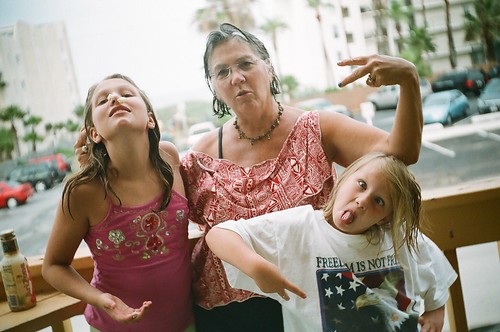
red flag

silly 3

Texas-brewed Shiner Bock beer was consumed and folks stayed up late laughing, telling stories, and enjoying each other’s company. It was good to see parents, aunts, uncles, and meet some new family additions. The 1980s-born cousins united in wearing gigantic sombreros paired with scanty short-shorts for a fashion statement that we’ll all be raving about for years to come. The Packheisers rocked South Padre, stormy weather and all.

twins and friends

After a few days of family fun, it was time to get back on the long road home to Arizona. We left the tropical storms of the coast, with a quick photo stop at the Alamo in San Antonio, then a different route, more northerly, to hook up with good ol’ I-40 and sail along favorite old Route 66 haunts. One overnight stop was Fredericksburg, a lovely Hill Country town founded in the 19th century by German settlers.
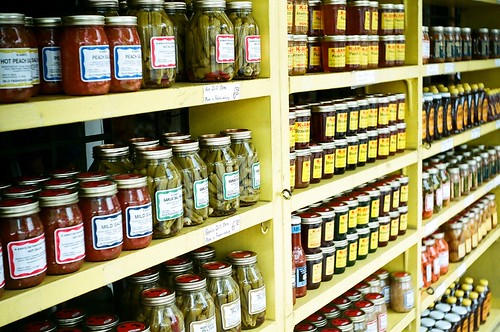
fredericksburg 3

The architecture in Fredericksburg is of brawny local stone, solid, traditional and built to last. On a sunny Sunday afternoon Main Street was filled with city slickers buying homestyle jam, and drinking beer on the streets.
They have an open-container law that allows it.

fredericksburg-main street 2

Fredericksburg was a nice bit of something real and solid to chew on, all leafy green shady, and white stone solid, giving us some energy for our voyage home. The next day we continued north, connecting up spidery backroads to Interstate 40, with a special stop planned for the Cadillac Ranch outside of Amarillo.

ellen jo & floyd at the cadillac ranch

The Cadillac Ranch was conceived in 1974, an art project and commentary on consumerism by an artists’ collective known as “Ant Farm”. With farmland donated by a local philanthropist and prankster, Stanley Marsh 3, the Ant Farm planted a series of vintage Cadillacs face first, arranged by year and size of the tailfins. The first, a 1949 model, is modestly tailfin-free, the last, a 1963 model also mild. In between, the tailfins swell to epic stature, before fading away. The installation, visible from I-40, was moved from its original site to a spot further west in 1997.
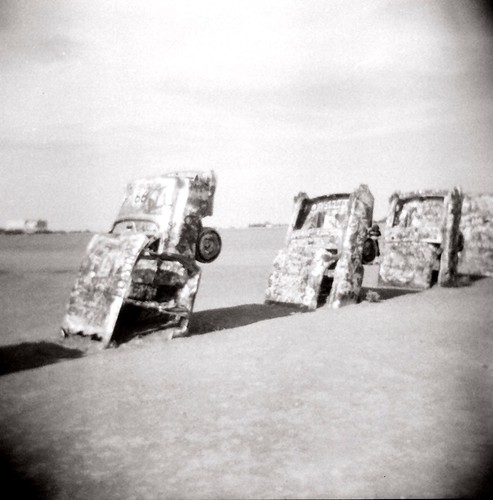
cadillac ranch -holga/BW

Graffiti on the Caddies is encouraged and, knowing this in advance, I’d packed a bag full of spray-paint rattle cans, and carved up a stencil to use before we left home. We arrived at the site in late afternoon, during a howling high-plains wind, the air full of manure stink. The wind did not make for optimum spray-painting conditions, and most of the color ended up across the back of my left hand, just before my stencil blew away. The Cadillacs are covered with 30 years worth of paint, all thickened, lumpy and bumpy. I took to just wielding the rattle can, free style, joining the small crowd of others tagging their words and thoughts onto the autos. Our final overnight stop was 2 hours to the west, in Tucumcari, New Mexico, at the famous Route 66 Blue Swallow Motel.

blue swallow at night

We’d stayed there once, back in 1999, and for years have lived with fond memories of its vintage style rooms, adjoining garages, and glorious neon road sign--always eager to return some day. Back in its mid-century heyday, Tucumcari was a prime spot on 66, boasting plentiful motel rooms, restaurants and encouraging folks to stay with the ubiquitous slogan “Tucumcari Tonight!” The owner greeted us by name when we arrived at the Blue Swallow, showing us to our room. It was just as we’d remembered it, if not better. Clean, comfortable, and obviously well-loved and tended to by the owner and his family. The neon brilliant in the night sky. Tucumcari, however, seemed worse for wear since a decade past, with many motels and restaurants closed down, and plentiful weirdos wandering the Mother Road, some shoeless, shirtless, hopeless, no service.
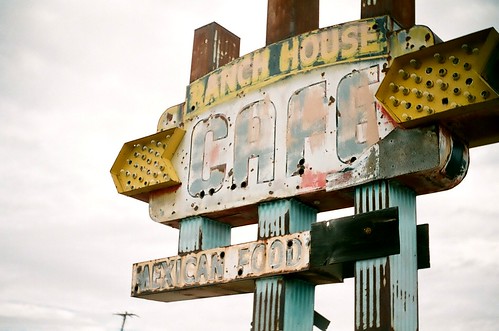
ranch house

The motel next door had long ago been abandoned, with thigh-high weeds in the parking lot, a pool full of garbage, and open rooms inhabited by feral cats.
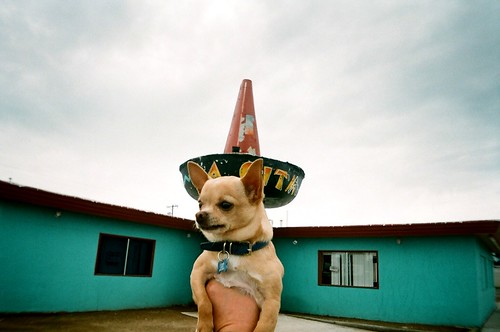
that's some-brero, Floyd!

From Tucumcari it was 7 hours to our own bed, a quick shot across 40 into Arizona. As always, the “Welcome to Arizona” sign with the state flag motif, caused me to burst into tears of joy. From that moment on it was easy sailing, almost home, propelled by sheer glee, every mile more familiar and closer to Clarkdale. We pulled into the Verde Valley at sunset, feeling more like ourselves than we had all week. The rental car was full of messy luggage, souvenir t-shirts, many pounds of sea shells, 17 rolls of spent film, and 2 very anxious pups. Rolling into Old Town Cottonwood towards Clarkdale, I finally realized it.. “I guess I thought every town was gonna be like this—lively and happening-- like our towns. Really, this is a good place where we are.”
The American Roadside is alive and well in Arizona.
“Of all the places we saw, this is the best place on the map,” said Chad. It’s always good to go away, but it’s even better to come back.

For more information:
www.austinmotel.com
www.seaturtleinc.com
http://www.libertysoftware.be/cml/cadillacranch/crmain.htm
www.blueswallowmotel.com

Ellen Jo Roberts is a sucker for a roadtrip. She lives in 94 year old house in Clarkdale AZ, with Bike Daddy Chad, and some well-traveled pets and vintage Volkswagens. Read all about it at ellenjo.com

Monday, February 21, 2011

Pinal and Gila Ramble

Pinal and Gila Ramble:
Superior, Globe and the Salt River Canyon
The Outs
The Noise
March 2011
Ellen Jo Roberts

superior copper

            Globe, Arizona is a mere three-hours down the road from home, yet it seems like an alternate universe. An Arizona we could be living in here in the Verde Valley, if the mines were still open and operating. Globe and its neighboring cities, Miami and Superior, are all picturesque historic communities built by copper.  There are a couple of roads down into Globe from the north and east. One route is Highway 188 via 87, and one route is 60 via Phoenix. U.S. Route 60, stretching from Virginia to western Arizona, has been gradually bypassed across the country by interstate travel. It is one of my favorite Arizona highways: a small town backbone winding its way through vintage towns and beautifully faded abandon throughout the state. It’s time machine that inspires the imagination.
  
         Highway 60 takes you through Superior, a sun-baked dream at the base of Apache Leap. Located 65 miles east of Phoenix, the historic small town is nestled into wildly scenic granite formations. It’s like a movie set! That’s because it is a movie set! Many motion pictures, including “Eight Legged Freaks” and “U-Turn”, were filmed there along its picturesque vintage streets and dusty sunsets. Superior has the looks naturally that Hollywood always strives for artificially any time the script requires a seedy- offbeat- 20th century- small western town. Heavily Hispanic in population, Superior is all churches and bars, with an occasional artist hipster thrown into the mix. I love Superior as an unspoiled relic of days gone by, not ironic, and not polished. I secretly wish I could move there, and be a part of some bound-to-happen renaissance. But, it seems perhaps not the best place to find a job. The only place usually open on Main Street, other than a handful of antique shops, is the cantina, with cool musty air spilling out onto the sidewalk from its open doors and shady interior.

superior arizona street scene in chocolate

The Boyce Thompson Arboretum is probably the most well known tourist attraction of the general area. Founded in 1925 and since the 1960s managed by the University of Arizona and Arizona State Parks, the arboretum fills a long cozy canyon with an amazing array of desert botanic specimens. It’s renowned for its Australian forest of eucalyptus varieties. As with all Arizona State Parks, they allow dogs, on leashes, so your canine companion can stroll the park with you.  From Superior to Globe is another 25 miles, including a pass through the Queen Creek Tunnel (1952), twisting roads surrounded by amazing rock, “the Top of the World” and then a gradual downhill into Miami. Though they are separate cities, Miami is often intertwined with Globe, and many of the local organizations wear the moniker “Globe-Miami”.

highway 60 shrine- close up

A collection of scenic highways springs forth from the area, providing additional adventure to the north and south. Highway 77 is a low slung 69 mile loop that connects Superior to Globe. Catching up to the Gila River via the Dripping Springs Mountains, and a town called Christmas, 77 is a fun jaunt for motorcycle gangs and car clubs. Passing through the communities of Winkelman and Hayden you can see active mining operations, mountains of tailings, and trains in action carrying ore.

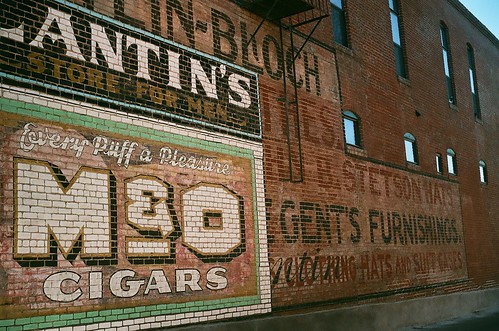
ghost sign -globe az

       We’ve been to Globe a couple of times in the past year visiting friends who are restoring a 101 year old home there, high on Noftsger Hill. The city is decorated with a great variety of vintage architecture, impossibly steep streets, and fantastic vistas. Founded in 1875 on land known by local Apaches as “Besh Baa Gowah” or “place of metals”, Globe supposedly earned its name from a globular lump of silver mined there. The Arizona Eastern Railway services the area mining operations, as well as shuttles tourists to the nearby Apache Gold Casino via their “Copper Spike” passenger excursion. Globe is the seat of Gila County.

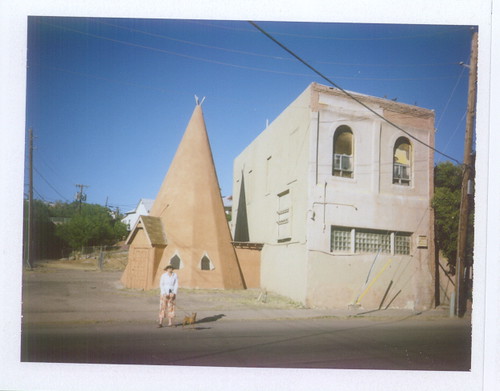
Something about this reminds me of Pee Wee's Playhouse


The city’s downtown business district features many surprisingly serious buildings, glowering with Corinthian columns of sober stone. The neighborhoods, comprised mostly of wood frame houses perched high on cascading hillsides, seem somehow familiar and foreign all at once, as if we were in Mexico. Neighbors wave and chat, friendly to strange passers-by. Yard art and improvised construction abounds: dinosaur encrusted fence tops, castle-like viewing decks, eccentric gazebos, coated with brightly colored paint. Since 1985, Globe has had a Historic Home and Building Tour each year. The 2011 tour takes place on the weekend of March 5th and 6th.

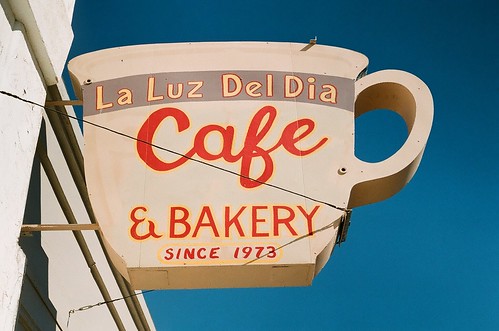
luz del dia -en la mañana

         Globe High School is notable for several of its past students: Arizona’s first woman governor, Rose Mofford, “Wonder Woman” Lynda Carter, and Anton LaVey, founder of the “Church of Satan”. What this says about Globe’s unusual mix of energies I’m not sure. Noisy trucks, strange noises in the night and beautiful ruins provoke a twinge of fear, like perhaps there is danger here. Globe’s sister city, Miami, seems a bit rougher around the edges, a bit seedier though similarly picturesque in its rural decay.  

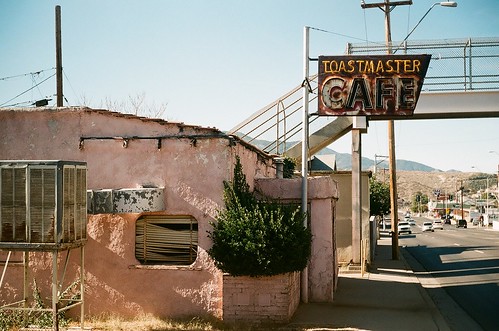
toastmaster cafe, globe az

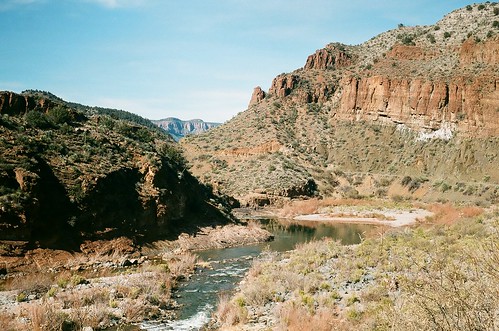
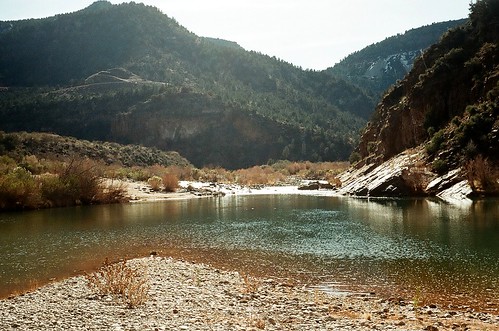
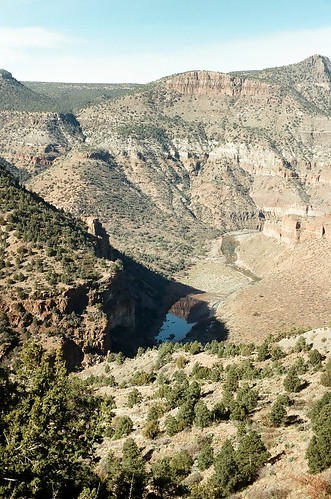
As the largest city in the area, Globe is a commercial center for Southern Gila County. It’s also a jumping off point for adventures on the Salt River. Up Highways 70/77, through the neighboring San Carlos/White Mountain Apache Reservation, the Salt River Canyon looms, an unsung beauty of giant proportions. Many know the river in its tame, below-the-dam incarnation, famous for subdued tubing trips nearer the sprawl of Phoenix. Others recognize it as that trickle that feeds into Tempe Town Lake.

salt river 3

  
 The real Salt, above the dams and flowing in its natural unfettered state, is a special rarity and part of a dwindling desert family of perennially flowing rivers and streams. The river begins at the White Mountains’ Mount Baldy and en route south it gathers up the Verde, and assorted streams like Carrizo, Cibecue, Canyon, Pinal and Medicine Creeks. The “Salt River Project” is an Arizona utility company that gathers both water and energy from four hydroelectric dams along the Salt River. The National Reclamation Act of 1902 promoted the harnessing of the wild river for ranchers and farmers. Theodore Roosevelt Dam, the first of the dams, was completed in 1911 and created Roosevelt Lake just north of Globe. It was followed to the south by Mormon Flat Dam in 1925 (Canyon Lake), Horse Mesa Dam in 1927 (Apache Lake) and Stewart Mountain Dam in 1930 (Saguaro Lake). Above the Roosevelt Dam the Salt runs how nature intended, wild and jagged through a deep scenic canyon, much of it protected by the Tonto National Forest and the White Mountain and San Carlos Apache Tribes.

salt river, january 2011

Seeing the Salt River Canyon for the first time can take your breath away. It’s several hours from everywhere, a lengthy detour to most, and for this reason, perhaps, seldom seen.

salt river 2

Mike Roseman is a river ranger for the Tonto National Forest out of Globe. “If the Grand Canyon was not in Arizona, the Salt River Canyon would be much more famous,” chuckles Roseman, known as “Rosie” to his pals. Previously a commercial river guide for Salt River Rafting, since 2004 Mr. Roseman has worked with the forest service, leading rafting expeditions on the Salt during the spring months when the water is highest. He emphasizes the importance of the Salt being protected, as one of the last free-flowing rivers of the southwest. “I don’t think a lot of the people in the Valley of the Sun even realize that the Salt is their lifeblood." He continues, “So many things change so fast in Arizona, it’s important to have and protect places like this. What the Salt River’s done for me is it’s a place where you can see Arizona’s soul.”
Mr. Roseman also mentions the importance of the White Mountain Apaches’ interesting and complicated history in the area, “They’re one of the few tribes to hold onto their ancestral lands. They kept their lands and have a living language.” Protecting the river with tribal permit use, the Apache are a significant reason for the river’s pristine wilderness. Its remote location also protects it from excessive use.
The river running season is dependent on seasonal snowfall. Though the ranger loves the high water seasons, of which recently they’ve enjoyed many, he says, “It’s probably good when there’s a drought year. It helps the area recharge.” There are several spots to access the river once Highway 70/77 switchbacks down to its shore. It’s a worthy stop for a camp out, a river excursion, or even just something short and simple like a pleasant picnic along its banks.

Superior, Globe, and the Salt River Canyon make for an epic loop of seldom seen scenic adventure.
Startling in both its remoteness and natural beauty, the region has much important Arizona history, and perhaps a key to its future in commodities both monetary and priceless.


For more information:
raftthesalt.com
globemiamichamber.com
copperspike.com
superior-arizona.com
ag.arizona.edu.bta

Ellen Jo Roberts was born during the month of March. She is celebrating 10 years of living in a historic brick home with Bike Daddy Chad, assorted pets, and vintage Volkswagens.
Read more about it at ellenjo.com
Tuesday, January 25, 2011

Love Bites

Love Bites

By Ellen Jo Roberts
The Outs
The Noise
February 2011

meanies

“Love bites. Love bleeds. It’s bringin’ me to my knees.” — Def Leppard

In our orally fixated culture, it is surprising people do not attack with their teeth more often.
We like to kiss, we like to consume, and we’re crazy for vampires. Inside our very faces are sharp and crushing weapons, though we are more inclined to utilize our fists, feet or brass knuckles in moments requiring defense. We only use our fangs to open packages.
         In grade school, there was always some kid who liked to bite, and this kid was always the biggest freak of the class. You never forget that kid, or the sharp pain and the bruise of prints left on your arm, shocking you to your senses. After toddlerhood, biting people is considering a social defect, and discouraged. It’s savage behavior, best left to the animals and the insects.
         Teeth carry much psychological baggage. We’re forever having crazy dreams about losing them, having them fall out in our hands, or dissolving into dust. Though we seldom use them to defend ourselves physically, they are still a source of power and prestige. People wear their teeth like jewelry, whitening them or capping them in precious metals or enamel. Blank spots are filled with bridges and dentures. We warn people to step back out of our grills.

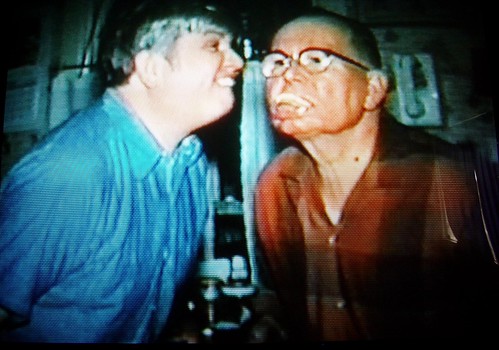
dad mugs, grandpa too

Since even before I grew all of my permanent teeth, I’ve had tooth anxiety. When I was a child, my mom suffered a mishap, tripping over a portable doggie gate in a doorway. When she hit the ground, she sent all of her top front teeth flying out by the root, through her bottom lip. Luckily, ace periodontists were able to put all of her teeth back in and save them, though to this day she won’t eat corn off the cob, or bite into an apple. She always told us that if we were falling, we should brace ourselves with our arms or hands, since it was much easier to fix those broken bones than it was to rebuild our teeth.

I knocked a tooth out when I was six. It was a bike crash, riding my older cousin’s too big ten-speed. The actual crash itself was knocked from my memory as swiftly as my face hit the telephone pole. All that is remembered is the metallic taste of blood in my throat, the sound of my cousin running up the hill shouting my name, and some passerby picking me up, dusting me off, and helping me search through sidewalk debris for my tooth, now tangibly absent from my mouth. I never found the tooth. My dentist said I probably swallowed it on impact, and how lucky it was a baby tooth.
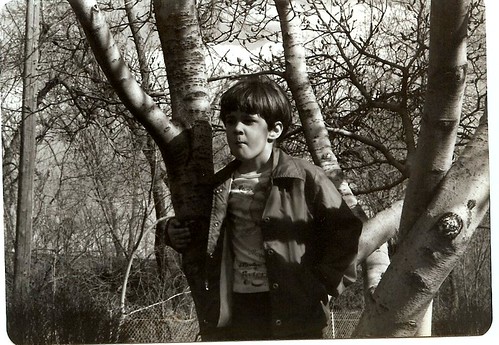
tough girl 1978

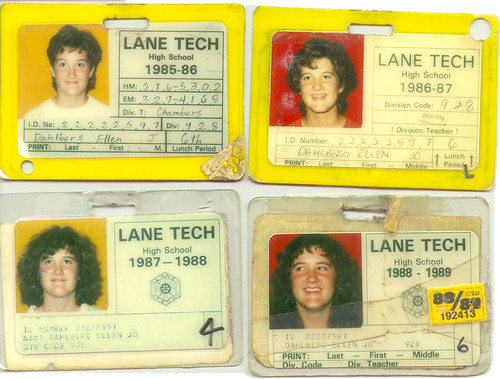
Like millions of American adolescents, once my permanent teeth arrived, I wore braces. Not only did I endure the braces, and hundreds of Saturday mornings staring at the orthodontist’s ceiling, I also suffered through a whole series of tortuous metal contraptions, including the dreaded “head gear.”

High School IDs, 1985-1989
As an adult I’m lucky to have all of my teeth, including all four wisdom teeth. I never thought this was a big deal until I accompanied a Mexican girl to the dentist. Claudia was from Chiapas, near the Guatemalan border where she grew up on a coffee plantation. She’d never been to a dentist in her life, and was suffering tremendous pain from several abscesses. Very scared and speaking no English, she needed a translator, so I accompanied her while the dentist did his exam. Several teeth needed to be extracted and he began the process that day, deftly yanking out one by one. A tooth escaped his grasp and in an arc-like trajectory bounced off her white paper bib, leaving a red blot before hitting the floor. That very night I called my mother to thank her for taking us to the dentist all those years. I’d never fully appreciated it until that moment. I even thanked her for the dreaded headgear.
          A love bite is what we call a hickey, a temporary neck tattoo identifying you as a teenager in love, hot and heavy. To see a hickey on a grown-up is really a bit pitiful. Even as a teenager it’s embarrassing. Lovers like to nibble on each other like candy. Mouth, lips and teeth are all exploited in advertising, to emphasize the ecstasy of flavors, sensations, beverages, wealth and beauty.
          Bared teeth can represent danger, aggression, anger, or with the subtlest turn of the corners of the mouth, happiness. In some cultures, bearing teeth is considered impolite, improper, or overly informal.
Can you imagine how different a piece of art DaVinci’s Mona Lisa would be if she were showing us her pearly whites?  In Latin American countries, a bribe is called a mordita, meaning a “small bite.” Everyone wants a little piece of the pie, including public officials and the police. Nom nom nom! The mouth chews, eats, and swallows. The teeth get stained with red wine, coffee, cigarettes.
Things disappear, including your money.

Animals bite. It’s both their appeal (watchdogs and the Discovery Channel) and our fear.
Sharks attack and kill surfers and seals with their many rows of sharp, ever-replenishing teeth.
Lions, tigers and bears all frighten us with the skilled wielding of their fangs. Though in North America it’s far more likely you’ll be bitten by a neighborhood dog than by an elusive big cat, or rare bear.

floyd attack

Photo by Frances Duncan
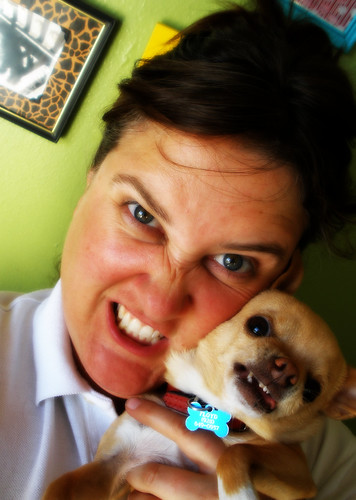
I have the cutest dog in the world. He’s traffic-stoppingly cute. Floyd is so good looking in fact, that similar to Hollywood starlets, he has become an absolute monster, a ferocious beast with a surly disposition. His cuteness is his curse. In order to protect himself from the constant throng of gawkers wanting to stroke his perfectly shaped noggin, he has cultivated a defense mechanism. He bites.
He will bite you. I’m very clear about it to any overly friendly stranger who approaches. The Chihuahua Bites. I really should just print up a t-shirt that says that, to save my breath. There’s a 100% chance of growls followed by a storm of teeth.
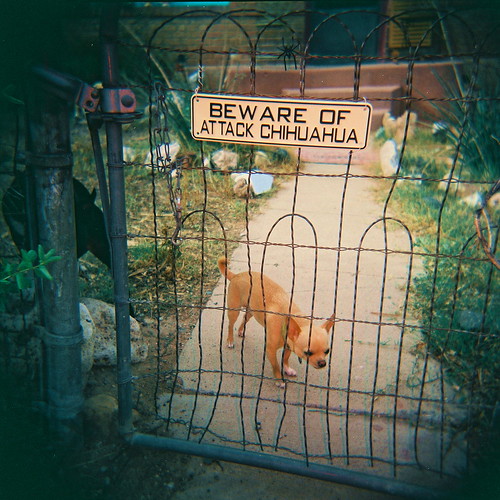
beware!

Before anyone writes me a letter telling me I should have my vicious beast “put down” (as someone once suggested), he’s no public hazard. He’s actually an obedience school graduate and completely well-behaved on every other level. You’re safe. Just as long as you don’t try to pet him.
The dog only stands about 1 foot tall, and weighs 5 ½ pounds, with tiny twig legs. “Five Pounds of Fury” is what we call him, but he’s not bloodthirsty and won’t aggressively charge you, unless you get too close or accidentally appear menacing. Also, I’d advise against approaching our house, or car. He’ll really go bananas trying to protect “his property.” There’s a reason I have a “Beware of Attack Chihuahua” sign on the front gate. Folks think it’s a joke. It is not!
            If, even after the many prior warnings, you’re foolish enough to get down to his level and offer him your fingers, you probably deserve to be bit. A big football player guy we knew owned a Bull Mastiff, same age as Floyd, but 150 pounds bigger. Being a fan of big dogs, he always thought it silly how small Floyd was, and took great joy in teasing him into a frenzy, poking at him and poking at him, until finally we heard an incredulous “OW! The little [censored] bit me!” The thick-necked football player was cradling his crumpled hand, blood streaming.
             Floyd looked up at us embarrassed and slightly relieved. His bitey behavior is a lingering anguish to me, since I am so friendly to everyone I meet, and yet my dog is exactly the opposite. In perhaps a bit of karmic payback, Floyd has lost more than half of his choppers, pulled by the vet during routine dental care due to typical small dog tooth defects. (He still has most of the important ones, though, so don’t try to sneak up on him just yet.) I wish I’d thought earlier to have them save all of those tiny teeth, so I could make them into a sharky necklace for Floyd to wear when he is an old man.
            To his friends and the people he knows, he is sweet, frisky and lovable. He likes to run laps around shoulders and lick noses. One can transition from stranger to friend in Floyd’s eyes. It is possible to break on through to the other side, just by investing a little time and patience. I’ve seen people go from “I will rip your face off” to “Hooray! I love you!” in as little as a week. He’s a complicated dog full of deep emotions.
Despite his complexity with strange humans, he is wonderful with strange dogs. We joke he is a “dog ambassador,” as all canines love him instantly. Confident and approachable, he is always able to woo friendship from fellow pups. He’s even befriended some strange rodents, mules and cats.

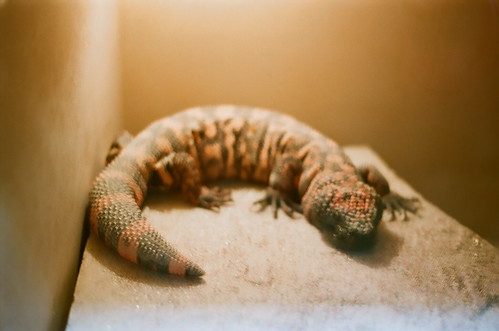
Dogs’ mouths are relatively clean in comparison to humans, and house cats. Domesticated felines are among the worst when it comes to infection-prone bites, perhaps second only to the Gila Monster.
gila monster in the reptile house

The desert Southwest is home to many sharp, barbed dangers that can chomp you: cactus, “goatheads” (a.k.a. puncture-vine), rattlers, and many venomous bugs. Technically insects don’t have teeth, but it doesn’t prevent them from issuing pesky bites to other living creatures. Bed bugs, fleas and mosquitoes survive on our blood. Arizona has some scary venomous arthropods, like the Black Widow, the Brown Recluse, and the lobster’s scariest cousin, the Scorpion. We’re unfortunate to be neighbors of the Hualapai Tiger, or “kissing bug” that lurks in the night causing frightful welts on many of my pals. My least favorite biting bug in Yavapai County, however, is the Cedar Gnat, or the No-See-Um. They get me every time, and I swell up in miserable blotches.
“This bites!” we might yell, or “Bite me!” Overall, despite the erotic nibbles of romance, getting bitten is considered not all that pleasant an experience. Our teeth fail us. They give us strange dreams. They crack, decay, fall loose. Even with their fragility they’re sometimes all that’s left of us at the end of the road. Everything else goes back to dust, but our bones and teeth remain as one last identifying marker of the person that once was. What kind of diet we had, how old we lived to be. How we looked when we smiled.

Happy Halloween from Clarkdale!
Happy Valentine’s Day to all of our loyal Noise readers!

Ellen Jo Roberts got toys from her childhood dentist, Dr, Marvin Berman.
She still has her favorite, a rubber pig named “Dr. Berman’s Pig.”
She lives in Clarkdale with a whole lot of toothy creatures.


Read all about it at http://www.ellenjo.com/

Monday, December 20, 2010

Saving Eliphante

Saving Eliphante
January 2011
The Noise
The Outs
Ellen Jo Roberts

“Eliphante is unique in all the world, born from the pure creative well at the core of the human spirit, unhampered by regulations from without. As a result, it speaks to that place of creative power in each of us, and most people respond with both awe and excitement about the possibilities of really living by one's inner striving for beauty, really making it manifest, in all aspects of one's life.”
-Alna Laurel, director of Eliphante.

inside pipe dreams

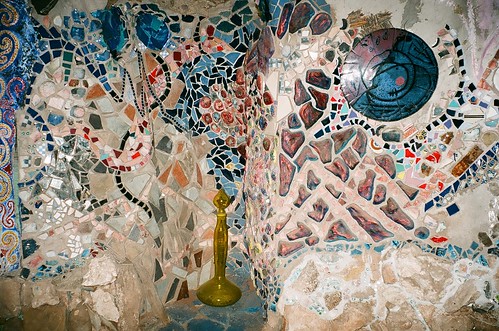
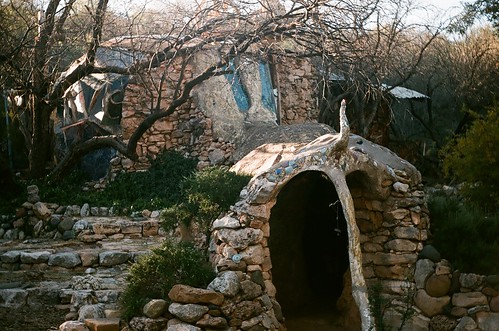
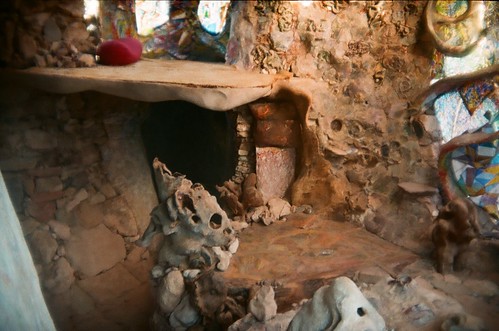
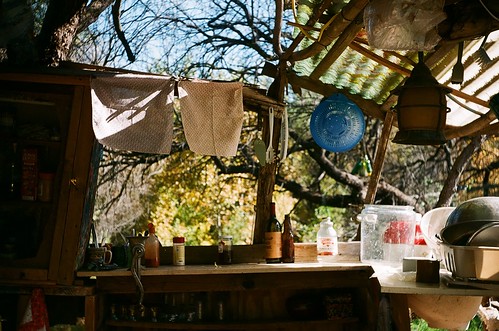
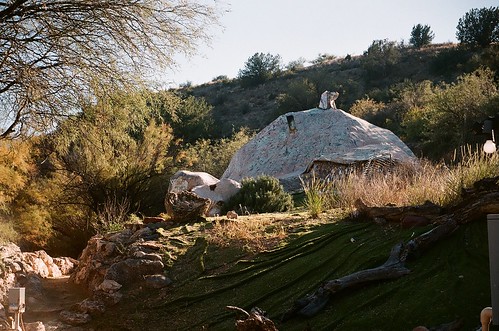
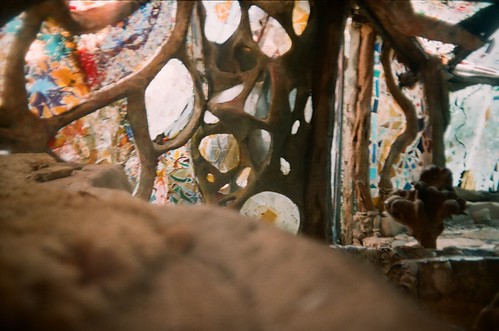
Beginning around 1979, and continuing for the better part of three decades, Michael and Leda Kahn created a magical folk art installation along the sycamore and mesquite-lined banks of Oak Creek in Cornville, Arizona. The entire complex is known as “Eliphante”, named after the first structure created, which resembles, with its ear-side doors and river wood snout, an elephant of sorts. Several buildings followed: the “Hippodome”, “Pipe Dreams”, smaller houses, outdoor kitchen, amphitheater and assorted art installations. The structures and art spaces are all designed with native natural materials, sandstone, wood, salvaged glass, mylar, foil, tile and metal, and many years of creativity, love and hard work. With its faded astro-turf pathways, donated by a Sedona tennis club, it's like a surreal mixed-media miniature golf course. It’s an open-air museum of alternative possibilities. Eliphante is a dreamscape.

It is also currently endangered: threatened by decay, crumbling infrastructure, and sitting on land at risk of being sold and leveled.

eliphante entrance

Traveling from Provinceton, Massachussetts in a 1960 Ford truck they called “Botchi”, Michael and Leda Kahn arrived in the Sedona area in 1977, artistic visionaries looking for a new way of life. It was not long before the Kahns connected with the Croziers, the landowners of the acreage that includes Eliphante’s parcel. The Croziers were also transplants from “back east”, and soon the Kahns were invited to become caretakers of the property. . The Croziers are benevolent landlords, generous and philosophical. A dynamic relationship was developed.
“The property is at present still owned by the original owners who invited Mike and Leda as caretakers back in '79”, states Ms. Laurel, “They originally bought 120 acres as an active cattle ranch, not in operation for many years, and have sold some of it. They had owned it only a few years before Mike and Leda entered the picture.”

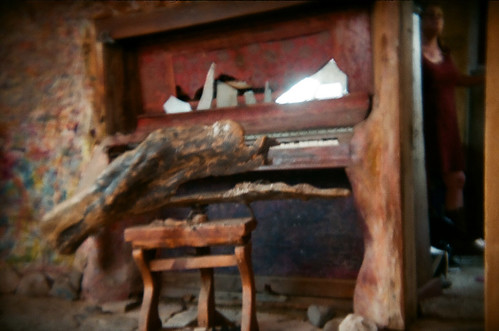
piano and secret natasha

The Kahns were sheltered at first in a truck-bed camper during the warm seasons. “As autumn came along, Mike felt moved to begin constructing a warmer winter shelter by digging into the hillside back of their camp, with earth insulation in mind,” explains Ms. Laurel,
“He gathered rocks from the hillside and from a dry wash half a mile back of the camp area, where he walked daily, both morning and evening, and brought back as many rocks as he could carry on his back in burlap sacks slung over his shoulder. Sometimes it would be two or three good-size stones. Other times, one would be all he could manage, it was so big. Usually he would get Leda to go along and carry her fair share as well.”

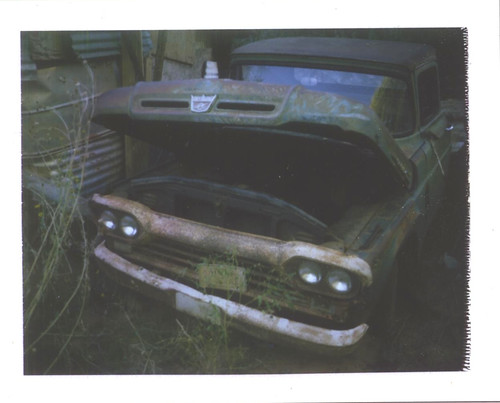
old ford with 1973 plate

“The building called Eliphante was built to be the home of Michael and Leda, but became in process such a work of art that it was never lived in. Though it served as stage for weekly music jams for many years, and also sheltered a few overnight guests on occasion, with or without the knowledge of Mike and Leda,” says Ms. Laurel, “This building with no straight lines or flat surfaces, made of found objects both natural and man-made, combining such disparate elements as driftwood and old auto windshields, manages to evoke the same high wonder and longing for what is true and pure and good as Tolkein's Elvenhome of Rivendell. Or at least the Hobbit homes of the Shire. A longing for times more innocent when creativity was unfettered by rules and unconfined by preconceived ideas of how things must be.”

hippodome interior

John Bianchini, a member of the Noise family (and former editor), is part of a small group of caretakers who currently inhabit Eliphante. An NAU journalism graduate originally from Salinas, California, Bianchini had the pleasure of meeting the Kahns in 2005, while taking photographs for a Noise feature written by Natasha Shealy. "Most who knew Michael cannot explain what Eliphante's intent was. It was never really an issue then. They do echo that Michael lived his life 'in-the-moment' and that he would just set-out and create these things whether or not people liked it or helped him.”

feeding the goat a handful of mesquite flour

Mr. Bianchini is actively involved in the preservation of Eliphante, and rousing folks to action on its behalf. “They call us ‘caretakers’, but I like to think of myself as ‘Guerrilla Outreach’ because I try more to get people involved to decide what should be done before going out and just doing it.”
"For many people, Eliphante reflects individual perceptions of where we are mentally. While a few have been put-off by its poverty and ruggedness, most see it as a magical land just short of gnomes and fairies”, says Mr. Bianchini, "Living in art is a way-of-life; something most people yearn for. Americans don't have much art in their daily lives and that might be the reason for the decline of American civilization.”

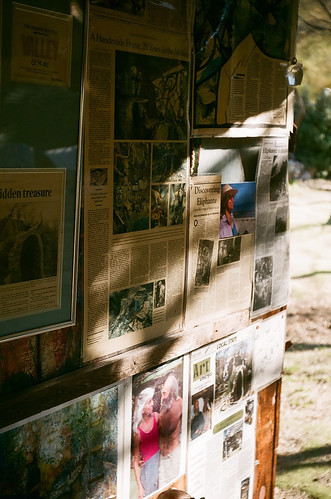
In 1994, the Smithsonian American Art Museum catalogued Eliphante into its “SOS-Save Our Sculpture” public awareness project, a growing list of U.S. public sculptural art to be documented, and conserved.

Michael Kahn of Eliphante, Paolo Soleri of Arconsanti and renowned Arizona sculptor John Waddell were all friends, and are considered to be artistic contemporaries because, according to Mr. Waddell, they “all sought to create something that could change society,” and they were “the rare few with the training and skill, willing and able and disciplined enough to follow their vision despite the obstacles that would hold most people back.”
Verde Valley resident Waddell is fond of Eliphante and what it represents.
"Michael was a man who had a vision of a completely non-commercial form of art,” says Mr. Waddell, “That in of itself was the motivation and satisfaction that it was made not for the market but for the total being of heart, soul and mind."

Waddell believes Kahn's unique nature had roots in art history. Michael Kahn started as a conventional painter and gradually became non-objective in his handling of materials. This transferred into building of structures that were in a sense non-objective. "At Eliphante you have an account of his day to day experience of putting objects together in an interesting way...'The uniqueness of configuration' is a cohesive construct where he had the impulse to put these found materials together."
The sculptor thinks Eliphante hints at a different way of life where the normal impulse to earn money did not exist. In some cultures, money is not the primary value. “Anyone can be as creative as Michael was. If you can understand this then you are on a progression."

In 2008 Michael Kahn succumbed to Pick’s Disease, a form of Alzheimer’s. In his final years he lost the ability to communicate verbally, but this did not stop him from continuing his creative flourishes and projects at Eliphante.
After his death, Leda moved away, to Santa Fe, New Mexico,

eliphante outdoor kitchen

Alna Laurel is the director of Eliphante Ltd., a 501c3 art organization. Her working relationship with Eliphante began in the late 1990s, but her path to it started much earlier, in the mid-1970s, while camping with her father and sisters at the entrance to the old Sexton Ranch in Cornville. Her family camped in the location for years. “While there, my dad met a man who was buying property across the creek from our camp, and the two of them held many long discussions on spiritual and philosophic matters, to mutual satisfaction. When Dad decided to move on to other camping grounds, his friend expressed disappointment that the philosophizing days were to be over. But Dad assured him that someone else would come along to take Dad's place as a spiritual friend.”

wall of fame

Ms. Laurel grew up to lead a creative life unfettered by convention, yet full of travels, adventures, artistic pursuits, family, and continuing education. Fast forward to 1998. Ms. Laurel’s sister, Laurie, searched for their old camping grounds during a road trip through Arizona.
“Finding her way mostly by instinct to the general area she remembered as our home, my sister stopped to ask directions of someone who turned out to be Michael Kahn, out cleaning the culverts at the entrance to Eliphante. Mike said he did indeed know the man Laurie was looking for. He owned the land Mike was camping on. He invited Laurie to look around his camp, which she did with mounting enthusiasm and excitement about all the magical structures defying every common idea of what a building should be.”

hippodome exterior

“When she went on to meet our old friend who owned that land and had given Mike free reign to build according to his artistic spirit, he told her that Michael Kahn was the one who came along to take our Dad's place as a spiritual friend across the years. And the relationship had been mutually beneficial, the one providing a piece of land and the other a spiritual artistic vision and creative drive which together resulted in Eliphante, a magical inspiration to most who are lucky enough to visit it.

“Naturally, as soon as I could I went to see Eliphante as well, and fell in love with it like most people do who visit.” Ms. Laurel moved from Hawaii to Cornville, “But I didn't get much involved until near the end of Mike's life when his Pick's disease had progressed to the point of speechlessness on his part and plans to leave Eliphante on Leda's part.”
In 2008, Ms. Kahn was present to hear Leda Kahn’s lament about having no one to carry on Eliphante on after she left. “Moved by my love for the place, I boldly volunteered,” said Ms. Kahn, ”only to discover that I knew nothing whatsoever about how to carry it on! I didn't even know what a non-profit was, much less how to operate one.”

eliphante glass
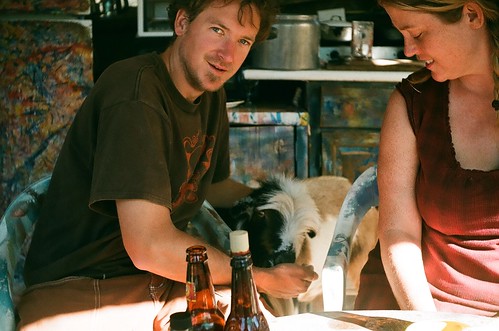
Caretakers Ryan Matson and Tracy Schinagel arrived from Portland in 2010, and have called Eliphante home since August, along with their clever and handsome dancing goat, Midas, who nibbles away at weeds and provides manure for gardening. Matson and Schinagel are energetic and artistic; a good blend for Eliphante.

Ryan & Tracy, caretakers of Eliphante

“I have never had the pleasure to meet the Kahns”, says Ms. Schinagel, a charming Tuscon native with a broad smile, “I feel like they created Eliphante out of the desire to surround themselves by beauty and art. They wanted to create something practical with the limited amount of funding available to them. In order for Eliphante to own the land it sits on, it needs to raise enough money to buy the well. If we don't raise the money to buy Eliphante, the land could be put on the market and could be purchased by someone that doesn't have any interest in preserving it.”

photo by Ryan Matson

“When I was younger, I wanted to be an architect”, says Mr. Matson, who spent many of his younger years on the move, “Buildings seemed to be all of the world I could really shape. Then I grew up and went into college, trying my hand at piloting airplanes, civil and mechanical engineering, electronic engineering. I settled on community development with undergraduate studies in the College of Urban and Public Affairs at Portland State University.”

In addition to raising the estimated funds for purchasing the property, the director and caretakers are also actively involved in much of the politics and paperwork necessary to preserve Eliphante for the future. The organization estimates they need to raise $75,000 -$100,000 to buy the land where Eliphante sits.
Ms. Laurel says, “Secondarily, we need to repair the three main sculptural buildings: meaning, lots of materials, donated or about $30,000 to buy, and lots and lots of volunteer hours. Probably the primary danger right now is the deterioration of the sculptural buildings, the heart and soul of everything. Whether their repair comes about through funding and volunteerism raised by the 501c3 or through paid labor in case Eliphante becomes purchased by another entity, I am fairly certain the buildings will be repaired to a better quality than they were originally built, beginning 2011.”

Mr. Matson adds that further plans include establishing public access rights, so that they may have commercial activity to generate funds to preserve and restore the land and buildings. Smaller buildings are being patched against rodents and poor weather conditions. Solar showers, composting toilet system, and greywater gardens are also on the agenda. The roof at the Eliphante building is in dire need of repair.
“We are always looking for able-bodied spirits to volunteer at one of our workdays,” says Mr. Matson, his enthusiasm contagious to all who meet him, “We also need donors of money and materials and other long-term financial support. The community we share is the most important asset toward the vision's success. ”
“We would like for it to be a creative space or retreat for artists,” adds Ms. Schinagel, “We would also like to open it for tours to the public.”

2010 american gothic

Noise favorite Natasha Shealy has returned to the Verde Valley from her North Carolina home in order to participate in saving Eliphante. According to Ms. Shealy, “Eliphante needs to be protected and used to inspire. I struggled with this, feeling it might be best returned to the riverbank it came from. But I feel Eliphante needs to be identified as a community asset and international folk art treasure. Many in the international folk art world would be inspired and astounded.”

"We cannot live how Michael did,” says John Bianchini, “but we recognize its value and seek to reconcile the two forces. When a commercial operation can be established to bring in income for Eliphante, we plan to focus on Eliphante's immediate repairs while working to purchase some surrounding acreage if available then to create an artistic eco-village.”

There are many ways you can become involved in the preservation of Eliphante.
They have a weekly Sunday evening potluck, and work party sessions each Tuesday and Sunday, where volunteers can help create, build, restore, and repair.

Volunteer: call Alna Laurel at (928) 634- 4707,
or Ryan Matson, Tracy Schinagel, and John Bianchini at (928) 634- 2687.
To assist in repairing the roof of the original building, "Eliphante", contact volunteer coordinator: Michael Lanning at (928) 284- 8884

Donate: make check payable to “Eliphante Limited”, and mail to PO box 971,Cornville, AZ 86325

Online: Roadrunnerspeaks.org. Also be sure to join “Eliphante Village” on Facebook.

Other: Donating special knowledge or skills is also greatly needed and appreciated. In particular: non-profit legal advice, film-making for publicity and fund-raising, grant-writing, and special construction skills such as rock-work, roof-work, reinforcing of highly unusual post and beam connections, electrical engineering and plumbing work.Eliphante Ltd. is also seeking volunteers to organize and staff fund-raising events in January, February, and March 2011.

“Eliphante remains a place where one can go to feel re-inspired and have their sense of magical possibilities refreshed, and for this reason alone, it is worthy of preservation,” says Alna Laurel, “Add to that its potential as a venue for awakening people's creative spirit and teaching how to let it blossom, and it becomes an urgent need in the present state of chaos and banality much of our society is experiencing. Where the human spirit feels acknowledged and empowered, there hope and renewal are born and sustained.”

pipe dreams- windows and mosaic

Ellen Jo Roberts thinks Eliphante is the bees knees.
She lives in a historic home made of Verde River sand bricks in Clarkdale Arizona with
Bike Daddy Chad, Cool Clyde, “Five Pounds of Fury” Floyd, and Slobber Face Ivan. Read all about it at Ellenjo.com.