Friday, May 21, 2010

Being Mexican is Not a Crime: SB 1070 and the Boycott of Arizona


Being Mexican is Not a Crime:
SB 1070 and the Boycott of Arizona
The Noise
June 2010
The Outs
Ellen Jo Roberts


Just when the rest of the country had almost started to forget the 1990s Martin Luther King Holiday debacle, Arizona is back in the daily headlines for a poorly presented pseudo-racist government policy. Governor Jan Brewer’s quick acceptance of the vaguely worded State Bill 1070, in a bid to curry Republican votes for election season, has polarized the state and the country. Arizona, heartbreakingly beautiful love of my life, has been reduced to a punch line, a punching bag. It pains me to see it so mishandled.

Arizona’s survived bad governors before. Remember Evan “Pickaninny” Meacham, the first Arizona governor to be impeached? Fife Symington was a swindler who resigned office after being convicted of fraud. Jane Hull used the state’s helicopter for personal travel. Now we have Jan Brewer running roughshod over the landscape, closing state parks, deregulating gun permissions, legalizing fireworks, and cutting the Arizona Office of Tourism’s budget by 70%, with seemingly little thought of the impact. The ill will generated by SB 1070, closure of parks, and the snuffing of a proactive tourism program will have a long lasting impact on our state’s reputation and economy, long after Brewer’s appointed term expires.

For a country so lion-hearted as the USA, always running to the assistance of countries half a planet away, it’s a bit incredible we’d not invest more thought and positive energy into the situation with our very own next door neighbors.

There is a silver lining to all this. There is a correct answer on immigration policies that could eventually take shape from all of this uproar. But, as of today, it’s not yet arrived. Both right wing and left wing arguments hinge on something sensational, partial truths, fear. Perhaps at some point, folks could discuss this reasonably, rationally. There’s a sense of general disappointment that our former Governor Janet Napolitano, now Secretary of Homeland Security, hasn’t yet championed something more proactive and positive at the federal level in regards to illegal immigration. Arizona’s answer, building fences and questioning citizenship based on a hazy set of suggestions seems distinctly negative, backwards, and so very 20th century.

Mexican President Felipe Calderon calls the new law “discriminatory”, and warns that Mexico will not support the criminalization of migration. He blames the United States’ big appetite for illicit drugs as a primary cause for border breach. The Mexican Foreign Ministry issued a travel advisory for Mexican nationals visiting Arizona, warning, “It must be assumed that every Mexican citizen may be harassed and questioned without further cause at any time.” President Barack Obama had cautioned Governor Brewer against signing the bill, though acknowledges the bill arrived as a “misdirected expression of frustration” due to the lack of solutions at the federal level. The president is enlisting the federal judicial committee to review 1070, line by line, due to his concerns it has the “potential to be discriminatory.” One week after the bill was approved, additional modifications to the bill, HB 2162, were passed, addressing and correcting racial profiling aspects to 1070.

Those supporting the bill are generally proud of Arizona’s tough maverick stance on illegals, attempting to take control of a situation the federal government hasn’t.
Those against the bill say it’s unconstitutional, fascist, against civil rights of American citizens, who now may be targeted by patrol simply for being of Mexican heritage. It sends an unfriendly message to international companies and travelers.
“Show me your papers” sounds a bit Gestapo.

Governor Brewer insists the bill would only apply to people who commit suspicious and potentially illegal acts. Such as speeding, loitering… or perhaps just appearing the slightest bit like an illegal alien, the overwhelming majority of which in the US are from Mexico. Brewer’s F.AQ. info sheet assures if you’re an American citizen you don’t need to carry documentation (…unless maybe you’re a Mexican American? In which case, you’d probably better.)
Enforcement of 1070 falls squarely on the shoulders of Arizona police.
Police support of the bill is mixed, with statewide police officers generally pro, and the Arizona Association of Chiefs of Police generally against. They already have their hands full with daily local situations, in addition to attempting enforcement of immigration policies, technically an issue that falls under federal jurisdiction. President Obama expressed concerns that 1070 “would undermine the notions of fairness that we cherish as Americans, as well as the trust between police and our communities that is so crucial to keeping us safe.” How will 1070 be enforced? A DVD with complete step-by-step instructions will be sent to all Arizona Police departments prior to the bill taking effect in July.

It’s what I’d call a Trojan Horse law. The government expands its powers in ways we’d normally see and agree are unconstitutional by wrapping said expansion in an emotionally charged set of circumstances.”- Phoenix Arizona man

Right wing fundamentalists will attack you personally if you disagree with them. They will question your education, your religion, your patriotism, make threats, and could very well show up at your front door with a shotgun. They title their jingoistic letters to the editor “Illegals Go Home!”or“America First” and bark in ALL CAPITAL LETTERS.
To hear them tell it, their family arrived here “legally” via the Mayflower, or Ellis Island, learned English immediately, worked steadily, paid their taxes promptly, and every one of them fought in our armed forces. None of them ever even so much as made an illegal U-turn, or ripped a “do not remove under penalty of law” tag off a pillow. To them, the Mexicans are a faceless flood of humanity streaming over the border unabated, not speaking English, not paying taxes, stealing our government services, living on the dole, and getting free health care. And unlike we Americans, the Mexicans are criminals! Gangsters, murderers, pimps, drug dealers, rapists! And if you don’t agree, then maybe you’re a commie pinko and you’re part of the problem, ya’ damn hippie bleeding heart liberal. The truth, like everything else in the United States, is a bit more complex. The Mexicans are like us in more ways than they are different.

White people are so quick to forget their Italian, German, Polish and Irish ancestors also faced persecution when they came over here; many ‘illegally’ as well. How quickly we forget…or find some reason to justify this racism.” –Chicago man.

The left wing, on the other end of the spectrum, shout through the streets with signs and swastika t-shirts, demanding Arizona be boycotted as punishment for this affront to human rights. They demand the Lakers wear “Los Lakers” jerseys when playing “Los Suns”. The Arizona Boycott was actually initiated by one of our own politicians, Congressman Raul Grijalva of Arizona’s 7th Congressional District. Seattle now joins the ranks of several other West Coast cities officially “boycotting” Arizona, including San Diego, Los Angeles and San Francisco. Heavily Hispanic pro-baseball teams
have entertained thoughts of relocating their spring training camps from Arizona. Phoenix officials estimated a potential loss of $90 million dollars in canceled tourism and conferences. I’m basically a lefty, a Democratic fish swimming forever upstream in Republican stronghold. I’m accustomed to people disagreeing with my politics.
However, the “activists” and their boycotting are just as unreasonable as the fear mongering right wing. One must wonder how many of them have even read the bill, and how many have merely jumped on a bandwagon of negativity because it’s currently the cause currently in vogue. Boycotting Arizona is wrong, and it will hurt all the wrong people: the working class folks, the small businesses, the school and park systems.

Arizona has only been a state for 98 years. Prior to that, it was a territory. And before that, for much longer than it’s been any part of the USA, this land was property of Mexico, shared with the native tribes who’ve inhabited the land since time immemorial. The Chicano culture is the fabric that holds Arizona, a state full of snowbirds and transplants, together. This stirs much of the anger surrounding the new law. Mexican families with history here far longer than many of us more recent arrivals will now be potentially suspect.
“Clearly, and bluntly, the state law is racist and discriminatory against so-called ‘illegal immigrants’ crossing the borders from the South, namely from Mexico,” said Simon Ortiz, a Native American Studies Professor at Arizona State University, “Many of the border crossers are indigenous peoples who are directly affected. Without any doubt, the law is wrong headed; it targets people who fit a certain profile.”

Self-righteous supporters of SB 1070 conveniently neglect to mention that however “legally” they believe their ancestors arrived, they were still setting foot on land forcibly taken from Native American tribes. Perhaps Arizona’s Hopi, Navajo, Yavapai Apache, Havasupai, Pima, Maricopa, and Tohono O’Odham tribes should start asking us all for our paperwork.

Bottom line is, we’re ALL illegal! We stole this country from the Native Americans! They should tell us all to get the f #!&* out!”- Jerome Arizona woman.

The Federal Immigration and Nationality Act, already in effect nationwide, states that any alien citizens present in the U.S. must present documentation upon request. American citizens are required by law to present drivers licenses and proof of insurance if stopped by highway patrol. Traveling through most European nations requires frequent presentation of identification, even within borders. In Texas borderlands, police strictly monitor roads, asking for documentation from all.

“Don’t even get me started. Here in El Paso, Border Patrol and police are pulling us over and checking our identification all the time… I think illegal immigrants are a slap in the face insult to people like my father who immigrated here legally.”- Texas woman.

People (from all countries) immigrate here illegally because we have a demand for cheap, below minimum wage labor. Many industrial and agricultural economies are carried on the backs of illegal laborers. This is 100% our fault. Despite rigid laws already in place in Arizona, sanctioning business owners with substantial fines for lacking proper documentation of their employees, illegal immigrants still find work easily. Most of the Mexicans I know, legal and illegal, are extremely wary of the government, being basically distrustful of their own, and tend not to go anywhere there’s paperwork. This includes any type of social services. According to Department of Homeland Security statistics, illegal immigrants are estimated to pay about $7 billion dollars per year into Social Security, a system from which they will never reap any benefit.

US Immigration allows illegal immigration, in fact encourages it! The nation’s cheap industrial food production and processing depends on immigrant labor. Folks want cheap food, but they fail to link the fact that it requires cheap labor!”- Washington state woman.

Fact: It is not easy to become an American citizen. You cannot just show up and sign the guest book, like people joke. It’s grown a bit more complicated than it was when the Statue of Liberty waved folks into Ellis Island. Back then, you got photographed, examined, quarantined, perhaps given American-ish new names to better assimilate, and sent on to your way. In order to apply for citizenship in the 21st century one is generally required to have family already here, or marry into one. You need to have special work skills, and/or an education of value to our country, or be seeking political asylum.
After 5 years of “Resident Alien” status, one may apply for naturalized citizenship.
It is a lengthy process.

Approximately 140,000 immigrant visas are available each fiscal year for aliens (and their spouses and children) who seek to immigrate based on their job skills. If you have the right combination of skills, education, and/or work experience and are otherwise eligible, you may be able to live permanently in the United States.”
- United States Citizenship and Immigration Services

100 years ago, when my maternal great grandparents arrived on the Cunard Line’s “Ultonia” from Serbia, all you had to do was pretty much show up. In 1910, as the Ultonia entered New York Harbor, my grandmother was born on board and became an instant citizen. My great-grandmother, Ana Komlenich, lived in Chicago for 75 years without ever learning more than a few words of English. She signed her name with an “x”. She laughed uncontrollably at The Three Stooges. Despite her lack of assimilation, my great grandmother was part of our nation’s story just as much as anyone.

A woman requesting to be known only as an “Anonymous Business Owner and Long-time Tax Payer in Arizona” shares her thoughts about SB 1070:
I am against any frivolous law. It is already illegal to be here illegally. If you get stopped for a traffic violation and you don't have a valid US driver's license, it is already in the authority of the officer to request additional documentation…As a US citizen, if I was pulled over, could not produce a valid driver's license AND lied to the cop about my address, I am going to JAIL, regardless of my citizenship status,” Ms. Anonymous continues, “People on both sides of the argument (and let me tell you, I have had knock down drag out fights with people on both sides) have completely lost sight of what this law actually says. Most of the arguments I hear for, and some against, have absolutely no bearing on the actual content of this absurd law…

“I know ranchers along the border, and there is no way that this law is going to stop coyote and drug violence as they cross over. In fact, all this law is likely to do is catch a few illegal immigrants who have already been here for a while and are too dumb to A) not get a fake social security card, then valid driver's license and/or B) not get stopped for violating a traffic law--all this is likely to be LONG after they have crossed the border…

“Yes, immigration is a problem, but SB1070 isn't going to actually DO anything but piss off everyone. If Jan Brewer's only intention was to call national attention to a problem, then this was inarguably a tremendous success. Arizona is now the object of hatred the world over. Yippee!”

Obviously, an immigration reform needs to happen. For the safety and dignity of all people, both citizens of the US and citizens of the world. Checking documents will not keep out the drug cartels and the high dollar criminals who can afford the best paperwork and bribes money can buy (-just like banning guns will not prevent the criminal element from owning them.)
People don’t just cross the border in the dark of night. John McCain’s fence won’t keep them at bay. They cross on the highway in broad daylight. They arrive in cars, planes, boats, trains. They come as tourists and overstay their visas. And despite popular belief, they’re not all from Mexico.

“I don’t hear that they’re going after all of the illegal Irish immigrants working in New York bars.” – Brooklyn woman, currently residing in Scottsdale AZ.

Illegals pay thousands of dollars to unscrupulous middlemen to be stuffed into trunks, or packed tightly into the backs of vans. In Arizona, coyotes dump them off in the most dangerous stretches of lonesome desert, to battle the devastating heat of summer, and risk death by dehydration. Leaving trails of garbage, clothing, blankets, plastic, diapers throughout the desert, depending on the kindness of far flung ranchers to supply water.
It’s truly surprising that capitalist America hasn’t realized they’re missing out on a real goldmine here! A big money maker for our weakened budgets. Instead of paying coyotes for illegal passage and risking their lives to arrive in the U.S., immigrants could pay the U.S. government, to register into work program, complete with legal documents, and safe journey into the United States. Illegal immigrants already here could register for such a program as well, perhaps with references, background checks, employers and sponsors getting involved.

Hey smart people of beautiful Arizona!
Let’s entertain some better ideas on how to deal with this issue.
Instead of shouting over each other ALL IN CAPS, maybe instead we hash out the best of our ideas, stir them in a melting pot called America, and make something good out of all this.


Ellen Jo Roberts lives in an undisclosed location in Clarkdale Arizona.
She wrote a letter to Governor Jan Brewer. She’s not yet heard back.
www.ellenjo.com

Wednesday, May 5, 2010

Homes of Jerome- History on Every Corner


Bob Bradshaw photo

Homes of Jerome
May 2010
The Outs
Ellen Jo Roberts

When we lived in Jerome, people always asked us how we did it. Tourists would stop their rental cars in front of our house, as we sat on the porch eating our breakfast. They’d bellow: “Where do you buy your groceries?!” and take photos of us like we were monkeys at the zoo. It always gave us a chuckle. People want to know how you Jerome folk do it. It’s a bit more magical and inconvenient than most other towns. Everything is vertical there. The outrageous views, picturesque buildings, vintage style, and overall dreaminess are tempered by the crooked, crowded parking, nosy neighbors, narrow side streets and crumbling infrastructure. Jerome is simultaneously everyone’s fantasy and nightmare. It takes a hardy breed to inhabit it, and keep it alive.

The first Jerome Home Tour took place in 1966, making this May’s tour the 45th annual, and longest running tour in Arizona. Jerome in 1966 was still a ghost town, just newly being discovered by hippies, artists, and counter culture types who brought it back from the dead. In the past 45 years, Jerome has become something quite different: a bustling economic success, a major tourist draw full of fabulous art galleries, boutiques, adorable accommodations, and an amazing collection of premium restaurants and cafes — far more than you’d expect in a town with a population hovering right around 350 residents. On the weekend of May 15-16, you can see for yourself how Jerome folk thrive and survive with their antiquated plumbing, steeply angled streets, and awesome 75-mile view.

This year’s home tour will feature a great selection of both vintage and modern homes on the seldom seen side streets of Jerome, as well as commercial structures, like the Connor Hotel, the United Verde Apartments, and the recently restored Audrey Head Frame. The Christ Church of Jerome, built in 1927 and now home to the Jerome Historical Society, is also part of the tour’s itinerary. Tours will take place from 9AM to 3PM each day. Transportation will be provided to each location, but the tour, with many steps, and steep paths is not wheelchair accessible.

Cheifetz Cottage
Steve and Karen Cheifetz are Phoenicians who purchased their historic Jerome cottage 8 years ago. The simple structure was home to Jerome miner, Damian Gutierrez and his family. Señor Gutierrez corralled burros near the house, as a tourist lure for photo ops.
His talented son, Alfredo, was born in 1929. Legend has it, when Alfredo was a child, his incredible singing voice and dancing style earned him tips from miners each pay day when he performed on top of the bar at the Spirit Room. Young Alfredo would often return home with more money than his father's weekly salary. A Hollywood talent scout wanted to sign him up to become the next Mickey Rooney, but his strict parents forbade it. Alfredo's boisterous personality did not let up in later years.
As an adult he continued to perform music, and opened a restaurant where he would entertain guests in between cooking meals. His restaurant was in the location currently home to Cottonwood’s “Georgie’s.” Alfredo later shared the Gutierrez family home with his fashion designer wife, Ava Dering. Known popularly in the jet set as “Alfredo’s Wife,” she achieved some nationwide notoriety in the 1970s and ‘80s for her wild and colorful fashions.
How did the Cheifwetz family become part of the home’s history?
“It's a long story,” says Ms. Cheifetz, a native Ohioan who arrived in Phoenix in 1983. ”Steve introduced me to many different towns in Arizona years ago. When he decided to share Jerome with me, he said I would fall in love with it instantly. We had hopes of getting a place there someday. While sharing Jerome with our kids years later, we spotted a for sale sign. We called to check out houses and bought our home the next day!”

Attracted by “the beauty, the lifestyle and people, the music, the historical preservation and of course, the natural surroundings,” the Cheifetz family is now part of Jerome’s story. With extensive garden and stonework, the cottage boasts one of Jerome’s loveliest yards.
“Some would see the town’s commitment to preserving Jerome’s history and character as a challenge, but that is one of the things that drew us to town. The fact that new and long time residents feel a sense of honor and duty to keep out commercialism and contribute to the community is heartwarming,” says Ms. Cheifetz.


Ron Chilston photo

The Mills House
Perched high above town on “the Boardwalk” of Company Hill is a renovated Victorian, named for past mine supervisor, Carl Mills, who lived there with his family. Their son, Mark Mills, a Frank Lloyd Wright disciple and one of the foremost architects of his time, was born in the house. Originally built in 1898 for use by mine managers, this beautiful Victorian home was occupied by the Mills from approximately 1921 to 1950. They were likely its longest-term residents.

During the last half of the 20th century, the home suffered much neglect. By 2003, the roof was partially collapsed, and much of the house was filled with earth from the hillside above. The beautiful redwood facade was held in place only by vines of ivy. Many of the beautiful Victorian accents had vanished due to weather or vandals. Local resident and realtor, John Scarcella, renovated the home, utilizing the original interior floor plan, raising the roofline and adding dormers to create a full-size second story.

Tucson residents Deneill and Bill Phinney purchased the home in 2006. At the time, Mr. Phinney was preparing to retire from his career as a railroad engineer for the Union Pacific, and the couple began entertaining options for the next stage in their lives.
During the summer of ‘06, the couple headed off on an unstructured vacation, wandering north towards Utah. “At a stop in Phoenix, we picked up a brochure for the Verde Canyon Railroad and saw Jerome marked on the location map. My husband had never been to Jerome and the last time I had been was when I was in my early teens. I had fallen in love with the place then, so we decided to see what it was like now … We fell in love with the area, the town and the people … and then we fell in love with our house. We were walking around one day and saw the ‘for sale’ sign.” Fate struck.

Ms. Phinney continues, “One of my dreams has long been to live in a Victorian. I used to live in San Francisco and would walk around looking at the houses with all of their bright colors and charming gingerbread. While we were in the process of buying the house, we would periodically sneak up to sit on the front porch and look at the view. The front porch is probably our favorite part of the house, even now. Well, with the exception of in front of the fireplace, when it is snowing. And the garden when the lilacs and roses are in bloom. Oh, and the quiet corner of the bedroom upstairs which is set up for meditation and reading … I guess we just love everything about it! "


Ron Chilston photo

The Sullivan House is the oldest home on this year’s tour, dating from 1886.
It was also one of the earliest historic preservations, as part of the 1970s Restoration Commission’s project to conserve and restore the Victorian homes of Company Hill. The Restoration Commission was formed by a group of Jerome hippies who had a notion to save the old architectural gems of Jerome. Saved by the counterculture, just like much of this eccentric little city!
At the time, the structures were all owned by Phelps Dodge, and the mining company agreed to the hippies’ plan, charging each commission member $50 a month rent to caretake each home. Sherry MacMahon purchased the home in 1987, as part of “Society Hill Preservation, Inc.” and has lived there with her husband Curtis Linder ever since.
The home acquired its name from Con and Mary Sullivan, who inhabited it with their eight children. Con arrived from Ireland and served for a time as a head honcho of the mine. The large Sullivan clan spent many years in the Victorian gem and even today, later generations still return to visit the old homestead.
The one thousand-square foot house, in its current incarnation, boasts a new foundation, a new wood burning stove, roof, paint, wood flooring, cabinetry, bathrooms, railings, and plumbing. Ms. MacMahon, owner of Papillion Antiques, has filled the home with vintage treasures, and details that make it one of Jerome’s loveliest homes.

The Kinsella House.
Built in 2007, this 3000-square foot, three-story home features 675 square feet of deck space, and according to the owner, “One hell of a view!”
“This property had no building on it throughout Jerome’s history, which was good, since this whole area was demolished due to the slides of the 1930s,” wrote Jay Kinsella, a longtime Jerome local, all around “go to” guy, and perhaps the town’s next mayor, “During the 1930s subsidence (slide), every building was lost from the east side of Main Street to Juarez Street. All the buildings were pushed down the hillside between the Sliding Jail and what is now the end of Rich Street.”

In the late 1940s, a two-story foundation was built, but construction did not go any further. “Just a two story shell sat ‘til the late 70s,” Mr. Kinsella continues.
In the early 1980s, the second story was removed and pieces were used as retaining walls on the street side of the property. Jane Moore owned the property during the 80s, and used the foundation shell as a corral to keep her horses. Jay’s brother, Jim, owner of the house across the street, was next to purchase the land. In the late 80s, the concrete foundation remnants were used as a burn area by the Jerome Fire Department. Jim Kinsella passed away in 1999, and his family inherited the property. In 2007, Jay and his wife Pam began construction of the single-family home.

“It took 5 months 27 days to complete the house,” Mr. Kinsella says, “This was from the removal of the old foundation to the first meal in the kitchen.”

The Audrey Head Frame is the largest and oldest mining structure in Arizona. Tour takers may peer down the 1900-foot shaft. The bottom 200 feet is full of water!

The United Verde Apartments, an art deco set of three buildings overlooking the upper park and the road to Prescott, once housed offices and clinics, and now is home to a variety of hip and clever shops (including Puscifer and Jerome Tattoo) as well as restored apartments. The ceilings in each apartment are remarkably tall in a way modern apartments would never be.


The Connor Hotel.
A Jerome icon, a handsome building on a picturesque corner, the Connor is home to the popular Spirit Room, and an adorable collection of twelve well-kept historic rooms. The hotel was built in 1898 by an Irish American named David Connor, so it seems only fitting that a fiercely proud Irish American named David Conlin purchased the hotel with his business partner brother, Robert, in 1980. The hotel was in continuous operation from 1898 until 1988.

“In that year, the town closed it due to numerous code violations,” said general manager, Anne Conlin, “It had become sort of a flophouse. You know, get a room from the bartender for five dollars, or sometimes nothing at all!,” Ms. Conlin laughs, though acknowledges that even during those bleak days, the hotel still wore a proud mystique, with countless fond memories for many generations of locals and visitors. She exhibits the same fresh faced charm and twinkling grin as David Conlin, her father.

In 1999, the Conlins began renovations, and the hotel was reopened in 2000, complete with fire sprinklers, new fixtures, wiring and everything up to code. The hotel will have four rooms open on the north wing of the building for the Home Tour, “They’re really nice rooms. All fully renovated, yet they all retain their historic character,” states Ms. Conlin. The renovation contractor kept as much of the original wood work, doors, and other vintage fixtures as possible through the renovation.

This year’s Jerome Home Tour will also include a “living history” time line, events of the years ranging from 1860-1898 re-enacted in the streets throughout the day by actors in period costumes. Highlights include Civil War mock battles, complete with camps, uniforms and vintage weapons.

If you ever were curious about how Jerome people live, now is your chance to get up close and personal. It’s an interesting dichotomy. The folks on Cleopatra Hill are a hardy breed, determined, resolute, and tough as nails, but not lacking one bit of charm, beauty or magic. It’s no easy feat to live life perched on the side of this mountain, but it is worth all the extra effort for those who call Jerome home.

All proceeds from the Jerome Home Tour will benefit future projects of the Jerome Chamber of Commerce. Tickets are $12 for adults, and $6 for children 3-12. Kids 2 and under are free. For more information, contact Colleen at (928) 649-3837. Special thanks to Gallery 527’s Donna Chesler for sharing great information and details on this year’s tour. jeromechamber.com

Ellen Jo Roberts may let you tour her historic home some day, except she is afraid her attack Chihuahua will rip your face off. She lives in Clarkdale with Bike Daddy Chad, some pets, and Volkswagens. Read more about it at ellenjo.com

Monday, April 12, 2010

There's No Such Thing As The Perfect Couple


Drinking rum cocktails watching the sun set over Clarkdale Arizona on a perfect spring night, adorable pets, fantastic climate, newly planted flowers--we are keenly aware of what a great life we've got.

Friends are splitting up all around us, married couples biting the dust.
We've seen it before and all it does is make us hold each other more tightly.

One thing I've learned in the 14 + years we've been married is that there's no such thing as "The Perfect Couple"....because every couple I've thought to be perfect has ended up crashing and burning in tremendous flames.

The Perfect Couple is a figment, something concocted by Hollywood and Hallmark.
Chad and I are far from perfect, be we work at it. We disagree much of the time, and our methods of dealing with the outside world and the challenges of life are 180 degrees different.

Astrologically speaking we just clash on every level. Never a dull moment.


He is analytical, scientific, overly sensitive and easily wounded. He is shy at parties, and sometimes awkward with new friends. He is distrustful of human motives, thinking everyone is out to get each other, or more specifically, out to get him.
I am light hearted, usually never taking things personally. I always think the best of people. People have their own things going on, and probably aren't even thinking of me, much less actively trying to sabotage me.

He is slow moving, and thoughtful. When he says something it is usually because he's given it a great deal of thought, and it is very meaningful. He sometimes cries at children's dance recitals and during heart-tugging films.
I am rash, shoot my mouth off without thinking, and sometimes make foolish detours, or neglect to read directions.

He thinks with enough pre-planning and list making one should never have to encounter anything bad. Never. You can circumvent anything bad simply by doing as much advance research as possible.
I think that you can never plan for every variable that could possibly happen, therefore I minimize the planning and just go with it, riding the world as it rotates, taking it as it comes.

He doesn't get angry quickly, but when he does it's a slow boil that lasts all day.
I get mad quickly, but forget it just as quickly.

We are night and day, yin and yang. I see the world through rose colored glasses, and he is a bit more realistic. I like to think these differences are complementary--that we make each other more well-rounded and a stronger team in the long run. Chad has taught me valuable lessons- like, foremost, "Not everyone thinks like you do, Ellen". Everyone's mind works differently. I am not always right. I do not always know everything. Stop and read the directions. Enjoy the silence and the scenery. Being the wife of Chad has made me a better person. Though sometimes the reality of being so different from each other also amounts to a major pain in the keester.

Yet still here we are together, after 17 years, almost 15 of them hitched as husband and wife.


In the 15 years we've been in Arizona, just about every couple we've known has since split up. With the exception of older baby boomers born in the 1940s and '50s, currently celebrating their 25th, 30th, 40th wedding anniversaries.

We sit in the yard sipping our lime crushed rum, and wonder how it is we've survived this minefield, with our peers crashing and burning to the left and the right of us. Couples more alike, more beuatiful, more seemingly together and in love than we've ever seemed to be. Was it all just an act for the public? Behind closed doors was it something else entirely? If they couldn't make it, how they hell can we (the obviously imperfect) ever make it?

"Maybe our values are more old fashioned, like the previous generation?", offers Chad.

His parents celebrated their 40th anniversary this year. They were high school sweethearts, first loves.

My marriage model is far different.
My parents were married for less than 8 years when my dad died in a car crash. I was 5, and my brother, Jimmy, was 3. We were raised by a single mother, and it seemed perfectly normal to us because we didn't know anything different. I certainly never thought I'd be married at 23.
For my generation marriage was no kind of commodity. There certainly wasn't the same importance placed on it as say, 30 or 40 years earlier, when women went to college to get their "MRS." degree.

My view to marriage was mostly based on my bickering grandparents who spent 58 years together before Gramp died at age 78. Would they have ever gotten divorced? No. Never. Unheard of. They toughed it out, even when they drove each other bonkers. I'm not saying this is good or bad-- just the way their generation did things. I never saw them be outwardly affectionate with each other, but I knew they cared deeply about each other. Could they have been happier with other people? Possibly? Would they have lived longer if they'd gotten hooked up with someone else? I don't think so. When Grandpa died, Grandma fell apart. She lived less than 2 more years, then was gone too. That's what happens when couples have been married for almost their whole lives.


Why are people so quick to hang it up? This is what always confounds me.
I bet they've not had nearly the number of challenges Chad and I have had, yet they hang it up.
Do I put up with an unusual amount of stress and drama in being married to such a different person than myself? I don't think so. Marriage is a tough gig. Anyone who signs up for it oughta realize. You think it's 50/50, but truth is a lot of times it's one person giving 100% and the other giving far less. Sometimes we take turns.

A key to happiness that occured to me recently, while running along the river on a glorious new spring day. The kind of day where the sprouting leaves are freshly green, the herons and hawks fly overhead right on cue, and the world just seems impossibly awesome.
The key to happiness is that you've got to be able to make yourself happy. You cannot be reliant on someone else for your happiness. For one, you're bound to be disappointed. And two, it's just not fair to that person. The key to happiness is to be happy alone, doing your own thing, generating your own good cheer. If you can do that you will be happy, I promise you.
You'll also be a valuable asset to your loved ones-- such a self-contained source of happiness will provide delight for all, with all the extra you'll have to share.

If you rely on your spouse, your friends, your family, any other person, to supply you your happiness it will end up a big mess.

A car club pal of mine recently pointed out to me that Chad and I are the only married couple still married from the club's early days. I also should have pointed out to her that I also still have the same car for the past 12 years. I pick something I like, and stick with it. Even when is gives me grief. I stick with it.

Ellen Jo Roberts was born a Dahlberg in 1972. She became a Roberts in 1995
Read all about it at www.ellenjo.com


Tuesday, March 23, 2010

Local Character: The Bee Man of Clarkdale AZ

This story appeared in the Noise last Spring, though in revisiting with Locy this past weekend, and taking new photos, I thought it would be good to post his story online too...


Local Character:
Locy Rogers,
The Bee Man of Clarkdale AZ
The Outs
March 2009
By Ellen Jo Roberts


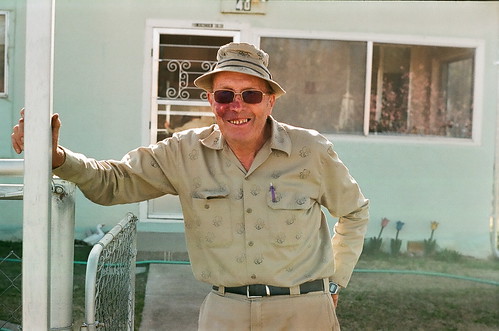
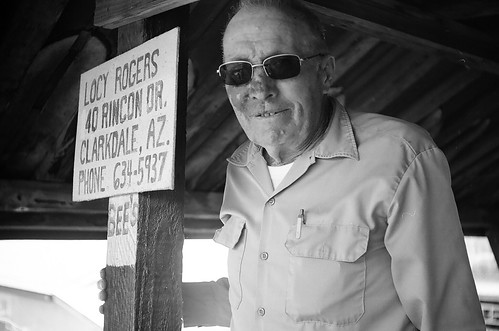
Locy Rogers just turned 80. He was born February 24th, 1929. This octogenarian has more energy and industriousness than many men half his age. A fixture in Clarkdale since 1960, Rogers is perhaps best known as “The Bee Man”. Everybody in the Verde Valley calls The Bee Man when they have a bee problem, such as a wayward hive in an inconvenient place. He will remove the bees and return them to his hives where he “works them” for honey, and will give them away or share them with other beekeepers.

“About three-fourths of ‘em, about half of ‘em, says ‘the police department, the fire department gave me your number,’” explains Rogers, with a twinkle in his eye as he starts to laugh and claps his hands together, “Oh-uh- I don’t want no trouble with the police!”

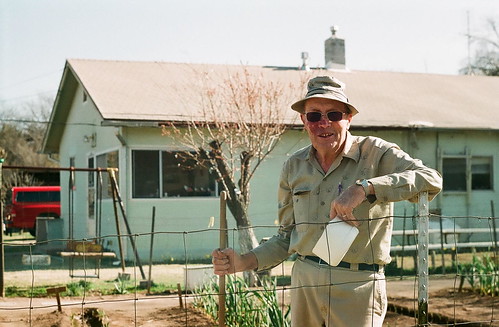
He lives in an 80 year-old house, on nearly an acre of ground near the Verde River in Lower Clarkdale, with a large irrigated plot for vegetables, abundant fruit trees, and a 30 year-old pecan tree that towers over the neighborhood. The pecan tree is a topic of jest for Rogers, who kids about it numerous time, how unusually large it is for its age, and how much the tree surgeons wanted to charge him to trim it back. He is full of quick smiles and sweeping gestures.


The Bee Man first started working with bees about 45 years ago, in an effort to help his son, “My oldest son had bad asthma, and they said honey would help. It helped some, pollen also, probably better than honey, but the pollen has to be from where you’re bothered. If your allergies are here, you need the pollen from here.”

Rogers was born and raised in Joseph City, AZ., along the old Route 66, between Winslow and Holbrook. At age 19 he left for Utah, working there a couple of years, prior to heading for Nevada where he worked in small independent mines. He soon moved to Mesa, Arizona, spending 4 years as a bus driver for the Gilbert School System. In June of 1959, Locy married his wife, Evelyn. By September of that same year the young couple had moved to the Verde Valley, for a job Rogers was offered here. They lived in Cottonwood for 6 months before finding a property in Clarkdale that appealed to them. In the late 1960s the Rogers moved to this current location, and together they raised 5 children, all of them attending local public schools. His children, and 11 grandchildren live in Arizona, California and Idaho. Quite a bountiful crop comes from this almost-acre. Locy Rogers proudly displays abundant family photos on the brightly-colored walls inside his house, telling me the names of all his children, and grandchildren. His wife passed on last year, at age 73.

He is very active in the LDS Church in Cottonwood. I am fascinated by the connection between his Mormon roots, and his rapport with the bees-- as bees and beehives are a traditional symbol of the cooperative and industrious nature of his religion. “Beehive is the Utah emblem,” he said, “but it can go on a lot of our stuff too”.

Since Rogers has lived in the Verde Valley for 50 years, I ask him what kind of changes he’s seen in our area. “Cottonwood was about that big when I moved here”, he says, gesturing, making a small circle with his hand, which he then expands, throwing his hands wide, “Pow! Clarkdale and everything else has grown, too.”
“What do you think about that Mountain Gate stuff up there?” I ask, referring to the ill-fated and over-ambitious subdivision in Upper Clarkdale. “Well it would be quite a lot bigger, if they hadn’t run out of money,” he laughs.


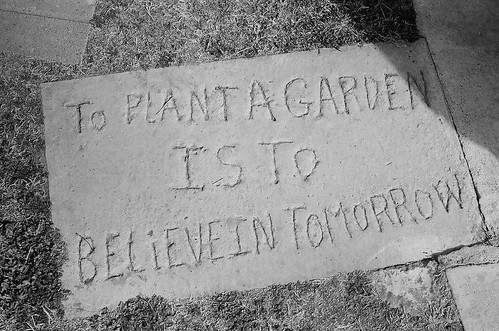
The Bee Man’s homestead is well kept, and tidy, yet not without its eccentricities. Folk art abounds-- quotes carved into concrete, a white plaster tiger in a cage, handmade stepping-stones, one for each grandchild, with their names made up of bits of tile and broken glass. Rogers has made much of this art, including a wooden sign above his front gate, welcoming visitors to “The Rogers’ Neighborhood”. His garden-themed work is featured in the yearly “Made in Clarkdale” art show each December. “You’re an artist, Locy,” I declare.
“I’m not a big expensive artist,” he responds, “Just a lil’ ol’ cheap one.”
I tell Rogers that I’ve admired his yard for years. I imagine it would be a fun place for a kid to grow up (since it always makes me wish I was a kid who lived there, running around that garden and playing on that vintage, sun-baked swing set, like some crazy 1930s dream). He continues to show me around the yard, “I had a little frame up there, I had 6 hives set on it for a number of years. And then I done this ‘n’ that and gradually got rid of the bees, and just catch ‘em and get ‘em going and then give ‘em or sell ‘em to somebody. That’s what I’ll do the rest of my life, is catch ‘em and get ‘em going. If you’re interested, and have a place to have ‘em, well, I’ll work out with you so you can go ahead and work with them.”


Beekeeping is not a hobby for the average homeowner--it’s not like maintaining dogs, or goats, or chickens. You can’t just buy a bag of bee food--they need to find their own food. You must just live in a good spot with close proximity to blooms. Arizona summers are sometimes a bit too dry for the bees to produce enough honey to survive the winter. According to Rogers, “They need seventy-five to one hundred pounds of honey in the fall, when it freezes, to survive the winter.” Bees do not go dormant or hibernate during the cold seasons, though they do move more slowly, and cluster up in a “basketball shape” for warmth. “When they run out of food they’re done, “explains Rogers, “Your pantry gets empty, you couldn’t go to the store, and your neighbors wouldn’t loan you a few bites of food—you’re gonna get hungry.”

I ask Rogers his thoughts on the current concerns about bees dying off-- the epidemic, virus or whatever it is that is killing them. “Well, I’m not sure just what it is, whether they know yet or not.
But, they talk like, summer before last, that the bees a lot of ‘em left and never come back. Why, I don’t know. Every so often, so many years, a cycle like this happens, so many years later the same thing happens again, and the same number of years again it happens. It’s a kind of sequence, why or what I don’t know. I had an article or two that talked about sixty to ninety percent of bees are leaving but not coming back.”
“What do you find here in the Verde Valley—do you notice that there is a drop off in bee population?” I ask.
“Not that bad, but because most of the times I’ve been catching bees –water meter boxes, hanging on the trees, hanging on the corner of something, under houses, and I catch them and bring them to the hives and get them going.”

Rogers says that if bees were to disappear completely, we’d be in big trouble. What would pollinate all of our fruits and vegetables? Then, further along the chain, with no crops, what would livestock eat? It would have a far-reaching and drastic impact. “If the bees are going down, and go out, ‘n’ we lose ‘em all… we got food to last us 4 years and then we’re out of food!”
“What do you think will happen, Locy?” I ask.
“I think they’ll come back in another few years”, he responds, “They’re blaming cell phones, global warming, and I think pesticides, is what I’ve heard. They’re blaming about three things, which one, or whether all three of them. Pesticides, people, you spray your yards, the pest control guy comes around your house, and different things and that’s the point for getting rid of some. And global warming, I can’t quite myself know why it would discourage them, or make it bad. But then your cell phones, as I understand it, if I’m not mistaken, the frequency, whether that is too much interfering with their system of life, I don’t know.”

Rogers predicts honey will become a commodity if the bee population continues to dwindle. “About 25 years ago I was selling honey for $8.00 a gallon. The last year or two years I’ve been selling it for $10.00 a quart.” Most of honey is made during the summer months. “If you have a rainy wet winter, and a big hive of bees, you need to be extracting honey every week to ten days, from the same hive. When they’re strong and really bringing in,” he says.

He currently has a small collection of active hives near a dry arroyo that runs alongside his property. When asked about Africanized bees, Rogers says that though he’s had some hives “go aggressive”, “killer bees” are generally much over-hyped by the media, “Most people are scared to death of bees. And then the news media the last three, few years have been every time you find a report on a bunch of bees, are ‘KILLER BEES!’ You’re not really maybe not scared of ‘em, but you don’t wanna’ be around ‘em much. And they start to talk about ‘killer bee’ or ‘Africanized bees’ and that makes you that much worse. I talked to a bee friend a couple of years ago, about them, and he said, ‘Locy, there’s no use of fighting the news media. They’re big, powerful, lotta’ money, they can do whatever they want.’ And I thought, eh, that’s about right.”

If you are unable to find someone to remove a crowd of bees from your property, Rogers recommends a novel, and non-toxic method: soapy water. “You get a bucket of water and dump it over your head,
and you’re almost completely wet, then you get them [the bees] clear wet and in 3 to 5 minutes, they’re all done. I’ve told people for the last 3 to 4 years, probably like you get a soft plastic bag over your head, and a rubber band around your neck, how long you gonna last? Okay, to me the soap would be sealing their breathing system, like the plastic bag would us, and when you run out of air, you’re gone. You don’t have to put this here poisonous spray, and stuff like exterminators do on’ em. But, a few of em that get aggressive. Anyways, in these water boxes I can’t get all of ‘em out of it into my box to bring home to put in hives to work ‘em. I just have to get soapy water and spray ‘em and close the lid and go home. I can’t save em all, but I saved most of em.”


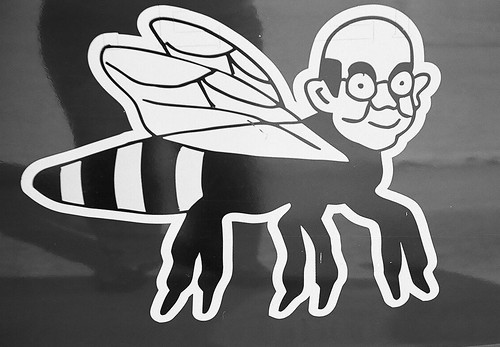
The Bee Man drives a red truck, with an amusing and memorable logo designed by local sign-painter John Alvey—it’s a bee with a man’s head. When on a call to remove a hive, Rogers uses a veil to cover his head, but otherwise works with bare hands. I ask him if he gets stung ever. “Sometimes quite a few and other times not at all.”
Rogers shows me how he collects the bees with his bare hands, with gentle and slow movements. It’s not unlike how people might respond to your movements-- a gentle nudge is acceptable, whereas a harsh shove might be taken as a sign of aggression.
“You be gentle to me, I’ll be gentle to you, and we’ll get along,” he explains.


Locy Rogers is preparing his garden for springtime, sowing seeds and tending to the soil. He has onions and garlic already growing, with plans to sow squash, corn, and his famous 4 O’Clocks that will line the fence. He grows a hybrid version with multi-colored flowers. He estimates he’s shared thousands of his special 4 O’Clock seeds with folks over the years, “You’ve heard of Johnny Appleseed? Well, I’m like Locy 4 O’Clock-seeds!” Rogers is a real gem of a person -- cheery, straightforward, generous and full of life-- a genuine local character. Though his bee rescue dance-card is full most of the year, he asked me to publish his phone number for folks who need his assistance.
His card reads “Bee Happy!”
Thanks Locy!
To contact Locy, please call (928) 634-5937.


Ellen Jo Roberts is not allergic to or afraid of bees, though she is not too fond of wasps, hornets, or those damn “no-see-ums”. She lives in a historic brick bungalow in Clarkdale, with Bike Daddy Chad, several killer dogs and one noisy big-mouth cat. You can read all about it at Ellenjo.com

Monday, February 22, 2010

Real Mexican


Real Mexican
The Noise
The Outs-March 2010
Ellen Jo Roberts


In my next life I want to come back as a Mariachi. They have such zest and good cheer, wear such dashing outfits, and get paid big bucks to whistle like jilguerillo birds.

Hello from Mexico where I have collected a slight sunburn, a small bag of sea shells, some tequila souvenirs for pals, and many photographs. The locals are all congenial, and they all tell me I speak with a Norteňo accent.”

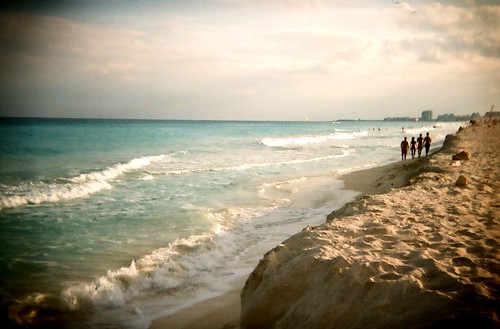
Recently, I went to Cancun for a friend’s wedding. Cancun was an invention of the Mexican government in the 1960s, developed as a tourism location. Along the Caribbean Sea in the Yucatan, it’s a Mexico unfamiliar, much different than our desert Mexico out west. Where our neighbor, Sonora, is dry, mountainous, dusty, full of cactus, and American retiree RVs, the Yucatan peninsula is green, tropical, flat, low elevation lush, and full of hard-bodied international 20-somethings, dancing ‘til dawn.


I’ve been to Mexico about 9 or 10 times now. A passport did not used to be required to drive across the border, but as of June 2009, tightening travel restrictions demand it. Arizonans frequently head to Mexico for lower priced prescriptions and dental work. We go there for amusement and adventures.


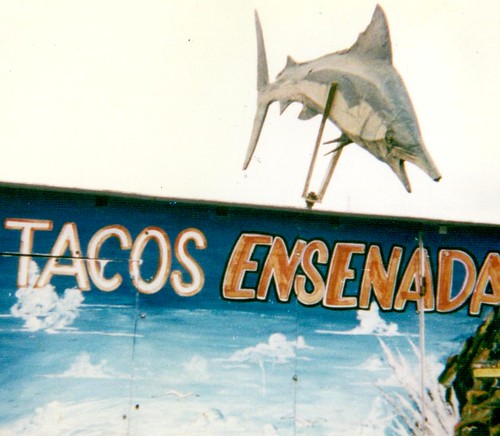
The first time we went to Mexico was a trip down the Baja California peninsula, to Ensenada, in 1997. We were alarmed at the confusing lack of street signs, and the abundance of litter. Thieves stole a bag of rubber rafts and a bike pump from our Toyota. We ate fish tacos at a street corner stand for every meal, drank cheap Kahlua and slept in our truck on the beach every night.
The Pacific was big, grey and cold. After dark, glowing green phosphorescent algae illuminated each crashing wave, like a most magical fireworks show.


Not long after the foray into Baja, we discovered a closer coastal town, Puerto Peñasco, Sonora. Also known as “Rocky Point”, it’s a Spring Break mecca to thousands of Arizona college students, being a mere 3 hour drive from metro Phoenix (even faster if you’re a lead foot). There’s an incredible tidal fluctuation where the Sea of Cortez meets Puerto Peñasco— revealing anywhere from 30 to 300 feet of shoreline, and amazing tidal pools brimming with wee creatures.
We spent many years escaping to those beaches, staying in cheap motels where you couldn’t flush the toilet paper, riding bikes to the beaches, kayaking, snorkeling, collecting shells, chatting with friendly locals and shrimp fishermen.


Puerto Peñasco is home to “C.E.D.O”., a renowned center of study for aquatic mammals of the Sea of Cortez, especially a rare and endangered cetacean, a type of short nosed porpoise known as the Vaquita, native only to these waters. Over the years, Puerto Peñasco has both prospered and suffered from its proximity to the U.S. The formerly small fishing community is now overrun by luxury high-rise time shares, and desert golf resorts. Technically, foreigners are not allowed to own property in Mexico, especially not near the coast. However, an elaborate round-about way via second parties and bank trusts does allow it, unfortunately making Mexico more American by the minute.
One must get further and further away from the border to find the real Mexico.


Our Baja Bug once ran out of gas outside of Sonoita. We had to push the car along the highway, singing to the Kinks on the tape deck until some Phoenix dude in a toy hauler stopped, and sold us a couple of gallons to get us into town.


Another time on the same road while returning from a Sonoran adventure with amigos, about 40 kilometers shy of the Arizona border, all of the truck’s dash warning lights lit up like Christmas. Much shouting, and distressed profanities as we pulled over to the roadside. It was July and a relentless 111 degrees. Luckily for us, we were near a small ranch house, the only structure for many miles. The woman who answered the door was named Socorro. My friend Hilda and I chatted with her, while Chad and Lucio attempted to remedy the Toyota’s problems. Seems the air-conditioning belt had sprung loose and hopped right into the engine’s fan belt. Everything was wedged tight. The situation seemed dire. Our lack of proper tools was foolish. At one point Lucio was wielding a giant rock, poised over the hot engine like a deranged caveman. Socorro asked us what we needed. We explained that if only we had a new fan belt we could just cut all that tangled mess out and replace the one belt most vital. She led us to her backyard, where a mesquite tree was covered with an assortment of fan belts in every size, dangling like delicious fruit in front of my teary eyes. We gave her $20 American dollars and a giant head-sized mango from our cooler, and soon we were back on the road home. Perhaps it’s only fitting that “Socorro” translates literally as “help” or “assistance.”

We snapped a photo of Socorro. Americans are always very smiley in photos, but as customary with “Real Mexicans”, Socorro did not smile. Instead she remained stoic, same as two of her young grandchildren standing with her, all three looking so serious.


I got schooled on “Real Mexicans” during the many years of my Arizona life spent working at hotels and resorts, with Mexican immigrants, both legal and not quite so legal. Some days I barely spoke English at all, and I loved it. I even started to think in Spanish. It is a time fondly remembered and I am forever grateful for all I learned. The Mexicans were surprised I could handle it, working so hard, side by side with them, but I changed their perceptions of Americans, just as they enlightened me to their Mexican ways. First off, they all thought I was typically “American” for wanting 2 days off a week. Most of them worked at least 2 or 3 jobs, and thought Americans were lazy.

“I am like an American today,” my friend Hilda joked with me, “Staying at home, under the covers, watching TV!” Hilda, a Jalisco native, has always encouraged me, telling me if she could be a success in a foreign country I had no proper excuse not to succeed in my own native land. Mexicans like to work hard. They don’t want to discuss it; they just want to do it. Americans are too enamored with lengthy meetings, chatter, and creating too many pieces of paperwork.


Mexicans like to give funny and insulting nicknames to each other. The little skinny-legged guy was Apėnas salir de un huevo, or “just hatched from an egg”. The drunk was Gusano Muerto, the dead worm in the bottom of the mescal bottle. The lady with the goofy walk and the big nose was La Guacamaya, some type of equally silly-looking bird. The really old guy was Listo Para Morir (Ready to Die). The woman with the large butt was known as simply as “Big in the Back”. “Mexican men like the ‘big in the back’ ladies,” they explained.

I had myriad nicknames, all alluding to my gigantic stature, including Macedona (which I think translates to “mastodon”), and Grandota. “Mėndiga” was another one, meaning too sneaky or clever for my own good. I learned that they only gave nicknames to people they liked.
It was an honor. If they didn’t like you, they didn’t even bother.

As serious as a Real Mexican could be in a photo, it was completely the opposite in life: joking, goofing, jovial all the time. It always confounds me that the Arizona government considers Mexican immigrants equivalent to terrorists. There has got to be a better way to handle the situation along our borders.


On my most recent trip to Mexico, I was traveling alone, moving from airport to airport, shuffling along in lines with strangers. By the end of my trip, my thoughts became clear and concise in the way they only can while traveling alone. Thinking more than speaking. Looking out on the world from 30,000 feet up. Observations become crystalline. Mexico, an amazingly varied landscape full of wonderfully warm people, incredible art, music, history, is often thought of as being corrupt, dangerous, violent, impoverished. Sure, it is all of these things, but there’s so much more to the story. Our lives here, al otro lado (on the other side of the border), are equally complex. In fact, compared to the way things are going in the U.S., Mexico doesn’t actually seem quite so mismanaged anymore. Maybe I’ll move there.
In my next life, as a Mariachi.


Ellen Jo Roberts was born in Illinois (1972). She lives in a historic Clarkdale Arizona house (1914) and drives a yellow car built in Germany (1973). She is married to Bike Daddy Chad (Illinois 1972). They share their home with assorted pets born in the 21st century. Read all about it at ellenjo.com

Tuesday, January 26, 2010

Attack of the 39 Foot Woman!


Attack of the 39 Foot Woman!
The Outs- February 2010
Ellen Jo Roberts


Cue scene…and ACTION! A giant woman invades the Verde Valley! Larger than life, a vision in white! The townspeople revolt violently! Chaos! Confusion!…and Cults? How will this story end? Stay tuned!


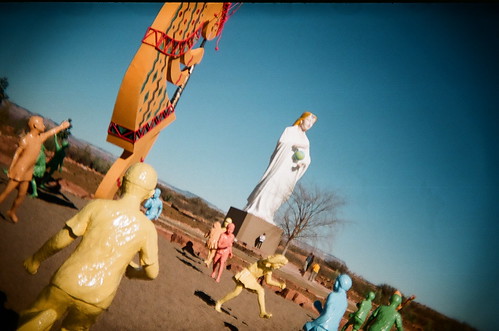
The Mago towers at the edge of Cottonwood, along Bill Gray Road, 39 feet tall, and standing on a 9 ½ foot base. Part of the Sedona Tao Center’s Mago “Earth Park”, she represents a vision of “earth mother”, gingerly holding a floating globe within her colossal hands. Like many atomic giants that terrorize the tiny townsfolk, Mago’s origins are in Asia. “Soul of the Earth” is the Korean mythology of Mago. Her outsized presence has stirred the Verde Valley into an equally jumbo-sized lather. For months, hundreds of letters to the editor rant and rave against her appearance: some protests reasonable, others prejudiced and hateful.
Reasonable complaints argue that this statue simply violates the building code, design regulations, and height ordinance. While others quote the Bible and argue against the basic tenants of the Constitution. Still others say it blocks the view and could potentially cause visual impairment to the vehicular public due to its dominance along State Highway 89A. Perhaps the biggest problem many Verde Valley residents struggle with in this tale is the center’s connection to controversial Dahn Yoga, its cult-like leader, Ilchi Lee, and his organization’s questionable business practices.


By the time you read this article, the giant Mago may be gone.
Sorry if you missed her. At press time, the park’s lawyer, Flagstaff land use attorney, Willam P. Ring, P.C., had offered a compromise to Cottonwood’s Planning and Zoning Commission offering to remove the 39 foot statue in exchange for a smaller 9 foot version.

“We understood, from the criteria, that monuments of spiritual quality were not subject the height ordinance”, Mr. Ring explained, at the public meeting January 25th, citing various Cottonwood building codes, “We are willing to admit this evening that was OUR misunderstanding. We are willing to retire that statue and replace it with a smaller Mago statue”.


I am a huge fan of roadside kitsch. We travel far and wide to catch sight of highway mascots, folk art, and assorted monuments to bad taste. There is something just so full of silliness, so full of joie de vivre, it makes me just plain happy to be alive on planet earth. When somebody believes in something so strongly and feels so compelled to create something so crazy, it renews my faith in the human spirit. The Mago and the other various religious figures depicted at the Sedona Mago Center’s Earth Park definitely qualify as Kitschville to the max. I half expected Mother Mago would be holding a giant donut, or a muffler, like her fiberglass kin folk across the USA. So, yeah, I gotta admit, I went there, and I kinda loved it. It was so totally over the top that it knocked my socks off.
The Mago is gigantic and glossy. She can be seen from as far away as Jerome, and far out along Highway 260. She is a pale-faced blonde, in a bright white robe. Locals squawk at her blonde “Barbie Doll” looks. It doesn’t meet our traditional notion of an “earth mother”, which is generally more in earth tones-- like the native and natural tribes that make up the majority of the globe. Against the Arizona blue sky, with Sedona’s red rocks in the distance behind her, she is a striking scene. Looking up at the 39 foot tall Mago I imagine this must be how I look to my pet Chihuahua, Floyd.


“The flowing robes, the grace. Striking.”
Carl Spackler, “Caddyshack” c. 1980

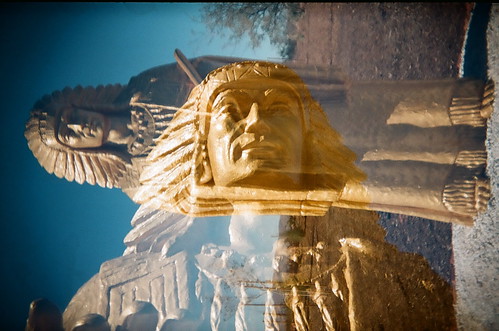
It would only be a matter of time before cartoonist Bill Griffiths (a well-known fan of gigantic roadside weirdness) would arrive in Cottonwood, Arizona to draw a “Zippy the Pinhead” comic featuring the Mago. The park, neatly landscaped with shrubs, trees, and stone pathways, is also home of many other not-quite-as-colossal figures, referred to by the city of Cottonwood as “ornaments’. There is a 15 foot tall Kokopelli statue, surrounded by lil’ multicolored children in action, running, kicking jumping in every direction. Naturally, the native North American legend of Kokopelli is one of fertility—the stranger that comes to town with his big “flute” leaving a throng of pregnant women in his wake. That’s where all these childrens came from! Basically, Kokopelli was just a gigolo! Why are we not protesting him? A small side courtyard features 10 foot tall golden figures of “Enlightened Ones” depicting Jesus Christ, Buddha...maybe Zeus, Confucious, and some Native American figure in full Plains feathered regalia.


While I was at the park avidly snapping photos, a pleasant man cheerfully introduced himself as “Alex, the owner”. We chatted a bit. He explained that the center, their own private property, was something they wanted to open up for everyone to enjoy, for the public’s use. He then invited me to come into a small building for more information and some tea. I saw the pile of shoes outside the door, and lost my nerve. If there were strings attached to this park, I didn’t want to be tangled up in them.


The Earth Park, consisting of 6 acres of land at Bill Gray Road and Highway 89A, was originally issued a permit in 2006 simply as a welcome center, parking lot, and shuttle staging area, to bring visitors from Highway 89A back out to the organization's retreat center many miles along the unpaved and wild Bill Gray Road. The Tao Center of Sedona opened its Mago Retreat in a remote area of the Coconino National Forest between Sedona and Cottonwood back in 1998. The retreat center is renowned for its “green” practices, using solar energy, grey water, and installing thousands of native trees and plants. They have an organic garden, fertilized by compost from their dining hall and manure from their horse stables.

In the past 3 years additional interim permits were approved allowing for such things as small events at the Earth Park, things like farmers markets, weddings, and parties. Landscaping was improved, and small gazebos were constructed. A conditional use permit legally allowed the Mago Center to erect the 50 foot Mago for their opening celebration, December 16th 2009. Once the permit expired, as it now has, the statue would have to be removed. These interim and conditional use permits assumed a final permanent design for the property would be presented within 3 years. It has not been. This makes the Cottonwood Planning and Zoning Commission testy. A stop order has been placed on various additional unapproved projects. .
The public hearing to review the statue’s conditional use permit needed to be postponed a month, when crowds too large to be seated arrived to protest. The meeting location was rescheduled for a much larger venue, Cottonwood’s Mingus Union High School auditorium.

“It’s incredible that you are the only planning and zoning commission in the U.S. to be gullible enough to allow this,” said feisty Cottonwood resident Judy Love, calling the Mago an ”incredibly ugly” statue, “That statue is a free advertising sign to get people into their compound, and relieve them of their money. It’s all about the money. It’s a business, not a faith based church, but it’s along the same lines as Jonestown, the Moonies, David Koresh, and the recent sweat lodge incident in Sedona. We should not allow this to happen in our community.”

“Why not give your neighbors a chance?” asks Dahn Yoga spokesman Joseph Alexander from Mesa AZ, “I have volunteered at the Mago Earth Park. It is designed to share with all people. This is not about religion, or one religion. It’s about recognizing each other as fellow citizens of the earth.”

Johhny LeDoux from Cottonwood declared himself as a member of the Nazarene Church, “To me this is an affront. This is an idol. This is a graven image.”

“I am opposed,” said Cottonwood businessman, Mark Avery, “I did not come here to talk about religious aspects. It should be known that the Tao Center is a for profit business.” Mr. Avery then sited the recent CNN report and investigation of Ilchi Lee. “If you put up a 4 foot statue it is not going to attract anybody. It’s not about religion. It’s about sign code. How can I attract people? It’s my business. I need to attract people. If you don’t enforce this, how can you control it when the hardware store wants to put up a 50 foot hammer?…It’s a business and it’s getting bigger by the minute.”

Ilchi Lee, a legalized American citizen born in South Korea in 1950, is a “brain philosopher”, and founder of a series of brain and body training programs, some criticized for their intensity and danger. Dahn Yoga includes traditional elements of yoga already familiar to us: stretching, meditation, circulation, and “chi” representing human energy flow. The Korean word “Dahn” translates as “primal, vital energy.” But, the program also allegedly features overexertion, sleep deprivation, dehydration, numbing repetition, and other tactics commonly used for breaking the spirit and controlling the mind. Various lawsuits were brought to court and dismissed throughout the ‘00s, including wrongful death, sexual assault, and unfair business practices. A current Arizona lawsuit, filed in May 2009, includes claims against Ilchi Lee from 26 former Dahn members and masters from throughout the United States, and Korea. All plaintiffs claim that after lengthy association with Dahn Yoga (sometimes years worth of various studies and programs, with aggressive encouragement to recruit new members and new money) they were finally “able the break the psychological manipulation and indoctrination sufficiently to leave Dahn.”

“The Dahn organization (“Dahn”), which is controlled by Defendant Ilchi Lee, operates under a complex web of corporate names, and is comprised of myriad for-profit and not-profit business entities and organizations, including but not limited to the Corporate Defendants, Dahn Yoga & Health Centers Inc., Tao Fellowship, BR Consulting, Inc., Mago Earth, Inc., Vortex, Inc., and CGI, Inc., all of which collectively operate and control more than 130 “Dahn Yoga” Centers in the United States, including 6 in Arizona, as well as more than 300 Dahn Yoga Centers in South Korea, 350 in Japan, and approximately 20 in Canada and the United Kingdom.”
-Case number 2:09-cv-01115-SRB in the United States District Court for the District of Arizona

The Sedona retreat hosts about 3000 guests each year, as the primary training facility for Dahn worldwide, and is noted many times throughout the current lawsuit. In the legal documents the essence of the organization comes across as a giant pyramid scheme, an aggressive business plan. Members are encouraged to attend more and more classes, and programs, sometimes going into great debt in order to do so. They’re encouraged to enlist new members into the fold, for more money. Dahn defendants deny all claims made in the lawsuit, referring to the plaintiffs as “disgruntled employees”.

“When Defendants deemed that they had been sufficiently indoctrinated, Plaintiffs were coercively induced to attend an extended Dahn Yoga training retreat in Sedona, Arizona, called ‘Master’s Training’. This retreat was designed by Defendants to further indoctrinate Plaintiffs into Dahn and reinforce a Dahn members 100% devotion to Dahn, and Defendant Ilchi Lee and his ‘Vision’”.
-Case number 2:09-cv-01115-SRB in the United States District Court for the District of Arizona

“When I look at Mago statue I see hope. Hope for unity. Hope for the future I had not seen before I began this practice,” said Johnell Moore a Dahn devotee from Mesa, Arizona. “The United States Constitution gives me the right to practice my spirituality in any way I like, as long as it doesn’t interfere with your rights.”


Danny DeBose, “an American Citizen and Veteran” of Cottonwood said, “One of the things I was fighting for was freedom of religion, for people to worship how they wish. That’s why we came here to this country. I’d like our constitution to be held up. I’m in favor of the Mago Park…Sometimes people don’t like what they see in art. But perhaps this is because they don’t like what they see in themselves.”

Many feel the Mago could become a major tourist draw benefiting the entire Verde Valley. The Mago Center is a for profit organization, with future plans for a motel, restaurant, gift shop and horse back riding at the site of their Earth Park. Hiding behind religion when it suits them, the Tao Center seems to want to play both sides of the coin depending on what side is more advantageous at the moment. In the end, it’s not about religion, business, good art or bad art. It’s about Cottonwood building codes, zoning, and design review. Rules, plain and simple.

5’9’’ Ellen Jo Roberts lives in a historic brick bungalow that meets all Clarkdale building codes.
She shares her home with 6’4’’ Bike daddy Chad, and several rambunctious pets that are all up to date on their vaccinations and fully licensed by local authorities.
Read all about it at ellenjo.com

Tuesday, January 19, 2010

Navigating the New Economy

Navigating the New Economy
The Outs - The Noise
January 2010
Ellen Jo Roberts


On “Black Friday,” the morning after Thanksgiving, we were nestled around a campfire, cuddling with coffee mugs to ward off the chill of the night before. We spent the holiday under the stars camped on a wild beautiful bluff overlooking the Verde River. Friends had organized an outdoor banquet, completely off the grid, but not lacking a thing. There were two turkeys, with all the traditional tubers and root side dishes, stuffing, numerous pies of assorted fruits and nuts, and a broad variety of beverages both hot and cold.
As we woke up to the day, all wild-haired and sleepy-eyed, somebody said,
“Isn’t it funny that at this very moment people are storming Super-Walmart, wrestling each other for the best deals on flat screen TVs?”
We all shook our heads, chuckling in disbelief.
The thought that people had camped out in the very same valley, the very same night, but in an asphalt parking lot waiting for “doorbuster deals,” could not have sounded more foreign to us.
Not just because we didn’t have the bucks to buy each other expensive electronics, and not just because the idea never even occurred to us — but also because frenzied spending seems a thing of the past — from a time when people spent money they didn’t have on things they didn’t need.

The current economy may be the new economy, the new normal — with the spendy memories of the not too distant past gone out like a tide that ain’t never coming back.
For us, our lives luckily have not changed too much — but, we’ve never lived large. Actually, that’s just a nice way of saying we were poor and broke before, and we’re poor and broke now. We here in Northern Arizona are well acquainted with “poverty with a view,” so for us it’s like the rest of the country is finally slowing down to our speed.
We may be on a low budget but this doesn’t mean our life isn’t rich. Our newest vehicle is 23 years old, and we don’t have any car payments. We bought a small house with a manageable mortgage. We shop local whenever possible. Many times we just go without. We seldom dine out, see movies at the show, or buy new clothing. Most everything we own is 2nd or 3rd hand. No cable TV, no satellite radio, no high-speed internet. For us, this way of life hasn’t changed much in 15 years.


This doesn’t mean we are without our extravagances.
I like a new pair of Fluevogs every few years, and ordering Fuji instant film for my old Polaroid cameras. Chad has expensive tastes in shampoo and hair wax. He indulges me the cost for art supplies, and processing 35mm film. We treat ourselves to new Levis every year, and splurge on a seasonal bottle of Bombay Sapphire gin. Perhaps our most ridiculous luxury is jetting our Chihuahua, Floyd, around with us on (rare) airplane trips.
Despite these lil’ splurges, we live cheap, filling our lives with experiences rather than expenses. We are very grateful to both still be employed, keenly aware of the many Americans who’ve spent the last few years scrambling for jobs after being downsized, out-sourced, or having their retirement savings swallowed by economic failure.


How has your life changed? In what ways have you changed your habits to navigate the new economy? How have our local communities been impacted, being heavily reliant on tourism? This is what I wanted to know. This is what I asked people. I talked to many artists and creative types who, by nature of their creativity, adapt to whatever is dished their way.
I have friends who’ve taken pay cuts, lost their jobs, and lost their homes.
But even in these tough clouds, silver linings are evident.


“People don’t think so materialistically. They think of other values in life, and live more simply,” said Verde Valley artist, Birgitta Lapides. “So, I think some good can come from it. People can realize the truly important things in life. It’s more who you are than what you have.”
Ms. Lapides shows her work in Jerome, a town that operates in its own economic micro-climate, a different planet than Every Day, USA, but still not completely immune to the ebb and tide of the outside world. Many artists who sell their work in the town have found the need to offer lower-priced series of works because the grand masterpieces are just not selling like they used to. Anne Bassett, renowned Jerome artist and longtime resident, has survived there for years, in times both lean and rich.
“I have aspired to ‘scrape by’ but not actually attained that status yet,” jokes Ms. Bassett. “I expect the US economy to get much worse as our war debt impacts are felt. Our nation's pitiful education system has lost us the edge on being global innovators in technology, and our foot-dragging on global warming has hampered our nation in green advancement, which I believe to be the only expanding financial venue around. My art income has stayed about the same for a couple decades, fluctuations not withstanding. Gold, art and real estate appreciate.”


Real estate, while generally agreed a good investment, has been troubled during recent years, with the realty boom busting big time. Denise Lerette is a realtor in the Verde Valley. She lives in a historic bungalow in Clarkdale, with her cat, Barrington, and dog, Jaeger.
“I'm not exaggerating when I tell you it has been tough,” says Ms. Lerrette, “When it hit our entire economy, it hurt in several different ways. First, of course, is the ol’ pocketbook. I learned how to live very frugally last year. I cannot stress how frugally I really mean! I had my gas turned off for 6 months. I became very adept at heating a tub, doing laundry, and other seemingly common tasks with a bare minimum of energy expended. I did not have cable or even turn on my TV. This I now like! I discovered the library and long walks with Jaeger. I latched on to a little device called a ‘Kill-A-Watt,’ thanks to a good friend in Flag, and got my APS bill down to $25 a month. It taught me a lot about conservation, tenacity, and kindness, above all.”
Ms. Lerrette sees a bright light at the end of the tunnel.
“The upside to all of this was really learning something about the varieties of human natures that do exist. Fortunately, I have not lost my faith in humanity and have seen that human kindness still outweighs its polar opposite. People working together is the only way we will truly survive and live well.”

Bethany Bezdek is a married mother of 3, living in Clarkdale.
The turbulent economy has made a profound impact on her family.
“We gave up our house because of the economy. Big change,” said Ms. Bezdek.
“I used to go to the health food store once a week. Now I go maybe once a month and buy 4 or 5 items. Our grocery bill for the five of us is always more than I think it should be, even with these changes. I grew up on government cheese and powdered milk, so I am not complaining. I still feel very fortunate to have food and to be able to buy it on my own.”
The Bezdeks no longer purchase books or magazines, and have very few meals out. And rather than going to the movies, the family enjoys free entertainment like libraries, parks and hiking. Their life remains joyful, despite the wild financial ride. “Truthfully, it feels fine,” says Ms. Bezdek, “Although I do miss just going out for Chinese on a whim. As cliché as it sounds, I have really appreciated the importance of our family and how lucky we are to love each other and enjoy each other’s company.”

Many people have changed their lives in big ways, and many make changes in small ways that add up big: killing watts and their televisions, cutting cable and internet, brown-bagging their lunches, quitting cigarettes, planning smaller vacations or “staycations.” Many donate more to charity than ever before.


“We really don't realize how spoiled we are until everything has been taken away. Like a kid getting grounded and having their phone, computer and TV taken away,” said Stacey Champion, of Phoenix.
Ms. Champion is the owner of Champion Indoors, an environmental consulting firm. A single mom raising two young children, she takes coupons seriously, and has downsized the “fluff,” like everyone’s nemesis, “Target ‘impulse’ buying.”
Says Ms. Champion, “I feel very fortunate that I grew up Midwestern and blue-collar, because when everything was really good and the money was flying in, I didn't go out and buy a new car, new house, etc. My debt load probably isn't as bad as many other people's because of this. I also take my kids to do as much volunteering and charity work as possible now, so that they can see, first-hand, that even though we aren't able to necessarily ‘do’ or buy all of the things we used to, there is still an awful lot to be thankful for — like a roof over our heads and food on the table. Small but important stuff.”
Ms. Champion, an idealist, believes good times will return, and we will get through this challenging time, “being more grateful and humble in the long run.”

Kenny Mattheis is a jack-of-all-trades, a bit of a genius, and a self-proclaimed “hobo,” who lives in a tiny but chic house in Humboldt, outside of Prescott.
“The biggest change I've had to make in my life due to cutbacks, is the amount of income I can donate to things I believe in. I'm used to giving 60 to 70% of my income to causes I feel will affect my life directly. I'm still able to give the same percentages, but 60% is a lot less these days than it's been in the past.”
Mr. Mattheis is a big fan of a website called Instructables.com, which offers instructions and ideas for fashioning useful second lives out of assorted objects, and things people discard. “Turning some things I don't use any more into useful things I can use, or other people say that they would like, or need. I've even been able to make a little money on the side helping people with projects or making stuff that they would like to have.”

Another issue aggravated by the financial downturn is health care: the millions of citizens who don’t have it, and are farther away from it than ever. “I find myself donating more and more art for raffles or auctions to assist those without medical insurance cover their costs,” says Clarkdale artist Judy Jaaskelainen, “These are people who we might refer to as the ‘working poor.’ They are not 'poor enough' to qualify for AHCCCS or other government assistance, but they do not have the means to cover the cost of medical care.”
Ms. Jaaskelainen is currently involved in selling raffle tickets to raise money for local artist, Mary [Druen] McKeown, who needs two new hip joints. Artists, jewelry makers, and businesses have donated a great list of items. “There will be other fund-raisers on Mary's behalf in the New Year,” says Ms. Jaaskelainen, “Mary is only one of the hundreds, maybe thousands, of ‘working poor’ in and around the Verde Valley. Artists, craftsmen, and musicians seem most at risk.”

In interviewing people, I discovered restaurant meals are the expense most commonly being trimmed from budgets in this new economy.
Jet Tennant, owner of Jerome’s Mile High Grill, runs the restaurant lean, confronting the downslide head on, basing their plan of action on past seasonal successes. “We also keep a strong bare bones crew who are willing to work harder when it is busy, instead of over-staffing. We put off improvements for a year to see how we would be affected. Living in a tourist town offers us a influx of people that other places don't have,” said Ms. Tennant, “I feel like we are riding a wave. It feels a bit wild, but not out of control. Just a ride, which is why I got into the restaurant business and being self-employed in the first place.”


Sedona is one of Arizona’s top tourist destinations, and feeds dollars to all of the outlying communities. Nena Barlow operates Barlow’s Jeep Rentals in Sedona.
“We were lucky to not drop very much early in the ‘recession.’ We have worked a lot harder to make the same money,” explains Ms. Barlow. “We became more aggressive with specials, reviewed and increased our marketing efforts, and set very tight budgets to keep costs in hand.
“What I observed was that the higher-priced goods and services have been the hardest hit. If you have some product that is on the lower-end of the price spectrum for which your customers are shopping, they will still buy. Everyone is looking for a bargain, and no one is too proud to ask for specials or discounts these days. We aren't looking at this as ‘how do we survive?’ but rather ‘how do we run this leaner and meaner from now on?’ Sort of like adopting a new diet — it's not some fad, it's a necessary adjustment we need to make to stay healthy from now on.”

Bradley Blalock is a gifted singer, musician, and a licensed massage therapist, working at the ASIS Clarkdale campus. The current economy has stimulated his creativity. He spends more time practicing music and creating music at home instead of watching TV or surfing the internet. Mr. Blaylock surrounds himself with positive people, “Staying creative and positive, as best I can to live nobly through this, without self-destructively escaping into negative behaviors, one day at a time.”

Our pal Natasha Shealy, a perennial Noise favorite, offers her tips for conserving money. Ms. Shealy lives in smalltown North Carolina, a rural hardscrabble microclimate not dissimilar to our own. She is surrounded by creative people, artists, writers and musicians.
“I cut expenses, and build skills wherever possible. Perhaps a Protestant hangover, I thrill in cutting my own wood for fuel, growing our own food, and brewing homemade beer and wine. I have harvested fowl, but have yet to hunt deer. I leave that to the mountain man … I am recording my ideas for a book to share with others.”
Ms. Shealy has always been inspired by the 1970s series of Foxfire books, with mountain folk telling tales of making soap, building cabins, pickin’ tunes, and slaughtering swine. Something tells me she’d be living this lifestyle and writing about it even if she were a millionaire.


A Jeroman who wishes to remain anonymous shared her secret of success with us: “Once a week I take an hour to tour the great fortune that can be found in the charity and thrift stores of the valley. Had I known what a fun sport this was, I would have started it years ago. When I think of all the countries and cities I have traveled to and yet missed out on the random filtering of items considered surplus! The trickle-down effect of ‘one mans trash is another’s treasure.’ The sport and randomness of finds is a daily renewal on the thrift front. It’s the closest thing to gambling I have ever done ... Some days I want to run out of the store and toss my fist into the air with triumph, and do the Rumpelstiltskin jig of joy.”
I’ve long been an avid fan of thrift shops, dating way back to the year 1985, when a hip older cousin took me to scout out my neighborhood secondhand store in search of a trench coat for his New Wave ensemble. Thrift shops are chock full of housewares, artwork, office supplies, movies, books, clothing, tools, and vintage appliances manufactured better than anything made today and sold at prices well below their value.
We reevaluate the notion of “stuff.” We reexamine the products we use.

The new economy has affected us in interesting and different ways. Some of us not at all, and some for the worse. Some have actually benefited from it, due to special skills, and situations. Many of us live how our grandparents did in the Great Depression, stitching socks, surviving on soup, and growing our own food. Young people just entering the job market have no great expectations for the fantastic career, knowing their fine education now offers no guarantees. Older folks who’ve worked hard their whole lives, planning ahead like the ants for winter, now find themselves in a pickle like the goofy grasshopper, at no fault of their own. Everything’s been erased, re-written, wiped out, like a brand new ball game.
In the end, might we be better for it?
When the true value of the important things shines brighter than bling ever did?
I think you know the answer.


Ellen Jo Roberts is low on budget but high on life. She lives in a historic bungalow in Clarkdale, Arizona with “Bike Daddy” Chad, “Cool Cat” Clyde, “Five Pounds of Fury” Floyd, Ivan a.k.a. “Goofy McSuper-Spaz” and several ancient automobiles.
Read all about it at ellenjo.com